Cthulhu
- Category
- Cosmic Entity (Lovecraft Mythos)
- Origin
- H.P. Lovecraft's fiction, primarily 'The Call of Cthulhu' (written 1926, published 1928); later the Cthulhu Mythos of August Derleth and others, and modern occultism
History & Lore
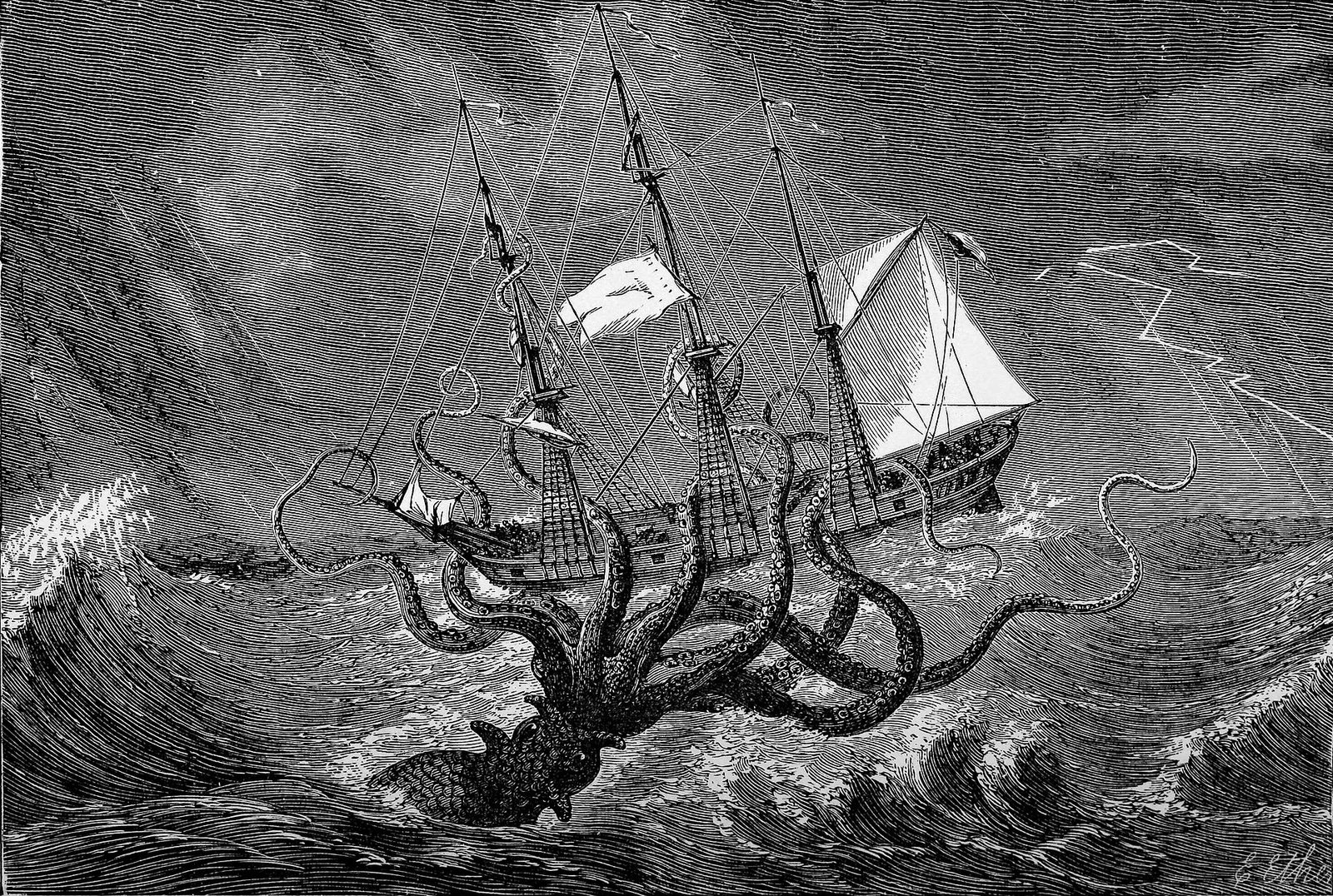
Cthulhu is a vast, winged, octopus-headed being invented by the American writer H.P. Lovecraft, who described it lying dead but dreaming in the sunken city of R'lyeh beneath the South Pacific until the stars are right again. Introduced in the story 'The Call of Cthulhu' (1928), it was meant as the face of an indifferent cosmos rather than a god to be worshipped, yet it has outgrown its fiction: as the centre of the so-called Cthulhu Mythos, as a working figure in parts of modern occultism and chaos magic, and as one of the most recognisable icons of popular culture.
Cthulhu is the only figure in this archive whose author is known by name, whose birth can be dated almost to the month, and whose creator insisted, repeatedly and in writing, that it did not exist. It was invented in the summer of 1926 by a reclusive writer in Providence, Rhode Island, for a story that the leading magazine of its kind at first turned down. A century later it is a household word, a museum of merchandise, a recurring presence in film, music and games, a symbol in philosophical arguments about the cosmos, and, for a minority of practitioners, a working magical current. Few modern inventions have travelled so far from their page, and few show so clearly how a myth can be made on purpose and then escape its maker.
The Author and the Story
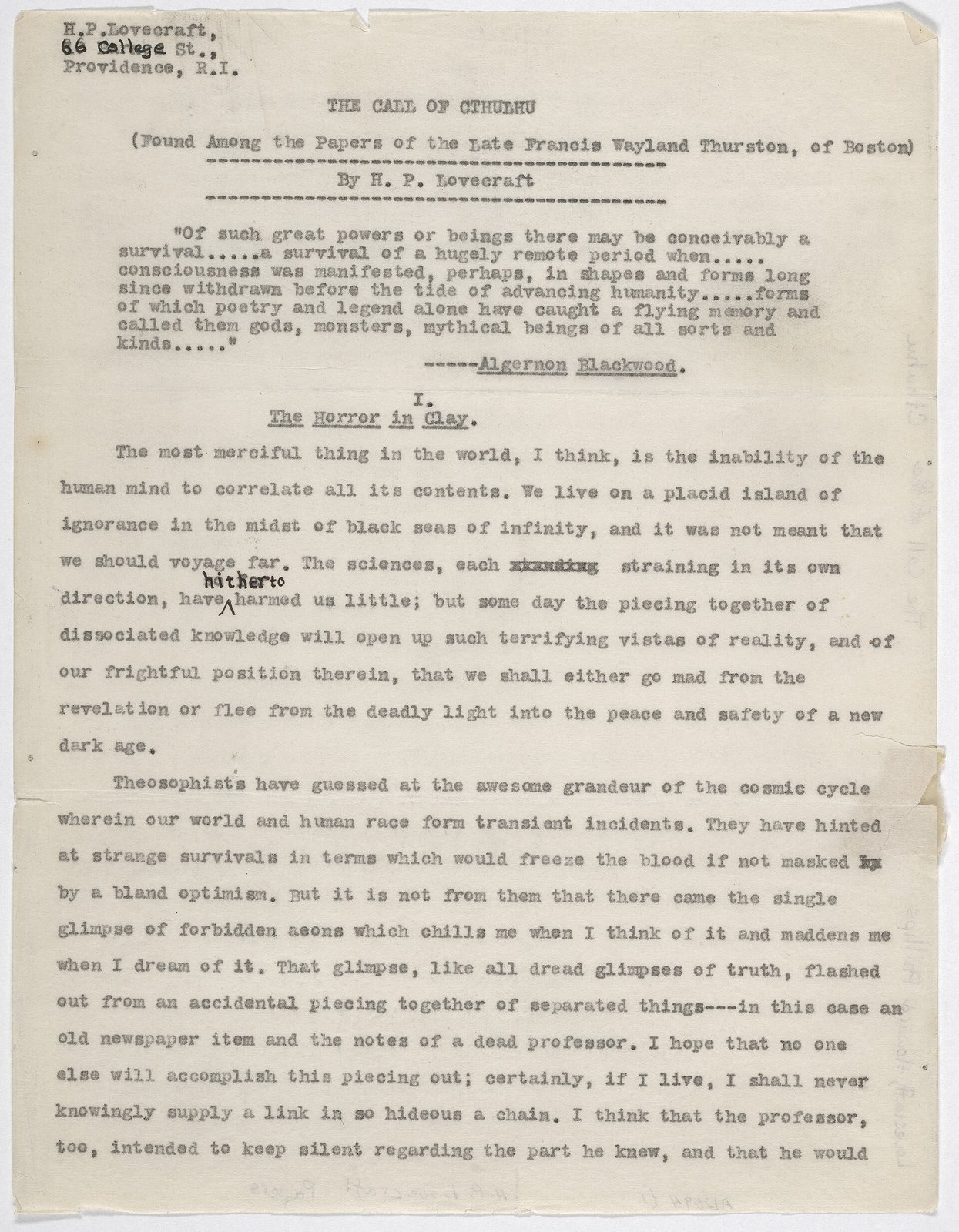
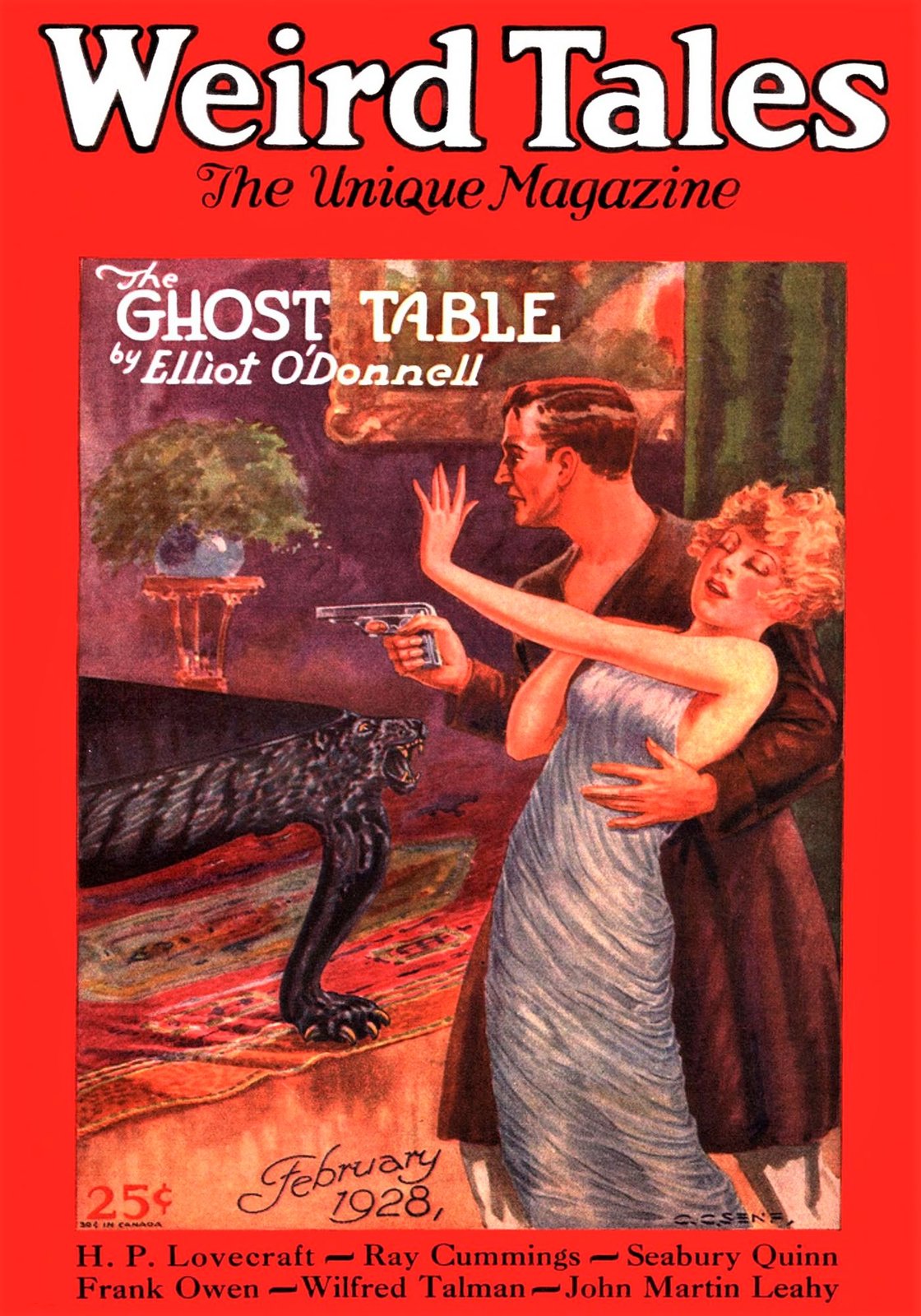
Howard Phillips Lovecraft (1890–1937) spent almost his whole life in Providence, wrote mostly for pulp magazines such as Weird Tales, and earned little from it. He was a convinced atheist and materialist, widely read in astronomy and science, who developed what he called cosmicism: the conviction that humanity is an insignificant accident in a universe that neither notices nor cares about it. The Call of Cthulhu, written in 1926 and published in Weird Tales in February 1928, was his most complete statement of that idea in fiction. It opens with one of the most quoted sentences in the history of horror: that the most merciful thing in the world is the inability of the human mind to correlate all its contents. Lovecraft had already sketched the idea of a monstrous submerged presence in Dagon (written 1917), but The Call of Cthulhu gave it a name, a city and a cult.
The Call of Cthulhu
The story is told through the papers of a dead professor, assembled by his great-nephew Francis Wayland Thurston, and it advances in three parts. In The Horror in Clay a young sculptor brings the professor a bas-relief he has made in a feverish dream in the spring of 1925: a creature at once octopus, dragon and human caricature, before a background of cyclopean architecture. In The Tale of Inspector Legrasse a New Orleans police officer describes a raid in 1907 on a cult in the Louisiana swamps, which chants a phrase in an inhuman language — Ph'nglui mglw'nafh Cthulhu R'lyeh wgah'nagl fhtagn, translated in the story as in his house at R'lyeh dead Cthulhu waits dreaming — and an aged cultist explains that the Great Old Ones came from the stars and will return when the stars are right. In The Madness from the Sea a Norwegian sailor's journal records how, in March 1925, his crew landed on a city risen from the sea at 47°9′ south, 126°43′ west, opened a vast door and released the thing within; he escaped by ramming it with his ship, and it re-formed behind him as the city sank again. Every account in the story is second-hand, every witness dies or goes mad, and the narrator ends by fearing for his own life — a structure built to make the impossible feel documented.
The Name and the Form
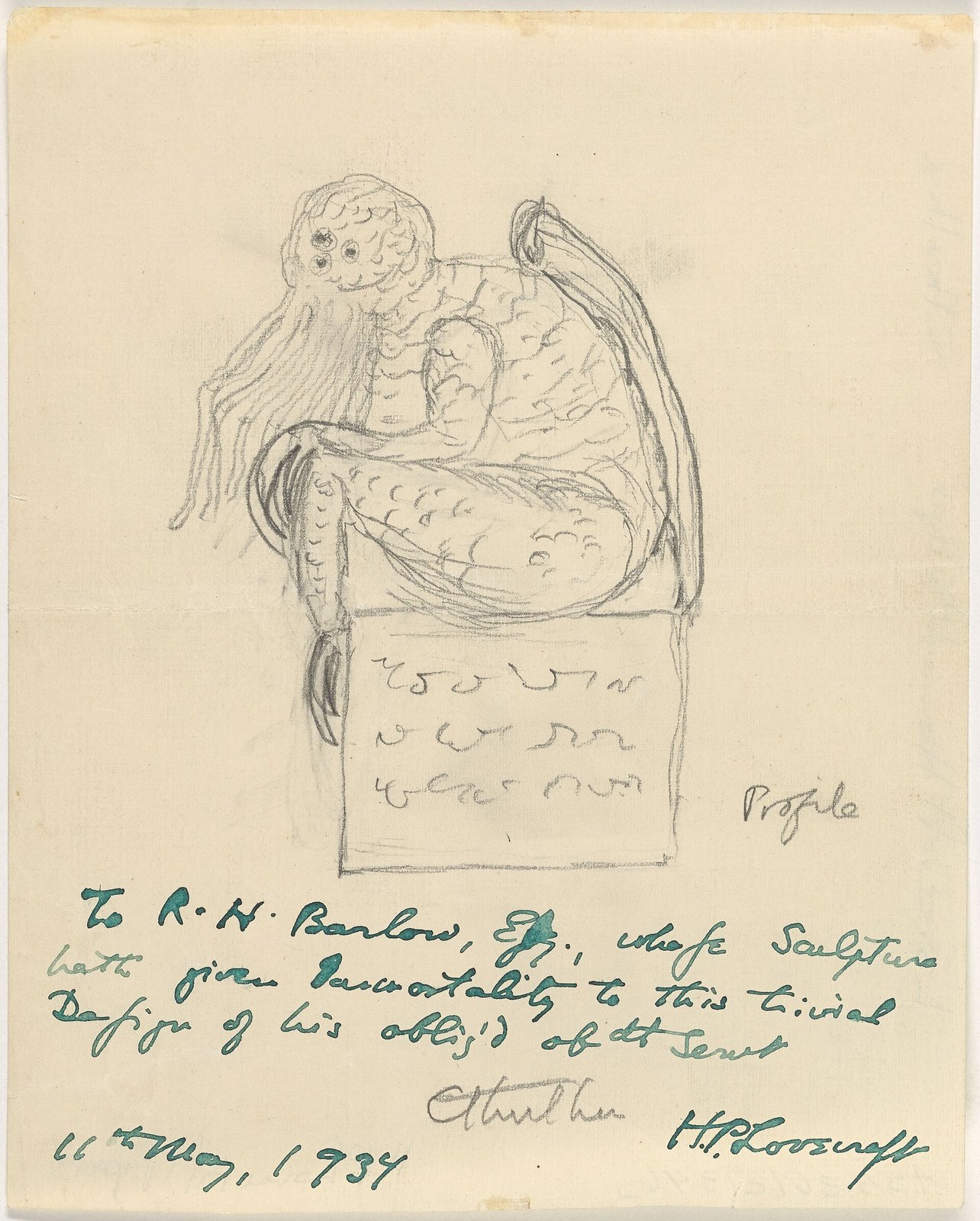
Lovecraft insisted that the name was not meant for human mouths: it was an attempt to render, in letters, a sound made by organs unlike ours. In a letter of 1934 he gave the nearest human approximation as Khlûl'-hloo, with the first syllable pronounced deep in the throat. The common pronunciation ka-THOO-loo has nothing to do with his intentions. The form is described in fragments: a pulpy, tentacled head over a scaly, rubbery body with long claws and narrow wings, many times taller than a man; the sailor's account adds that the creature was not really made of matter as we know it. Lovecraft drew it himself in 1934 as a hunched, winged figure with an octopoid face. Cthulhu is not the highest power of his fiction. It is a priest of the Great Old Ones, waiting on behalf of beings even further from human understanding, and appears in person in only one story.
From Story to Mythos
Lovecraft shared his inventions freely. Friends such as Clark Ashton Smith, Robert E. Howard, Frank Belknap Long and the young Robert Bloch borrowed his names and lent him theirs, and Lovecraft cross-referenced them in turn, half as a game and half to give his imaginary universe the texture of real lore; he jokingly called the whole thing Yog-Sothothery. After his death in 1937 his correspondent August Derleth founded the publishing house Arkham House with Donald Wandrei to keep his work in print, and coined the term Cthulhu Mythos for the shared setting. Derleth also reshaped it: he introduced a struggle between benevolent Elder Gods and the evil Great Old Ones, assigned the beings to the four elements, with Cthulhu as water, and wrote many stories of his own. Lovecraft scholars, above all S.T. Joshi from the 1970s onward, have argued that this moral, almost Christian framework contradicts Lovecraft's central idea that the cosmos has no sides at all. The Mythos as most readers meet it is therefore the work of many hands, of which Lovecraft's is only the first.
The Necronomicon
Lovecraft's best-known invention after Cthulhu is a book: the Necronomicon, a forbidden grimoire written by the mad Arab Abdul Alhazred, first mentioned in The Hound (1924) and given a mock history by Lovecraft in 1927. He stated plainly in his letters that it did not exist. Its fame produced the opposite belief. Library catalogues received hoax entries, booksellers fielded requests, and from the 1970s actual books appeared under the title. The most widely read, the so-called Simon Necronomicon (1977, in paperback from 1980), presents itself as a translation of an ancient manuscript and mixes Mesopotamian names with Lovecraftian ones; scholars of Near Eastern religion and of Lovecraft regard it as a modern composition, while some practitioners have used it as a working grimoire regardless. Another, edited by George Hay with an introduction by Colin Wilson (1978), was openly framed as a literary game. For the occult reception of Cthulhu, these books matter more than any single story.
Cthulhu in the Occult
From the late 1960s onward, parts of the Western occult world began to treat Lovecraft's fiction not as invention but as perception. The British occultist Kenneth Grant, head of the Typhonian Order, argued in The Magical Revival (1972) and later works that Lovecraft, like Aleister Crowley, had made contact with real currents beyond ordinary consciousness, and drew parallels between their imagery. In 1972 Anton LaVey's The Satanic Rituals included two rites written by Michael Aquino, The Ceremony of the Nine Angles and The Call to Cthulhu, which use Lovecraft's invented language. In the 1990s chaos magicians, for whom any symbol is a usable tool, built workings around the Mythos; Phil Hine's The Pseudonomicon (1994) is the best-known example. Groups named after Lovecraft's fictional cults have appeared and dissolved. Practitioners differ on what they are doing: some treat Cthulhu as a deliberately chosen fiction that works because it is believed, others as a real intelligence that Lovecraft glimpsed and misdescribed. Lovecraft himself would have rejected both readings.
Lovecraft and Race
Any honest account of Cthulhu has to include the views of its author. Lovecraft held openly racist and antisemitic opinions, documented in his letters, in an early poem, and in stories such as The Horror at Red Hook (1927). The cult in The Call of Cthulhu is described in racialised terms, and the fear of mixture and degeneration runs through much of his work. His later letters show some softening, but no reversal. In 2015 the World Fantasy Award, whose trophy had been a bust of Lovecraft, announced that it would be replaced. Writers have answered the legacy within the genre itself — Victor LaValle's The Ballad of Black Tom (2016) retells The Horror at Red Hook from the perspective of a Black protagonist, and Matt Ruff's Lovecraft Country (2016), adapted for television in 2020, sets the Mythos against the reality of racism in mid-century America. Readers continue to argue over how far the work can be separated from its author.
The Icon
No other creation of the pulp magazines has had a comparable afterlife. Chaosium's tabletop role-playing game Call of Cthulhu (1981), designed by Sandy Petersen, introduced generations of players to the Mythos and its sanity mechanic. Metallica recorded the instrumental The Call of Ktulu (1984); films, comics and video games from Alien to Bloodborne have borrowed its imagery of unknowable scale. Cthulhu became a plush toy, a candidate in mock election campaigns and a staple of internet humour, an absurd softening that Lovecraft scholars often note with irony. In the 2020s Lovecraft's vocabulary even entered debates about artificial intelligence, where the shoggoth — another of his creatures — became a common image for a system whose inner workings remain alien behind a friendly surface.
R'lyeh and the Real Ocean
Lovecraft placed R'lyeh at 47°9′ south, 126°43′ west, in one of the emptiest stretches of the South Pacific; August Derleth later gave a slightly different position. The spot lies not far from Point Nemo, the place in the ocean furthest from any land, identified in 1992. In 1997 American underwater microphones recorded an extremely loud, low-frequency sound, nicknamed the Bloop, whose source was estimated in the same remote region of the South Pacific. Because of the location, the recording was quickly associated with Cthulhu in popular culture and online discussion, and some suggested that it came from an unknown giant creature. In 2012 the American ocean agency NOAA attributed it to the cracking of large icebergs, and that explanation is widely accepted. The Vault records the association as part of Cthulhu's modern life; the sound itself remains a matter of oceanography.
Where the Vault Leaves It
What is certain is unusually precise: Cthulhu was invented by H.P. Lovecraft in 1926 as a literary embodiment of an indifferent cosmos, appeared in one story, and was expanded into a shared mythos mostly after his death. Everything beyond that — whether a deliberately invented being can become a real magical current, whether Lovecraft perceived more than he believed, how far an author's views can be separated from his creation, and what people find in the image a century later — is a matter of interpretation, and the Vault records each reading as it is held, without deciding between them.
Appearance
A gigantic being many times taller than a man, with a pulpy head bearing a mass of face tentacles, a scaly, rubbery body, long clawed limbs and narrow rudimentary wings; in Lovecraft's account it is made of a matter unlike any known on Earth
Powers
- Sending dreams to sensitive minds
- Inspiring cults across the world
- Awakening when the stars are right
- Overwhelming human understanding
- Reforming after injury
Also Known As
The Great Dreamer, The Sleeper of R'lyeh, The High Priest of the Great Old Ones, Dead Cthulhu, Khlûl'-hloo
Attributes
- Cosmic indifference
- Dreams
- The sunken city
- Forbidden knowledge
- Madness
Symbolic Correspondences
- Elements: Water — the sunken city of R'lyeh (a classification added by August Derleth); the void between the stars
- Colours: Greenish black, the grey-green of deep water, the slime of the sea floor
- Numbers: None in Lovecraft; his coordinates for R'lyeh, 47°9′ S 126°43′ W
- Associations: R'lyeh, the Great Old Ones, 'when the stars are right', the Necronomicon, dreams, the deep sea, non-Euclidean geometry, Providence, Weird Tales, the Cthulhu Mythos
The Figure, Symbol by Symbol
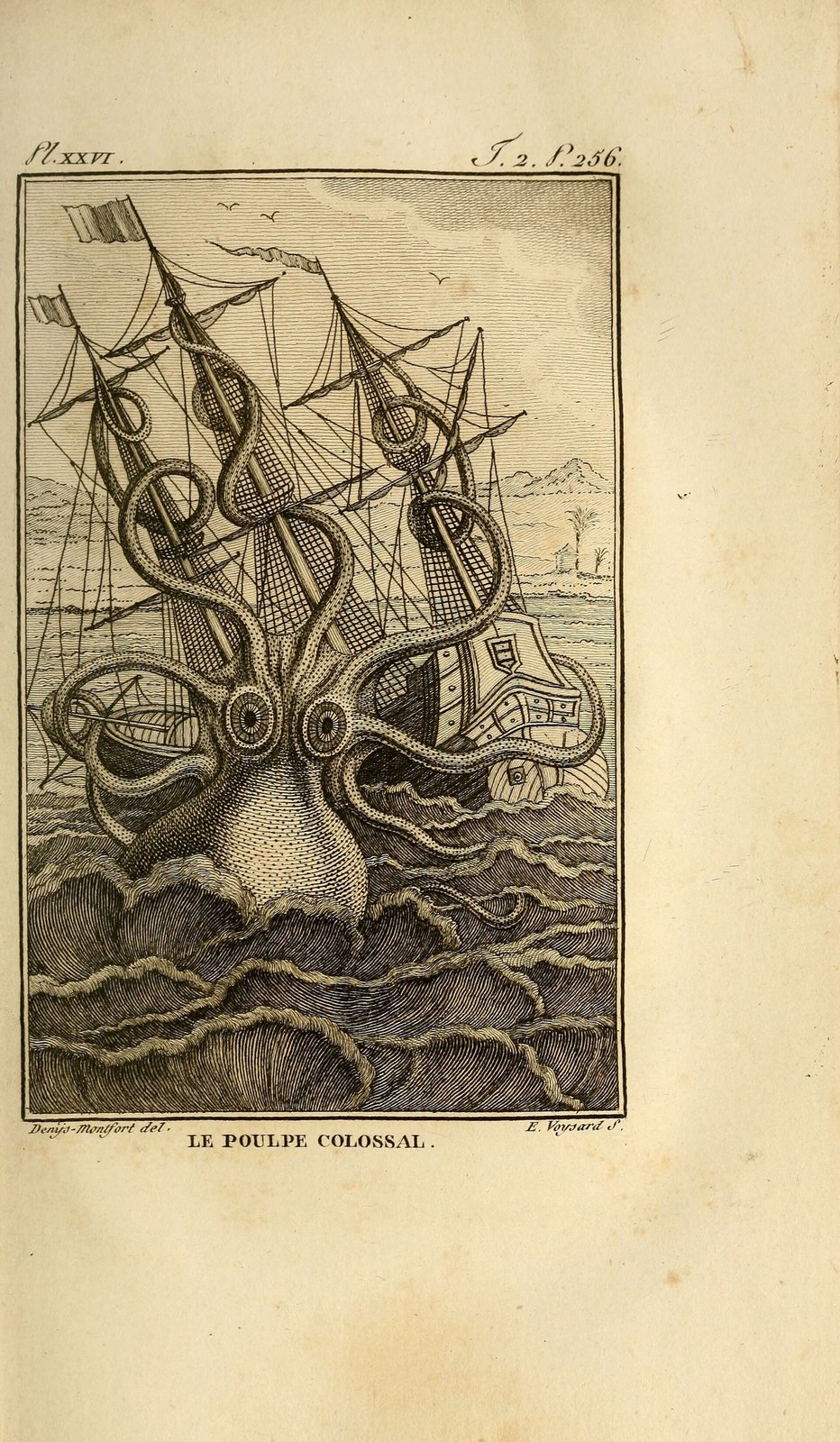
- The Octopus Head: The tentacled face joins the most alien creature most people know — the cephalopod of the deep — to a human-like body. It makes the being readable at a glance while denying it any expression a human could interpret.
- The Wings: Narrow, almost useless wings mark Cthulhu as a creature from elsewhere, one that came from the stars. In the image they hint at a mobility that does not depend on water or earth.
- Dead but Dreaming: The central paradox of the story: the being is dead and yet not; it acts through dreams while it sleeps. Read symbolically, Cthulhu is the thing that waits beneath consciousness and reaches people only when their guard is down.
- R'lyeh and Its Geometry: The sunken city is built with angles that seem wrong, surfaces that look convex and concave at once. It is Lovecraft's image for a reality that obeys rules human minds were not made to grasp.
- When the Stars Are Right: The return of the Great Old Ones depends not on prayer or sacrifice but on cosmic alignment. The phrase turns religious expectation into astronomy: humans neither cause nor prevent it.
- The Chant: Ph'nglui mglw'nafh Cthulhu R'lyeh wgah'nagl fhtagn: a sentence in no human language that the reader can nevertheless repeat. It is the point where the story invites the reader to join the cult, which is perhaps why it became the most quoted line of the Mythos.
- The Unpronounceable Name: A name that human mouths can only approximate is Lovecraft's way of saying that the being exceeds every category we have for it — including the word we use for it.
Reading the Whole
Taken as a whole, Cthulhu is the image of a single idea made monstrous: that the universe is vast, old and indifferent, and that human beings matter to it no more than insects matter to a mountain. Lovecraft built the figure to frighten through scale rather than malice. Cthulhu does not hate humanity; it barely notices it, and the true horror of the story lies less in the monster than in the moment a mind realises its own insignificance.
The century since has turned that image in every direction — into a moral battle between gods, into a magical current, into a joke and a toy, into a metaphor for technologies and forces too large to steer. That the same figure can carry cosmic dread, playful irony and devotion at once is itself the clearest sign of how completely it has left its author's hands.
Theological Significance
Cthulhu belongs to no theology, and that is its theological significance. Lovecraft created a being that has everything a god traditionally has — worshippers, a hidden dwelling, a prophesied return, a sacred language — and empties each of these of meaning. The cultists in the story do not receive grace or reward; their god does not answer, judge or love them. Religion appears as a human reaction to a power that has no interest in humans at all.
Anti-Theology
Literary scholars have described Lovecraft's work as an inversion of religious revelation. In traditional scripture, contact with the divine brings meaning, order and salvation; in Lovecraft it brings madness, because the truth revealed is that there is no meaning to be found. Cthulhu is the opposite of a creator and a redeemer: a being from outside the cosmos's moral order, whose return would not end history in judgment but simply end it.
Gods Made on Purpose
The occult reception adds another question. If a being invented in 1926 can, for some practitioners, become an object of ritual work, what distinguishes an old god from a new one? Chaos magic answers that belief, not origin, gives a symbol its force; Kenneth Grant answered that Lovecraft had perceived something real. Theologians and historians of religion see in Cthulhu a modern test case for how myths arise, spread and acquire meaning — this time with a known author and a printed first edition.
Practical Application
For most readers Cthulhu is a figure of literature and reflection, not of practice. Within the Vault it is approached in the same way as the other modern entities: as a subject of study, and as an image to think with. Contemplating it can serve as an exercise in scale — in sitting with the size and age of the cosmos without immediately reaching for comfort — and in noticing which fears and fascinations the image awakens.
Practitioners in chaos magic and in some Typhonian and Left-Hand-Path currents do work with Lovecraftian names and symbols, either as deliberately adopted fictions or as perceived realities; their methods are recorded in the sources listed below. The Vault documents that such practice exists without prescribing it, and notes that Lovecraft himself regarded the whole cycle as fiction.
Modern Interpretations
Cthulhu has become a mirror in which very different readers see their own concerns. The readings below are recorded as their proponents hold them.
The Philosophy of Cosmic Horror
Philosophers have taken Lovecraft seriously as a thinker. Graham Harman's Weird Realism (2012) reads him as a philosopher of objects that always exceed our descriptions, and the French novelist Michel Houellebecq's essay on Lovecraft (1991) presents him as a writer against the modern world. In this reading Cthulhu is the image of reality as it is when stripped of human meaning, and cosmic horror a genre for an age that knows how small Earth is.
Ecology and the Sleeping Monster
A widespread contemporary reading sees in the sleeping giant beneath the sea an image of forces humanity has awakened and cannot control: rising oceans, climate change, the deep sea as the last unknown space on Earth. The philosopher Donna Haraway proposed the term Chthulucene (2016) for a new era of entanglement with the living world, deliberately spelled differently and distanced from Lovecraft's creature, but inevitably read alongside it.
Lovecraft's Creatures and Artificial Intelligence
Since 2023 Lovecraftian images have appeared in debates about artificial intelligence, above all the shoggoth with a smiley-face mask: a vast, alien system behind a pleasant interface. Cthulhu itself is sometimes invoked in the same discussions as the image of an intelligence too large and too different to be understood or controlled.
Real Visions and Hidden Truth
A smaller current holds that Lovecraft's fiction drew on something real — genuine visions received in dreams, as Kenneth Grant argued, or older lore that the author reworked without understanding it. Proponents point to Lovecraft's own accounts of vivid dreams and to the coherence of his invented world; the Necronomicon editions and the Bloop recording are often cited alongside. Lovecraft's letters, which describe the Mythos as a conscious literary construction, are the principal counter-evidence.
Across these readings one thread holds: Cthulhu is the face people give to whatever seems too large, too old or too indifferent to be faced directly — and each age has found its own version of that.
Sources & Historical Texts
- H.P. Lovecraft — Dagon (written 1917, published 1919)
- H.P. Lovecraft — The Call of Cthulhu (written 1926, Weird Tales, February 1928)
- H.P. Lovecraft — The Hound (1924) and History of the Necronomicon (1927)
- H.P. Lovecraft — At the Mountains of Madness (1936); The Shadow over Innsmouth (1936)
- H.P. Lovecraft — Selected Letters (Arkham House, 1965–1976)
- August Derleth — The Trail of Cthulhu (1962) and other Mythos stories
- Simon (ed.) — Necronomicon (1977)
- George Hay (ed.) — The Necronomicon: The Book of Dead Names (1978)
- Anton Szandor LaVey — The Satanic Rituals (1972), with rites by Michael Aquino
- Kenneth Grant — The Magical Revival (1972); Nightside of Eden (1977)
- Phil Hine — The Pseudonomicon (1994)
- S.T. Joshi — I Am Providence: The Life and Times of H.P. Lovecraft (2010)
- Sandy Petersen / Chaosium — Call of Cthulhu role-playing game (1981)
- Victor LaValle — The Ballad of Black Tom (2016); Matt Ruff — Lovecraft Country (2016)