Star
The Pentagram
The five-pointed star, point up; ringed by a circle, often called a pentacle
The oldest star humans draw, and for nearly all of its life a sign of protection, health and order — the infernal reading is a late loan.
- Sumer, c. 3000 BCE
- Pythagorean hygieia
- The Five Wounds of Christ
- Golden Dawn: spirit over the elements
The form
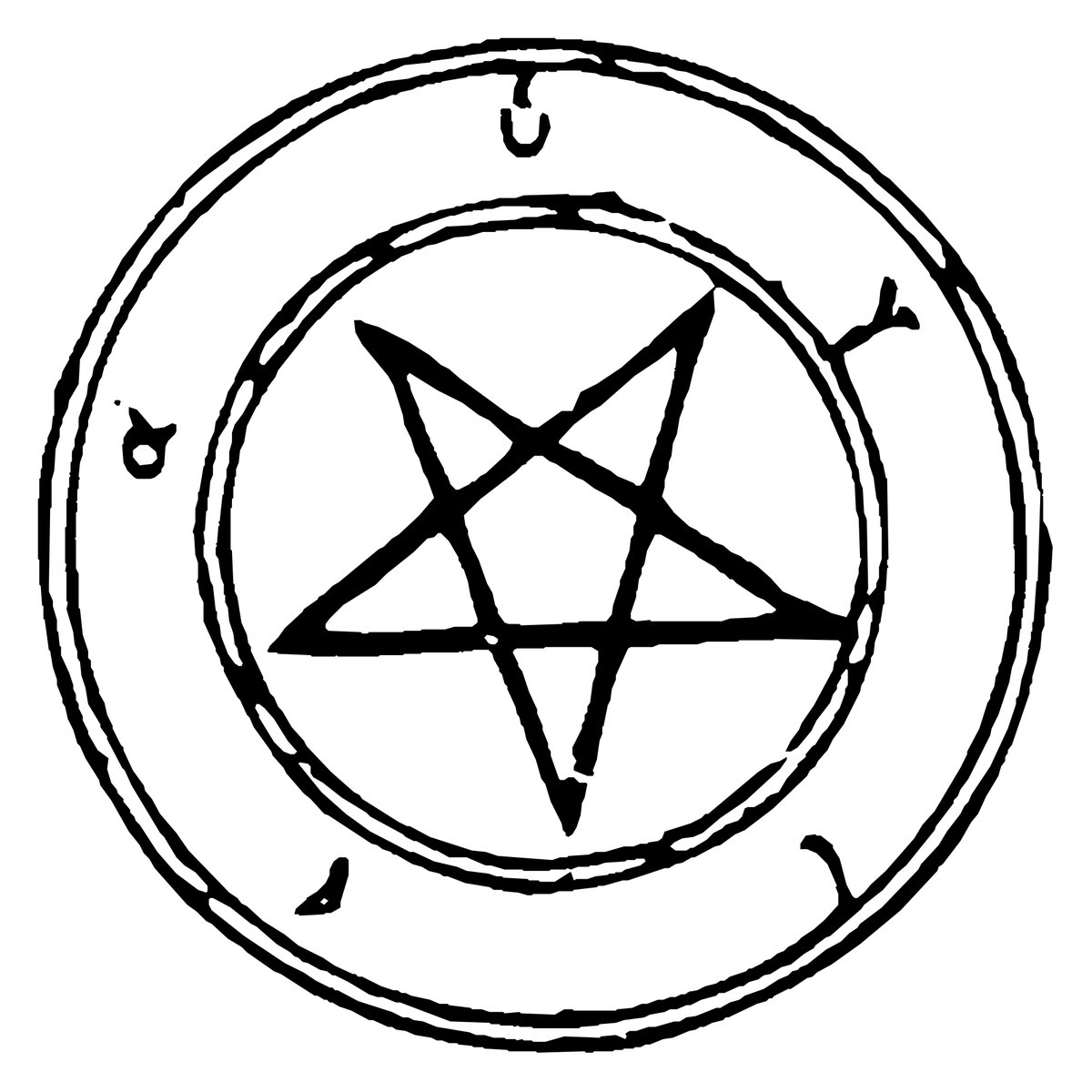
A five-pointed star traced in a single unbroken line — that is the pentagram. Ringed by a circle, it is what modern Wiccan usage calls a pentacle; in ceremonial magic the word properly means an inscribed disc (see below). One point stands uppermost, and the whole moral weight later hung on the figure rests on which way that single point faces: up for spirit ruling matter, down for the reverse. The lines cross to make a smaller inverted pentagon at the centre, and the proportions throughout are the golden ratio, the reason geometers have been drawn to it since antiquity.
The deep history
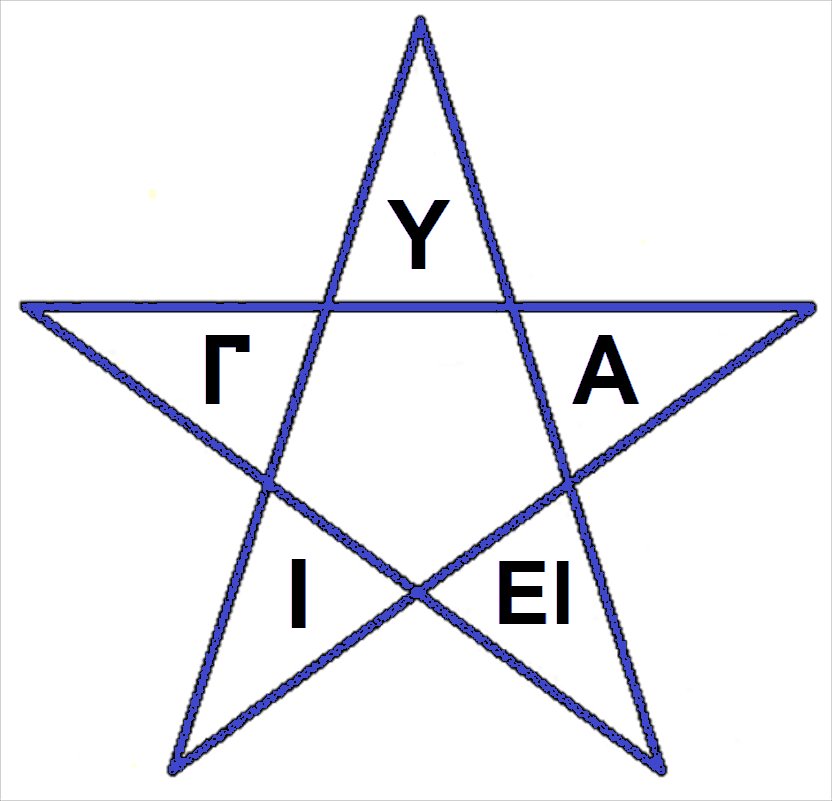
The five-pointed star is among the very oldest marks in the human record. It appears in Sumerian cuneiform around 3000 BCE as a sign for a corner, an angle or a small region, and on Uruk-period pottery long before that. The Pythagoreans of the sixth century BCE prized it, called it hygieia — health, wholeness — and are said to have used it as a secret token by which members knew one another. For its first three thousand years it stood for order and completeness, and for nothing sinister at all.
The Christian and magical centuries
Medieval Christianity read the five points as the Five Wounds of Christ or the five senses, and the star appears in churches and on heraldry — most famously on Sir Gawain's shield in the fourteenth-century poem, where the poet calls it outright a token of truth. In the grimoire tradition it is protective above all: the Pentacle of Solomon shields the magician, and the shape is drawn to ward, to bind and to keep out — never to summon.
The occult reading
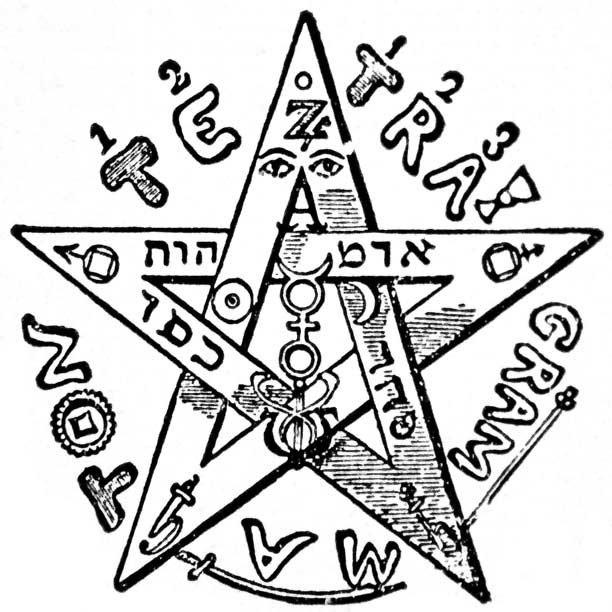
The reading now attached to it was fixed in the nineteenth century. Éliphas Lévi drew the upright star as the microcosm — a human figure with head, arms and legs at the five points, spirit crowning the four elements — and set it against the reversed star of the goat. The Hermetic Order of the Golden Dawn systematised this into elemental attributions and the pentagram rituals still used in ceremonial magic, and Wicca took the point-up star as its central emblem: one point for spirit, above earth, air, fire and water.
In the practice
For demonolatry and the wider Left-Hand Path the pentagram is a working tool, not a threat — a figure of the self standing whole, spirit over the elements, and a frame within which the elemental and directional powers can be set in order. It is one of the most common protective and ordering signs in real use, drawn for exactly the reasons the Pythagoreans and the grimoire-writers drew it.
Pentagram or pentacle?
The two words are not interchangeable, and almost everyone uses them as if they were. A ‘pentagram’ is the five-pointed star itself — from the Greek for ‘five lines’ — the figure drawn in one unbroken stroke. A ‘pentacle’ is properly an object: in ceremonial magic it is a disc of wax, metal or parchment inscribed with signs, and it serves as the earth-tool among the four weapons, beside the wand of fire, the cup of water and the dagger of air. In modern Wiccan and neopagan usage the word narrowed further, and ‘pentacle’ came to mean one specific thing: a pentagram enclosed in a circle. By that reckoning the star alone is a pentagram, and the star ringed by a circle — the version on almost every pendant sold — is a pentacle. The Vault keeps the heading ‘pentagram’ because that is the word people search for, but the distinction is worth having: the circle is not decoration, it is what changes the name.
Where the Vault stands
Upright, the pentagram is the least ‘satanic’ object in this whole lexicon — a sign of health, protection and spirit set above matter, carried by Pythagoreans, crusader knights and Wiccans alike. Everything sinister read into it is borrowed from what happens when it is turned over, and even that is barely a hundred and seventy years old. A point-up star on a wall means order far more often than it means the Devil, and the Vault will not pretend otherwise.



- Protective
- Ancient
- Spirit over matter