Figure
Baphomet
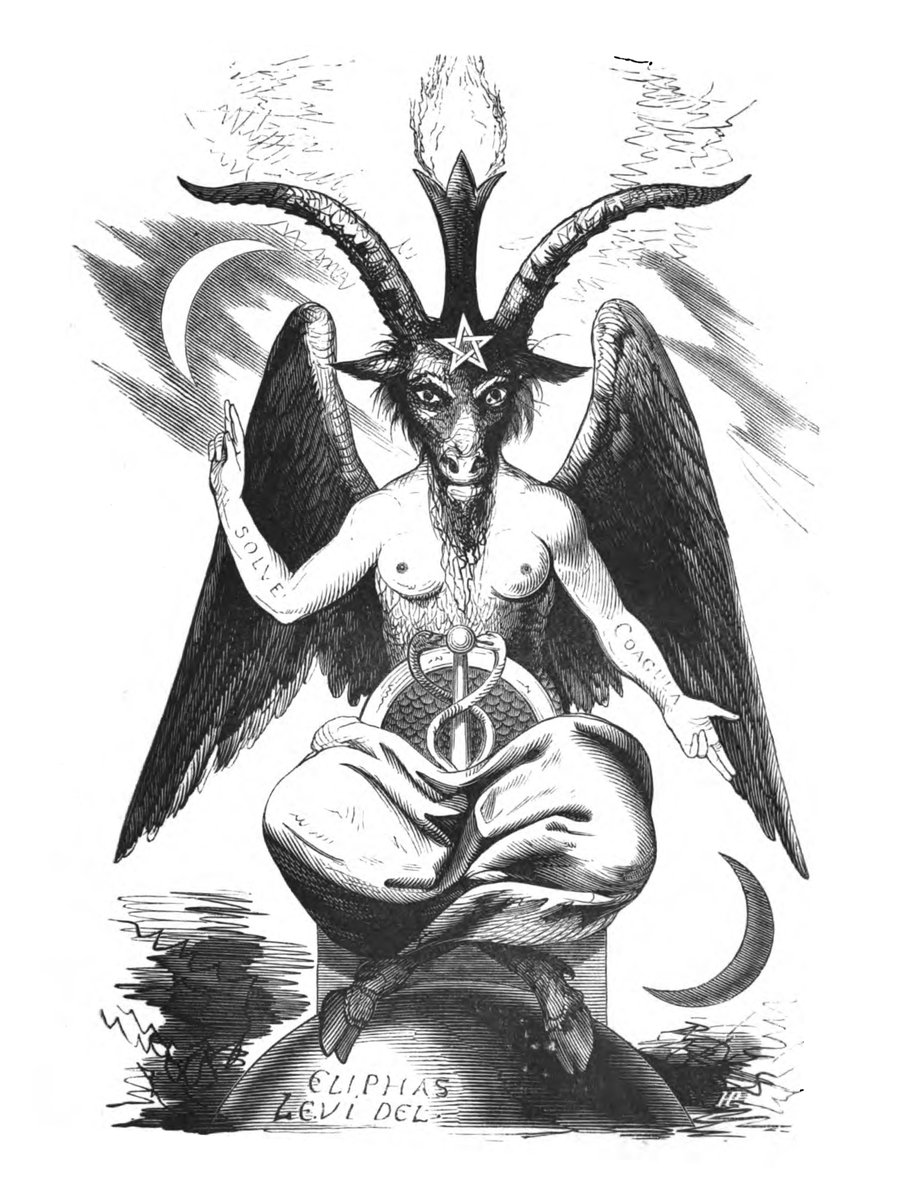
The Sabbatic Goat of Eliphas Levi; the idol of the Templars
A nineteenth-century emblem built to hold every opposite in one body — never an ancient god, and never actually worshipped.
- Templar trials, 1307-1314
- Levi's drawing, 1856
- Church of Satan and the TST
- A statement of union
The form, element by element
Lévi's 1856 drawing, the Sabbatic Goat, is a deliberate anthology of opposites. A goat's head — the black goat of the witches' sabbath — sits on a human torso. Between the horns burns a torch of intelligence; on the brow, a pentagram. The right arm rises and the left descends, lettered SOLVE and COAGULA (dissolve and bind), the alchemist's formula and ‘as above, so below.’ The figure has a woman's breasts and a caduceus rising from the lap in place of genitals; great feathered wings spread from the shoulders; the crossed legs are hooved and scaled; one hand points to a white moon above, the other to a black moon below.
What every part means
Each detail reconciles a pair. The half-human, half-animal body joins humanity and nature; the breasts with the phallic caduceus join female and male; the raised and lowered arms and the two moons join above and below, light and dark; the wings join the angelic to the bestial; SOLVE and COAGULA join destruction and creation. Lévi could not have been plainer about it: the whole is a hieroglyph of totality, everything held together in one seated body.
The name and the Templars
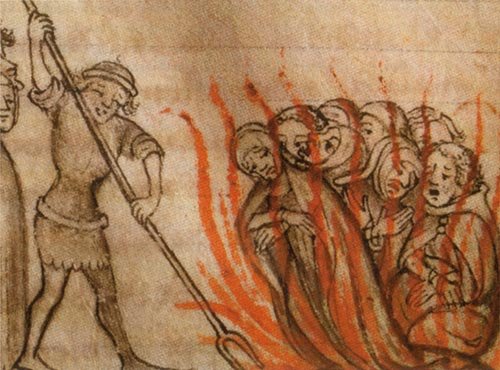
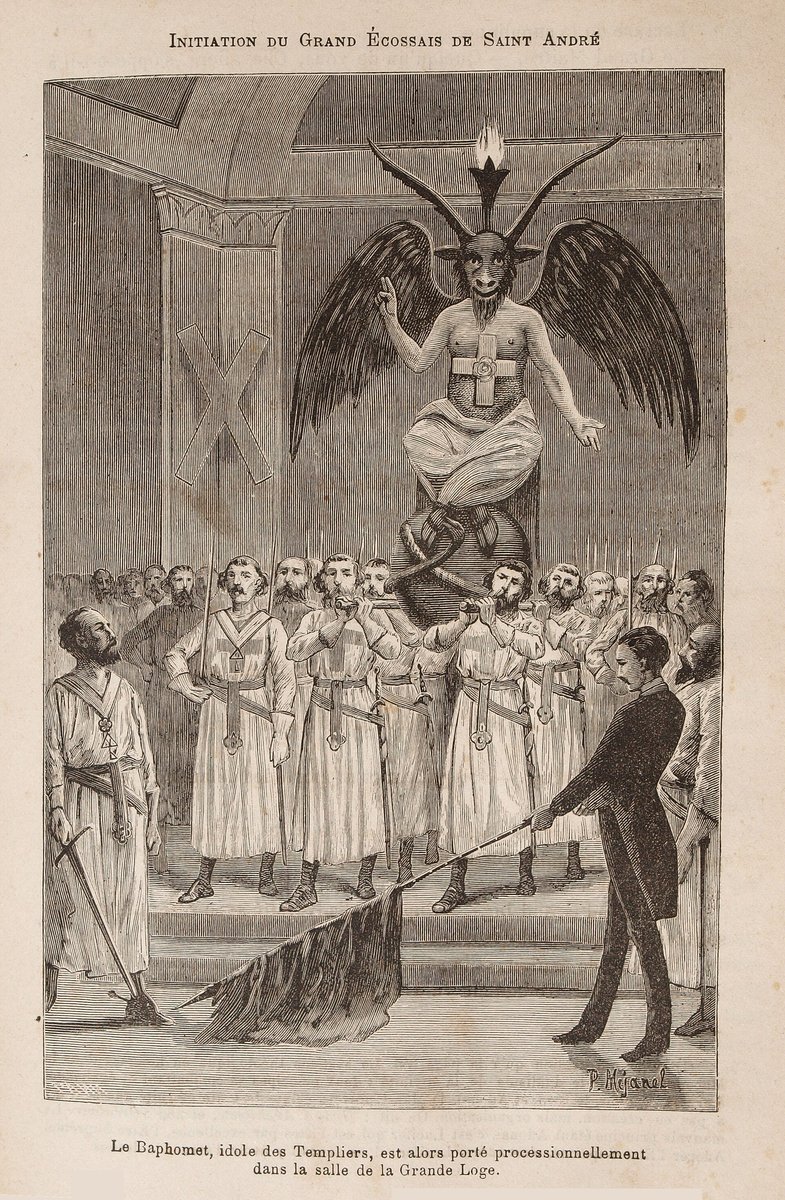
The word ‘Baphomet’ first surfaces in the 1307–1314 trials of the Knights Templar, arrested en masse by Philip IV of France, deep in debt to the order, and tortured into ‘confessing’ that they worshipped an idol of that name — described in the confessions as, variously, a head, a cat, a bearded figure, never twice the same. The likeliest explanation is that Baphomet is a medieval Old French garbling of Mahomet (Muhammad), a smear from an age that painted its enemies as idolaters. No such idol was ever found.
Levi's invention
For five and a half centuries Baphomet was only a word from a coerced confession. Then, in 1856, Éliphas Lévi drew the figure the modern world knows and named it the Sabbatic Goat, stating openly that he meant it as a symbol of the equilibrium of opposites — not a deity to be worshipped but a diagram of balanced forces. Everything visual about Baphomet is Lévi's design; not one line of it survives from antiquity.
The modern statue
In 1966 the Church of Satan folded Baphomet into its imagery. In 2015 the Satanic Temple unveiled an eight-and-a-half-foot bronze — a winged, seated Baphomet with two children gazing up at it — first offered for the Oklahoma State Capitol beside a Ten Commandments monument, later shown in Detroit and in Salem. It is deliberate protest art about religious pluralism and the separation of church and state, built to test whether a government that hosts one faith's monument must host another's.
The parchment that cleared them
The Templar confessions about an idol named Baphomet were extracted under torture and never agreed with one another — a head, three faces, a cat, a skull — and no such object was ever produced. What is less well known is that the Church itself did not believe the charge. In 2001 the historian Barbara Frale found the Chinon Parchment misfiled in the Vatican archives: the record of a private hearing in 1308 at which Pope Clement V examined the Templar leadership and absolved them of heresy, before political pressure from the French crown dissolved the order anyway. The men later burned as idolaters had already been cleared on the Church’s own quiet paper.
Where the Vault stands
Baphomet was never an ancient god and, on all the evidence there is, was never actually worshipped by anyone until modern people chose to take up Lévi's emblem. It is a nineteenth-century figure engineered to hold opposites together — male and female, human and animal, light and dark, dissolving and binding — and, in the Satanic Temple's hands, a piece of civic argument. The ‘Templar idol’ behind the name is a confession pulled out under torture to rob a wealthy order. The Vault reads Baphomet as the philosophy diagram its maker built, and treats the tale of the ancient devil-cult as what it is: an accusation, not a history.



- Eliphas Levi
- Knights Templar
- Union of opposites