Board
The Ouija Board
The talking board; the planchette
A patented parlour game whose effect has a name and a demonstration — and whose ‘demon portal’ reputation insults the actual work.
- US patent, 1891
- Kennard Novelty Company
- Ideomotor effect (1852)
- Owned by Hasbro
The form
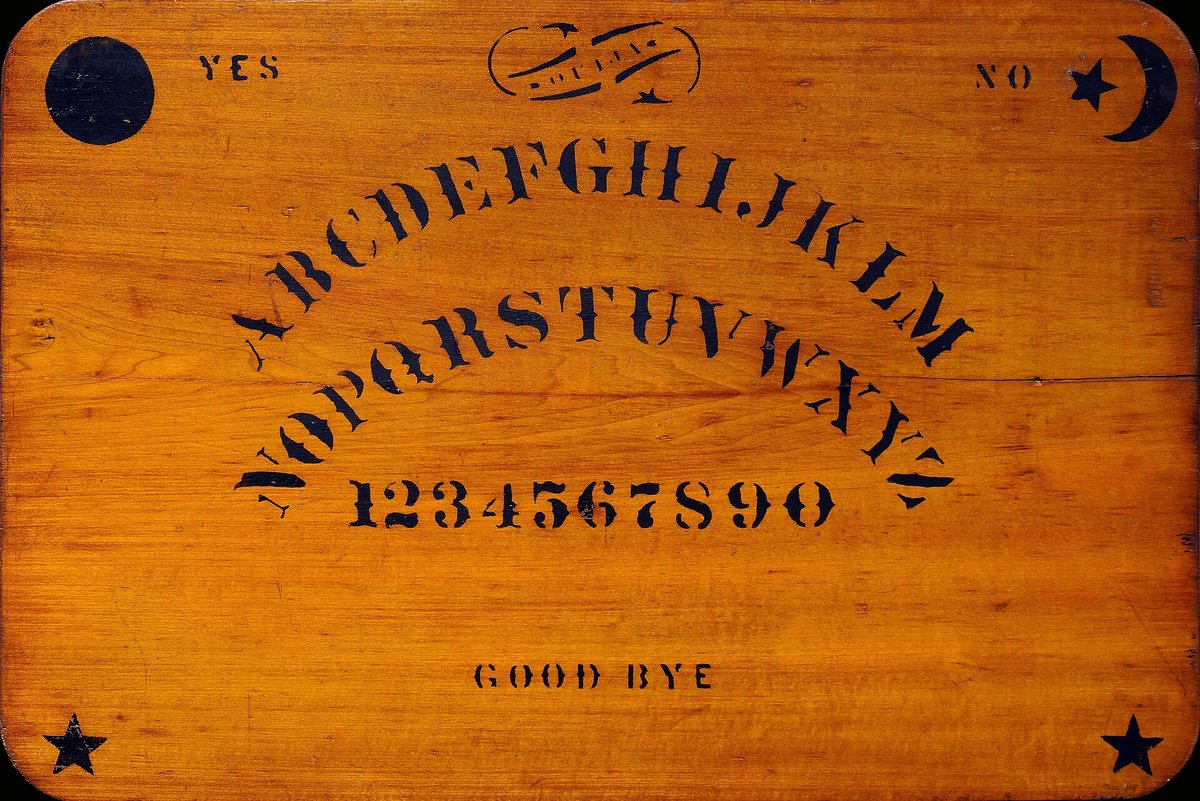
A flat board printed with the alphabet, the numbers zero to nine, YES and NO in the corners and GOODBYE at the foot, worked with a small heart-shaped pointer called the planchette. Sitters rest their fingertips on the planchette, ask a question, and watch it slide from letter to letter — the part that seems to move on its own.
Where it comes from
Talking boards grew out of the American Spiritualist boom of the nineteenth century, when contacting the dead was a mass pastime. The Ouija specifically was patented in 1891 by the Kennard Novelty Company of Baltimore and sold as a wholesome parlour amusement; it was hugely successful. Parker Brothers bought it in 1966, and it is owned today by Hasbro and sold, legally and literally, as a toy.
Why it moves
The planchette moves by the ideomotor effect — small, unconscious muscular movements the sitters make without any sense of initiating them. The mechanism was described by the physiologist William Benjamin Carpenter in 1852, predates the board, and also accounts for dowsing rods and facilitated communication. The old test is simple: blindfold the sitters, or turn the board so they cannot see the letters, and the coherent replies stop at once. This is not cheating — the sense of the pointer moving by itself is entirely real to the people at the table, which is exactly what makes the effect interesting rather than trivial.
Where the fear comes from
The board's sinister reputation also has a date — 1973, and The Exorcist, in which a girl's possession begins with a board. Before that film it was advertised as family fun in the newspapers; after it, an occult hazard, and the churches that now warn against it were largely silent for its first eighty years. The Satanic Panic of the 1980s then attached itself to the board along with everything else it could reach.
A toy company owns the doorway
The board is a patented commercial product with a paper trail. Elijah Bond filed the patent in 1890 and it was granted in 1891, at a moment when spiritualism was a mass enthusiasm and talking boards were a parlour craze; William Fuld took over production and marketing and is often miscredited as the inventor. The name’s origin is disputed, with the most repeated story — that the board spelled its own name and said it meant good luck — coming from Fuld himself, who had every reason to tell it. Parker Brothers bought the rights in 1966 and Hasbro owns them now. Whatever else it is, the object sold as a gateway to the other side is a trademarked board game with a corporate owner and a shelf in the toy aisle.
Where the Vault stands
Here the Vault will say it plainly: a mass-market board is not a doorway to the Ars Goetia, and marketing it as one is nonsense that cheapens the actual work. A spirit is reached by its own seal and its own name, addressed by someone who knows who they are speaking to — not spelled out of a toy by a circle of strangers who could not name what they think they are calling. What the board really surfaces — the room's own held-back words — is worth respect; the demon it is sold with is not.

- Patented 1891
- Ideomotor effect
- Hasbro toy