Seal
The Sigil of Lucifer
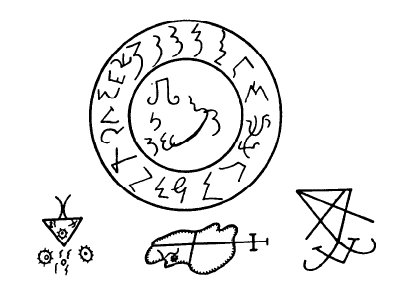
The Seal of Lucifer, from the Grimorium Verum
In its own book a working sigil — a spirit's signature, not a creed. Its life as a free-standing ‘Lucifer’ badge is modern.
- Grimorium Verum, 18th c.
- One seal among dozens
- No letters, no goat
- Adopted by modern Luciferians
The form
A geometric line-figure with no letters and no imagery — a small cup or ‘V’ at the base, a downward-pointing triangle or crossed lines in the middle, and a short cross or bar at the crown, sometimes with a small circle where the lines meet. It is austere and abstract, nothing like the pictorial Baphomet marks.
Where it comes from
The sigil first appears in print in the Grimorium Verum, an eighteenth-century grimoire, probably Italian, that falsely claims a far older Egyptian pedigree. There it is simply the seal by which the spirit Lucifer is called — one sigil among many for a whole hierarchy of spirits, drawn by the same conventions as any grimoire seal, and given no special weight over the others in its own pages.
How grimoire seals work
A seal of this kind is understood as a spirit's own sign — its name written in a script only it and the practitioner share, closer to a signature or an address than to a spell. You do not invent it and it is not about you; you use it to reach a specific, named intelligence. That is a very different thing from a chaos-magic sigil built from a sentence of desire, and confusing the two is one of the commonest errors made about the seals in this Vault.
The modern career
Twentieth- and twenty-first-century Satanism, Luciferianism and pop-occulture lifted the sigil out of the Grimorium Verum and made it a free-standing badge — of Lucifer as the light-bringer, of rebellion, of the Luciferian current as a whole. Printed on jewellery and album art, it now works as a logo far more often than as a working seal.
The name is a translation error
Before the seal there is the name, and the name is an accident. Isaiah addresses a taunt to a fallen Babylonian king as helel ben shachar, ‘shining one, son of the dawn’ — a reference to the morning star. Jerome rendered that into Latin as lucifer, which simply means light-bringer and was an ordinary Latin word for Venus at dawn; early Christian writers even used it as a personal name, and there is a fourth-century Saint Lucifer of Cagliari. Only later readers, taking Isaiah’s taunt as a description of Satan’s fall, turned a Latin common noun into a proper name for the Devil. The seal itself comes from the Grimorium Verum, an eighteenth-century French compilation that falsely claims a 1517 Memphis imprint.
Where the Vault stands
In its own book the Sigil of Lucifer is a tool, not a testament — the summoning-sign of one spirit among a crowd of them. Its use as a general emblem of Luciferianism is a modern repurposing of an eighteenth-century seal, and there is nothing wrong with that so long as it is known for what it is. The drawing means ‘this spirit’; the creed came later, and the Vault keeps the two apart.

- Grimorium Verum
- Luciferian
- Working seal