The case study — and this Vault's own first spirit
The Cult of Baal
A god, a conquest, and a name that has been in continuous use as an accusation for three thousand years — filed today at number one in our own compendium.
No continuing organisation under the name “Cult of Baal” appears in the documentary record — no order, no lodge, no scripture, no roll of members. The phrase circulates almost entirely as a description applied to others rather than as one anybody claims. What follows separates the three things it is used to mean: the ancient cult, the modern claim, and the reading of power that has grown up around it.
Lord of the storm
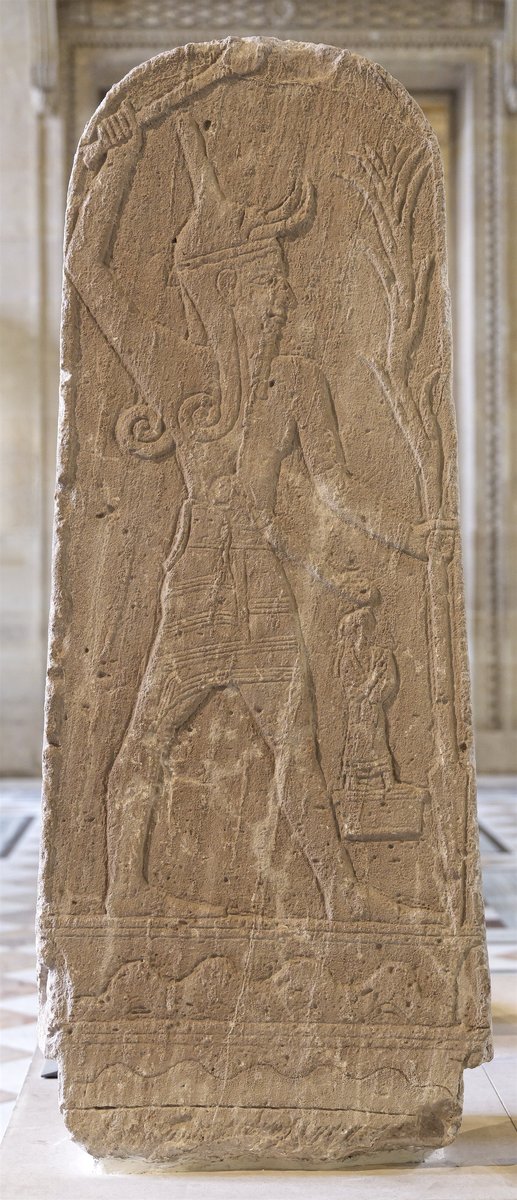
What existed is far more interesting. Ba'al is a Northwest Semitic word meaning simply lord, or master. It was a title before it was ever a name, and it attached to a great many local gods across Canaan, Phoenicia and Ugarit — the best known being Baal Hadad, the storm god who brings the rain, the rider of the clouds, who in the Ugaritic Baal Cycle dies and returns with the season. For centuries he was entirely ordinary. He was the god the neighbours had.
People named their children after him, and the Hebrew Bible still preserves a few such names, somewhat embarrassedly. Gideon is also called Jerubbaal; a son and a grandson of Saul appear in Chronicles as Eshbaal and Merib-baal, and in the books of Samuel as Ish-bosheth and Mephibosheth — the baal replaced by bosheth, “shame”.
Then his worshippers lost. The polemic of a rival cult became scripture, and in scripture Ba'al is the false god above all others — the idol on the high place, the one Elijah humiliates on Carmel. A word meaning "lord" was converted into a proper name for an enemy. Ba'al Zebul, "Baal the prince" or "lord of the lofty house," was mockingly bent into Ba'al Zebub, "lord of the flies," the god of Ekron in the second book of Kings — which is Beelzebub. And Bael is the first spirit of the Ars Goetia, a king ruling in the east over sixty-six legions: the opening entry of this Vault’s own compendium. A storm god, demoted to a demon, filed at number one.
This is the clearest case there is of the Vault’s reading of the demonic catalogue. Baal was not filed under evil because of anything he did. He was filed under evil because his people lost the argument and the winners wrote the catalogue. Read the Ars Goetia knowing that, and it stops being a bestiary of monsters. It becomes a list of the defeated.
Moloch and the valley
Any account of the ancient cult runs into Moloch, and the ground there is genuinely unsettled. The Hebrew Bible condemns causing children to “pass through the fire” to Molek, and places it in the Valley of Ben Hinnom outside Jerusalem — Ge-Hinnom, which becomes Gehenna, which becomes the ordinary word for Hell. On the identity of Moloch there are three live readings: a distinct deity, often equated with Milcom of the Ammonites; a Punic technical term (molk) for a class of offering rather than its recipient; or a title, from the root m-l-k, “king” — in which case the king in question may be the storm god himself.
Jeremiah names the high places in that same valley as high places of Baal, and Neo-Assyrian contracts threaten the burning of a son before Adad — who is Hadad, who is Baal — as a penalty clause. At Carthage the tophet precinct has yielded thousands of infant urns under dedications to Baal Hammon and Tanit; whether they record sacrifice or infant mortality is argued in the journals to this day.
The modern claim
What is usually meant today by “the Cult of Baal” is a body of contemporary material holding that an elite — described variously as financial, political or dynastic — maintains the worship of Baal or Moloch in private. Particular items recur as evidence within it: the replica of Palmyra’s monumental arch raised in Trafalgar Square in 2016, widely reported at the time as an arch from the Temple of Bel; fashion campaigns and corporate marks read as coded signals.
The most cited item is the Bohemian Club’s annual encampment in California, where the Cremation of Care ceremony is performed at night before a concrete owl some forty feet high, an effigy representing worldly care carried across water and burned. The encampment, its membership and the ceremony are matters of public record; what the ceremony means is what is disputed.
Adjacent to this sits the bloodline literature, of which Fritz Springmeier’s Bloodlines of the Illuminati (1995) is the best-known example: it names thirteen dynasties and assigns each a governing demon. Its structure descends from the Barruel-to-Protocols line traced on the Illuminati card.
The reading of power. The most developed part of this material is not an accusation but an argument about how power binds people, and it draws on genuine comparative religion. It runs: initiatory systems are graduated, each degree costing more than the last; transgression performed collectively and then documented binds far harder than any oath, because it cannot be disowned; the offering in such systems is selected from the socially marginal, the Greek pharmakos, whose loss raises no alarm; and the rite is placed in liminal ground — across water, outside jurisdiction.
Proponents apply this to modern cases; the historical cases they cite are documented in their own right. Among them are the 1440 trial of Gilles de Rais; the Affair of the Poisons at the court of Louis XIV, whose records the king had sealed and in part burned; and the MK-Ultra programme, whose files were ordered destroyed in 1973 and survive chiefly through a misfiled set of financial papers found in 1977.
What is on the public record, and what is not. In the Epstein case the following are documented: the non-prosecution agreement of 2007–08, which extended immunity to unnamed co-conspirators and was withheld from victims; a 2019 press report that Alexander Acosta had told Trump transition officials he was told Epstein “belonged to intelligence”, which Acosta later denied knowledge of; Ghislaine Maxwell’s 2021 trafficking conviction; the circumstances of Epstein’s death in federal custody, including guards charged with falsifying observation logs, camera failures on the tier, and the dissent of the pathologist Michael Baden; and the January 2026 release, in which victims’ names were left unredacted while other names remained blacked out.
The ritual allegations that circulate alongside these facts rest on anonymous, uncorroborated tips; they are unverified, and this page does not reproduce them against any named person.
Bael himself is in the compendium at number one, and he is approached exactly as any of the others: by honouring him, and asking. There is no order to join.