Emblem
The Ouroboros
The tail-eater; the serpent devouring itself
The snake that eats its own tail — a sign of eternity and unity carried by Egypt, alchemy and the North alike.
- Egypt, c. 1600 BCE
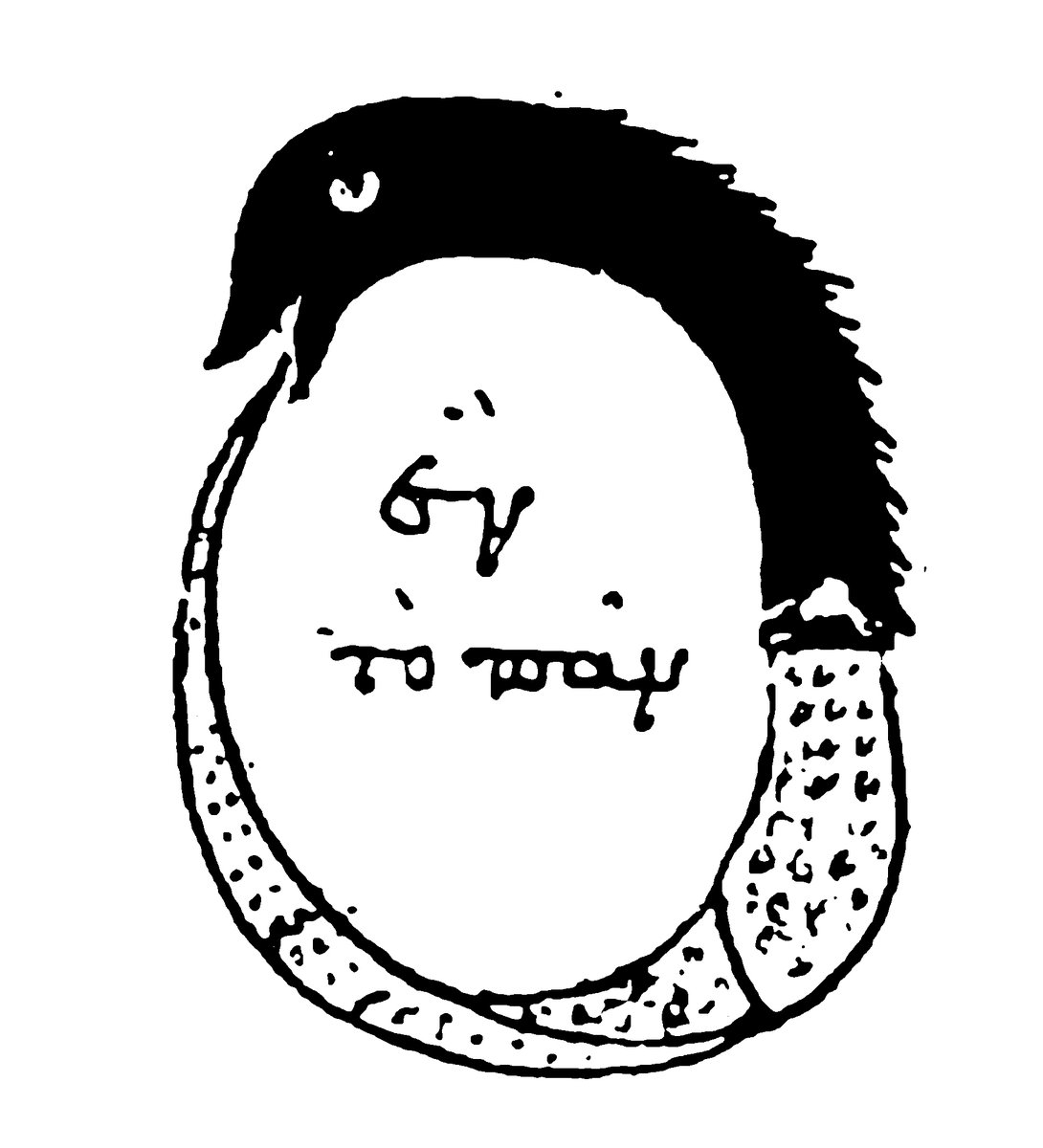
- Greek alchemy: hen to pan
- Norse Jormungandr
- Eternity and the cycle
The form
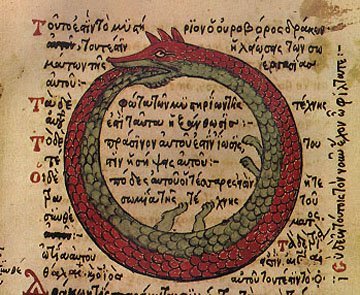
A serpent, or a dragon, curled into a circle with its own tail in its mouth. Sometimes it is drawn half light and half dark, joining the two; sometimes twisted into a figure-eight, the lemniscate of infinity. It is one of the few symbols whose meaning is legible from the shape alone: the end feeds the beginning, and the circle never closes because it never opens.
Where it comes from
It appears first in Egypt, on a gilded shrine of Tutankhamun around 1600 BCE, encircling the sun-god as a sign of the eternal cycle of time. Greek alchemy in Egypt took it up with the motto hen to pan — ‘the all is one’ — in the Chrysopoeia of Cleopatra, where it stands for the unity of all matter and the endless round of dissolution and renewal on which the whole art depends.
What it means
Across its traditions it reads as eternity, the cycle of destruction and creation, the self-sufficiency of a cosmos that feeds on itself, and the reconciliation of opposites. Norse myth gives it a vaster, darker face in Jormungandr, the world-serpent that circles the earth biting its own tail, whose letting-go marks the end of the world at Ragnarok. Hermetic writers read it as the world-soul; the chemist Kekulé credited a dream of the tail-eating snake with revealing the ring of benzene.
Where it is seen now
It is worn as a sign of eternity, tattooed as a mark of cycles and return, and used across esoteric and ‘dark’ imagery, which lends it, to outsiders, an occult or sinister air it does not carry in any of its sources.
One is the all
The oldest drawing of the serpent eating its tail that survives with a caption is in the Chrysopoeia of Kleopatra, an alchemical papyrus from Alexandria of roughly the third century, and the caption is two words: hen to pan, ‘one is the all’. That is the entire doctrine in three syllables. Its most famous modern appearance is stranger still: August Kekule said in 1890 that he had arrived at the ring structure of benzene after dozing before a fire and seeing a snake seize its own tail. Whether the dream happened as told is debated, but the structure was right, and organic chemistry has been drawing closed rings ever since.
Where the Vault stands
The ouroboros is among the most consistent symbols in the whole record: for three and a half thousand years it has meant the cycle without end, and the one that contains the many. Any menace it seems to carry is borrowed from the serpent it happens to be drawn as. The meaning it actually holds is wholeness, and the Vault reads it that way.


- Eternity
- Alchemy
- Unity of opposites