Star
The Unicursal Hexagram
The single-stroke hexagram; the Thelemic star
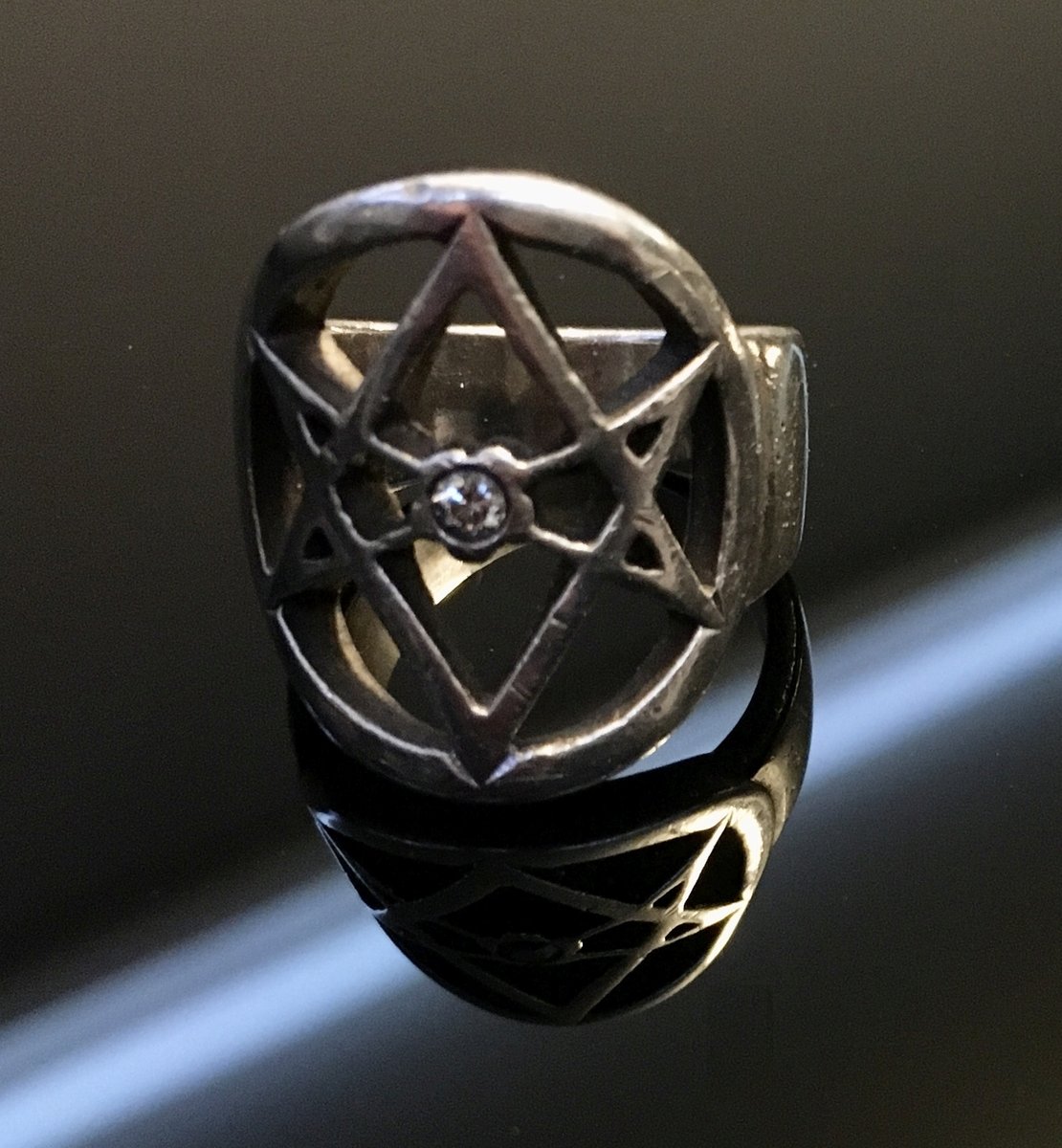
Crowley's own six-pointed star, drawn in one line and centred on a flower — a sign of union, not of Satanism.
- Designed for Thelema
- One continuous stroke
- A five-petalled centre
- Macrocosm to the pentagram's microcosm
The form
A six-pointed star that, unlike the ordinary hexagram, is drawn as a single unbroken line rather than two separate triangles — hence unicursal, one course. It is slightly elongated to make that single path possible, and Aleister Crowley set a five-petalled flower at its centre, so that six points meet five petals: eleven, the number of magick in his system.
Where it comes from
The unicursal hexagram was taken up and popularised within Thelema, the religious and magical system Crowley founded after receiving The Book of the Law in Cairo in 1904. Where the pentagram is the microcosm, the human being, the hexagram serves as the macrocosm, the cosmos and the divine — and the unicursal form let it be drawn and traced in ritual as one continuous act, without lifting the hand.
What it means in Thelema
It stands for union: of the magician and the universe, of the five and the six, of Nuit and Hadit — the infinite space and the point of light — in Crowley's cosmology. The five-petalled rose at its heart is the reconciling term, the place where the great and the small meet, and the whole is an emblem of the Great Work: the integration of the self with the whole of things.
Why it is mistaken for satanic
Because it is Crowley's, and the British press of his day branded him ‘the wickedest man in the world,’ the mark is read by outsiders as a black-magic sign. Thelema and Satanism are constantly confused precisely because both refuse mainstream Christianity, but they are distinct systems with different gods, different books and different aims.
Why one line, and why eleven
The name is the point. A common hexagram is two separate triangles; this one is drawn in a single continuous stroke without lifting the hand, which is exactly why ritual practice wants it — a figure traced as one unbroken act rather than assembled from parts. Crowley set a five-petalled rose at its centre, and the arithmetic is deliberate: five for the rose, six for the star, eleven together. Eleven is the number of magick in Thelema, named as such in his writings, so the emblem states its own subject. The rose in the star also reads as the union of the microcosm and the macrocosm, the human five folded into the cosmic six.
Where the Vault stands
The unicursal hexagram is a Thelemic sign of cosmic union, not an infernal one, and its dark reputation is guilt by association — with Crowley, and with everything the twentieth century decided to file under occult. What it actually encodes is a marriage of opposites and the pursuit of the Great Work, and the Vault reads it that way.

- Thelema
- Crowley
- Union of opposites