Moloch
- Category
- Canaanite Deity / Demon
- Origin
- The Hebrew Bible (Leviticus, Kings, Jeremiah); the Levant and Phoenician Carthage (first millennium BCE); later Jewish, Christian and occult tradition
History & Lore
Moloch is the name the Hebrew Bible gives to the recipient of a rite it condemns more fiercely than almost any other: children 'passed through the fire' in the Valley of Hinnom outside Jerusalem. Whether Moloch was a god, a title meaning 'king', or the name of the offering itself is debated to this day, and the bull-headed bronze idol with a furnace in its belly is a picture painted centuries later. From the prophets' warning he became a demon of Christian tradition, Milton's fiercest fallen angel, and in the modern world a name for any system that consumes the young to keep itself running.
Moloch is one of the few names from the ancient world that still frightens people who have never opened the book it comes from. It conjures a single, complete image — a bronze god with the head of a bull, arms stretched out over a fire, drums beating so that no one hears the children — and almost none of that image is in the text that made the name famous. The Hebrew Bible never describes him, never tells his story and never says what he looked like. It names a practice, a place and a prohibition, and condemns all three with a fury it reserves for very little else. Everything else was added later, layer upon layer, by commentators, poets, painters and film-makers who each needed Moloch for something of their own. To follow Moloch honestly is to follow two histories at once: what the sources actually attest, and what the centuries built on top of them.
A Name Without a Portrait
The biblical name rests on three Hebrew consonants, M-L-K, the root of melek, king. Ancient Hebrew was written without vowels, and the form read today — Molek, Molech — comes from the vowel points added by the Masoretic scribes centuries later. As early as 1857 the scholar Abraham Geiger proposed that the scribes deliberately voiced the word with the vowels of boshet, shame, as they did with other foreign gods, so that the name itself carried a verdict. Many scholars accept this; others think the pronunciation is simply old. Either way the name means little more than the King, and the Greek translators of the Septuagint sometimes rendered it exactly that way, as a ruler rather than a person. A king without a face, a myth or a single surviving image: Moloch enters history as an absence the prophets were determined to fill with horror.
Moloch in the Hebrew Bible
The name appears in only a handful of places, but each is unmistakable. Leviticus 18:21 forbids giving any of one's offspring to Moloch and so profaning the name of God; Leviticus 20:2–5 orders that anyone who does so — Israelite or foreigner living in Israel — be stoned by the people of the land, and warns that a community which looks away will share the guilt. First Kings 11:7 records that Solomon built a high place for Molech, the abomination of the Ammonites, on the hill east of Jerusalem; elsewhere in the same chapter the Ammonite god is called Milcom. Second Kings 16:3 and 21:6 accuse the kings Ahaz and Manasseh of making their sons pass through the fire. Second Kings 23:10 tells how King Josiah defiled Topheth in the Valley of the Son of Hinnom so that no one could make a son or daughter pass through the fire to Molech, and Jeremiah 32:35 condemns the high places of Baal built there for the same rite. Jeremiah 7:31 and 19:5 speak of children burned at Topheth — the second passage naming Baal — with the striking line in which God says he never commanded it, nor did it come into his mind. Isaiah 30:33 and 57:9 may echo the same name in the word for king. And Amos 5:26, read in its Greek translation, becomes the tabernacle of Moloch quoted by Stephen in Acts 7:43 — the only time the name appears in the New Testament.
The Valley of Hinnom and Topheth
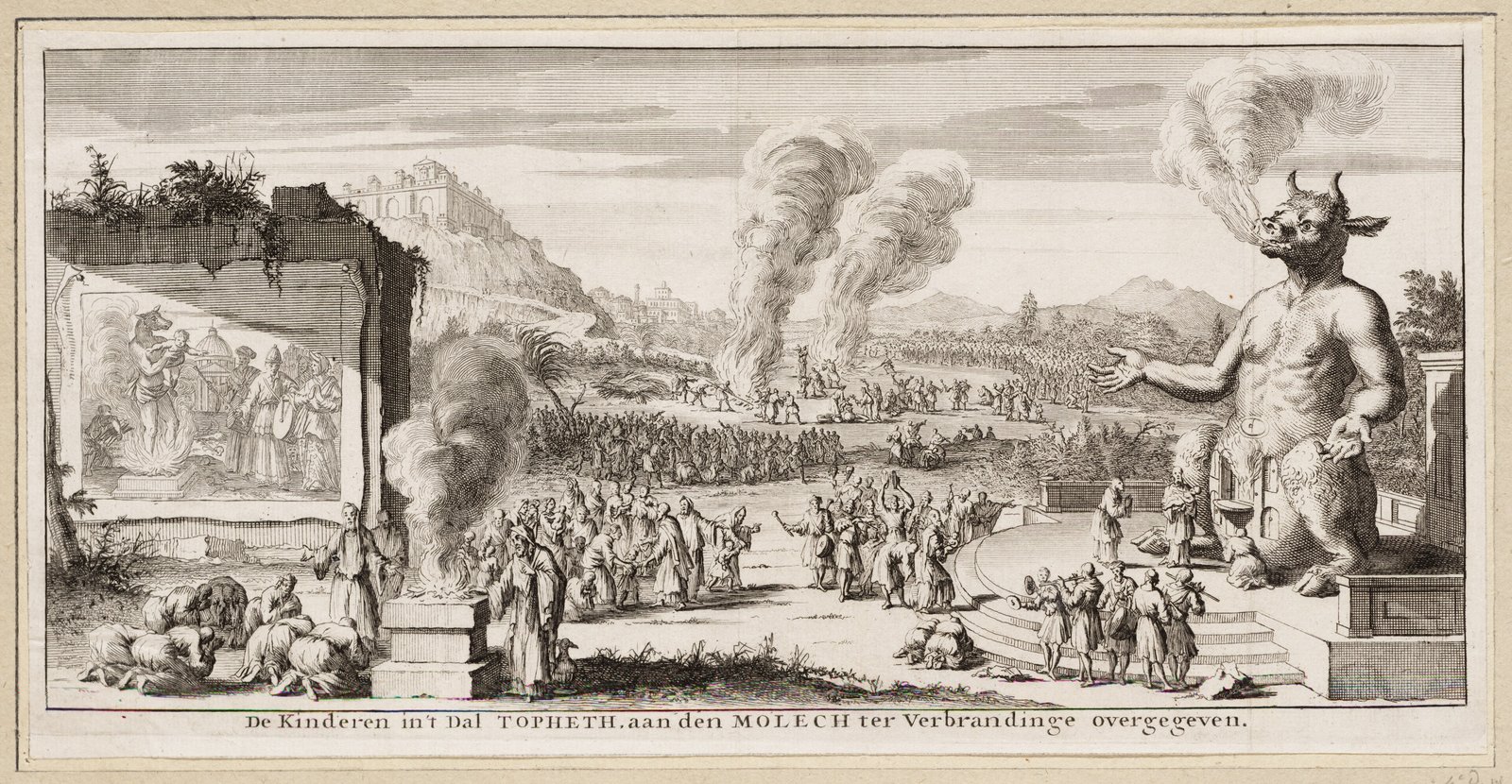
The Valley of the Son of Hinnom — Gei Ben-Hinnom — runs along the southern and western edge of old Jerusalem. In the book of Joshua it is nothing more than a boundary line between the territories of Judah and Benjamin. By the time of the kings it holds Topheth, the place the prophets associate with burning children. The meaning of the word is uncertain: it may be related to an Aramaic word for a hearth or fireplace, while the medieval commentator Rashi connected it with tof, the drum, explaining that drums were beaten so that the fathers would not hear their children cry out. Josiah's defilement of the site in the late seventh century BCE is the most concrete event in the whole story. The valley's later fate is better known than its use: as Gehenna it became, in Jewish and then Christian thought, the name of the place of punishment after death — the word Jesus uses in the Gospels for hell. The often-repeated explanation that it was a smouldering rubbish dump with eternal fires goes back to the commentator David Kimhi around 1200 CE; archaeology has not confirmed it, and many scholars doubt it.
To Pass Through the Fire
The Bible's most frequent phrase for the rite — to make a child pass through the fire — has been argued over for two thousand years. One reading takes it literally: the children were burned to death as offerings, and the prophets meant exactly what they said when they spoke of burning sons and daughters. Another, already found in rabbinic tradition, reads it as a rite of dedication in which the child was carried between or over flames and lived, dedicated to a god rather than killed by him. Because Leviticus 18 places the prohibition among laws about sexual conduct, some ancient readers even took it as sexual; the Mishnah (Megillah 4:9) records that reading and rejects it. Most modern scholars now hold that, at least at Topheth, children died, while accepting that the polemical prophetic texts cannot simply be read as neutral reports. The sources were written by the rite's opponents, and they are the only sources there are.
A God, a Title or a Rite
In 1935 the German scholar Otto Eissfeldt changed the debate. Punic inscriptions from North Africa use the word mlk — molk — not for a god but for a type of sacrifice: mlk ʾdm, an offering of a human being, and mlk ʾmr, an offering of a lamb, the latter surviving in Latin inscriptions of the Roman period as molchomor. Eissfeldt argued that the biblical lammolek, usually translated to Molech, originally meant as a molk-offering, and that the god Moloch was a misunderstanding: a name born from the name of a sacrifice. The thesis was influential for decades and is still defended. Against it, George Heider (1985) and John Day (1989) argued that Moloch really was a god — an underworld deity related to the Malik attested in Ugarit, Mari and Mesopotamia, where he was equated with Nergal, lord of the dead. Others identify him with Milcom of the Ammonites, as First Kings seems to, or treat the name as an epithet of Baal, whom Jeremiah names in the same breath. The question is not settled. The safest summary is that the word may mean a god, a title, or a rite — and that the biblical writers may have had reasons not to distinguish.
Carthage and the Tophet of Salammbô
The strongest material evidence comes not from Israel but from Carthage, the Phoenician city on the coast of modern Tunisia. From 1921 onward excavators uncovered a sacred precinct, now called the Tophet of Salammbô after the biblical word, in use from the eighth century BCE until the Roman destruction of the city in 146 BCE. It holds thousands of urns containing the cremated bones of infants and very young children, often mixed with the bones of lambs and kids, beneath stone stelae dedicated to the goddess Tanit and the god Baal Hammon. Lawrence Stager and Samuel Wolff estimated in 1984 that some twenty thousand urns were deposited between about 400 and 200 BCE alone. Similar precincts exist in Sicily, Sardinia and elsewhere in the Phoenician west. Whether these children were sacrificed or died naturally and were given special burial is one of the most contested questions in Mediterranean archaeology. A study led by Jeffrey Schwartz in 2010 argued that many of the remains were of prenatal or newborn infants consistent with natural mortality; a team including Patricia Smith and Lawrence Stager answered in 2011 that the age profile pointed to sacrifice; and in 2013 Paolo Xella, Josephine Quinn and colleagues concluded that the inscriptions, the literary sources and the archaeology together made sacrifice the most convincing explanation. The stelae record vows: a child or an animal given because the god had heard the dedicant's voice. Not one of them names Moloch.
The Greek and Roman Witnesses
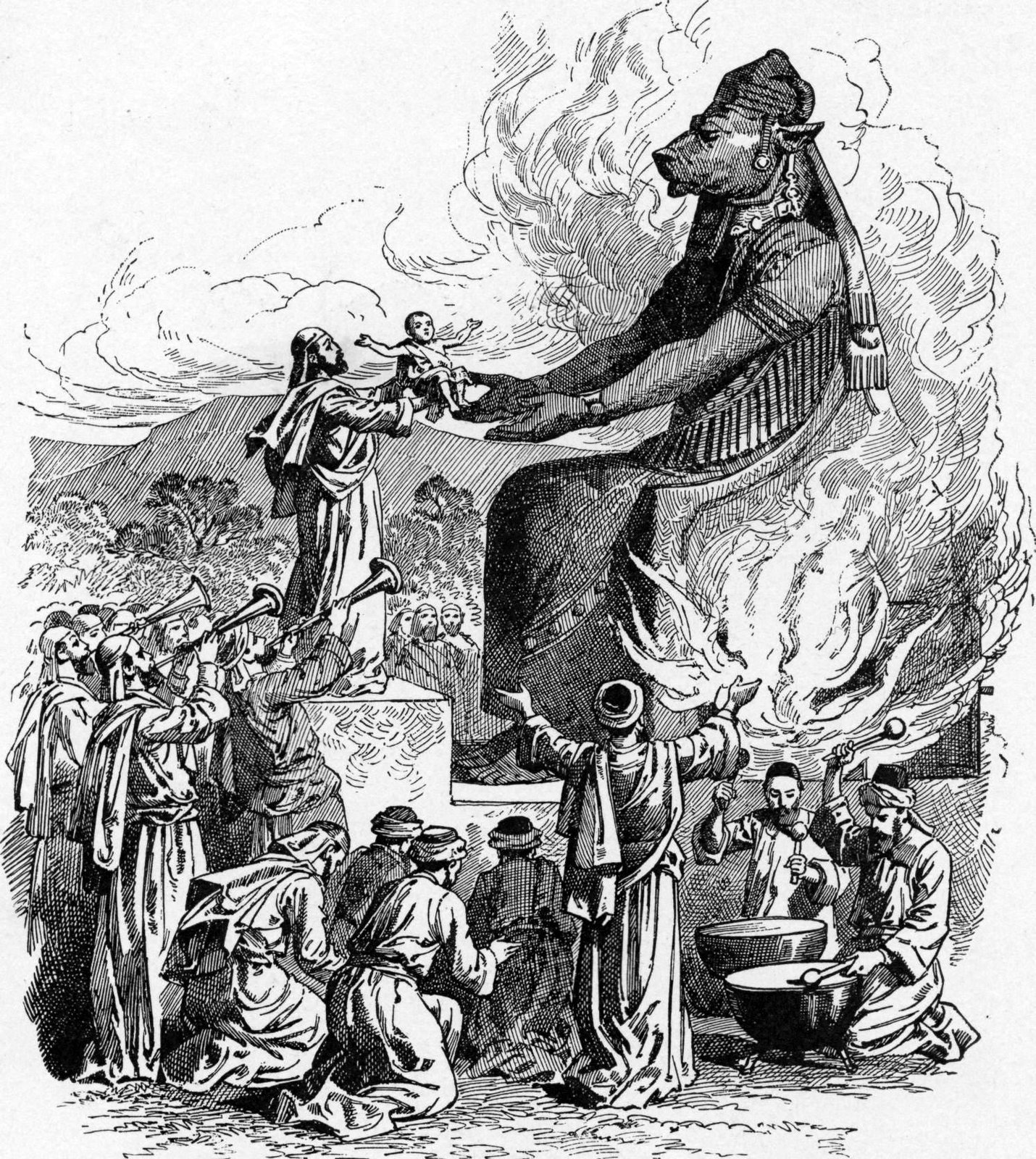
The image of a burning idol comes from Greek and Roman writers describing Carthage — all of them outsiders, and several of them its enemies. Kleitarchos, writing in the fourth century BCE and quoted in a later commentary on Plato, describes a bronze statue of Kronos with outstretched hands over a brazier, into which children were placed; as the flames contracted their limbs, their mouths seemed to grin, the origin he gives for the phrase sardonic laughter. Diodorus Siculus (Library of History 20.14) reports that in 310 BCE, besieged by Agathocles of Syracuse, the Carthaginians sacrificed two hundred children of noble families to Kronos, whose bronze statue held out its hands so that the children rolled into a pit of fire. Plutarch (On Superstition 13) adds the flutes and drums that drowned out the cries, and a mother forbidden to weep. Tertullian, himself from Roman Africa, wrote around 197 CE that children had been sacrificed to Saturn openly until a proconsul hanged the priests. Kronos and Saturn are the Greek and Roman names for Baal Hammon. None of these writers speaks of Moloch; the connection between their Carthaginian Kronos and the biblical name was made by later readers.
The Bronze Bull
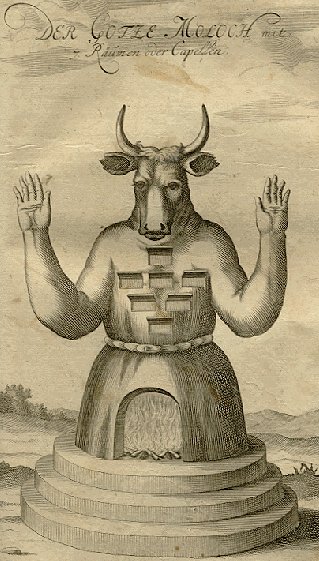
The figure the world now pictures — a bull-headed giant, hollow, heated from below, arms outstretched, sometimes with seven compartments in its body — was assembled in the Middle Ages. Rashi, in eleventh-century France, described Moloch as an image of brass heated from beneath, with priests beating drums. The medieval anthology Yalkut Shimoni gives it the face of a calf, outstretched hands and seven chambers: one for flour, one for turtledoves, then a ewe, a ram, a calf, an ox, and in the seventh a child. To this were added the Greek accounts of the Carthaginian Kronos, the bronze bull in which the Sicilian tyrant Phalaris was said to roast his enemies, and perhaps the Minotaur of Crete. The result is vivid, coherent and largely late. Bull imagery belonged to many Levantine storm and sky gods, Baal among them, but no bull-headed statue of Moloch has ever been found.
From God to Demon
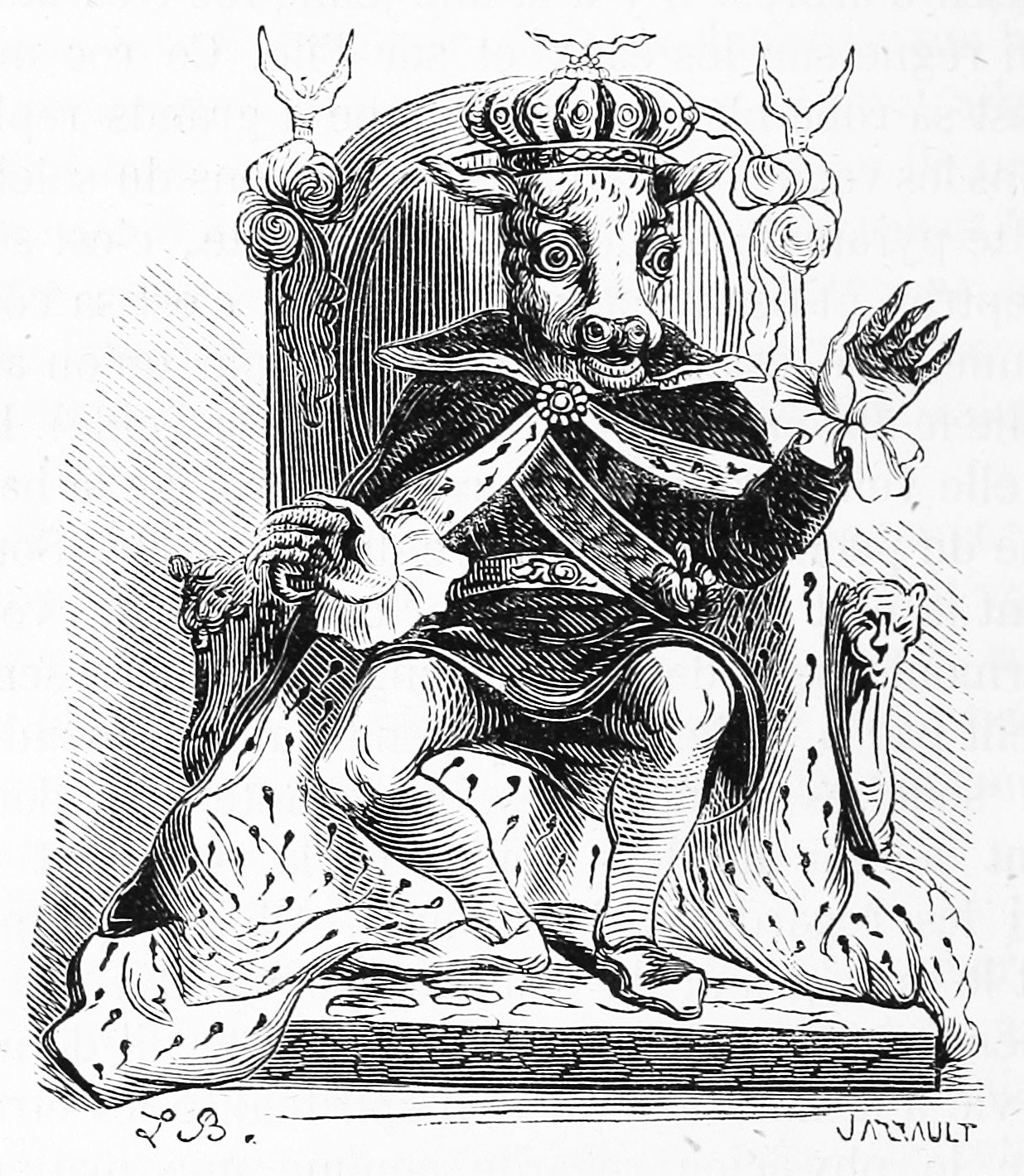
In later Jewish writing and in Christian thought the gods of the neighbouring nations became fallen spirits, and Moloch, already the name of the worst rite the prophets knew, was an obvious candidate. In 1667 John Milton gave him his most lasting form. In the first book of Paradise Lost he is the first of the fallen to be named, a horrid King besmeared with blood of human sacrifice and parents' tears, worshipped with drums and timbrels in the valley of Hinnom; in the second book, at the council in Pandemonium, he is the one who demands open war on heaven at any cost, preferring annihilation to submission. Jacques Collin de Plancy's Dictionnaire Infernal calls him a prince of the land of tears and a member of the infernal council. In Aleister Crowley's tables of correspondence (777) he appears with Satan among the powers of Thaumiel, the inverted crown of the Qliphoth. He belongs to no catalogue of the Ars Goetia and to none of the classical grimoires of conjuration; his demonic career is literary and theological rather than ritual.
Moloch, Kronos and Saturn
A thread running from antiquity to modern esotericism ties Moloch to Saturn. The Greeks called the Carthaginian Baal Hammon Kronos, the Titan who devoured his own children, and the Romans called him Saturn; in Roman Africa he was worshipped as Saturn into the third century CE. Amos 5:26 names a star-god Kaiwan, the Akkadian name of the planet Saturn, and the Greek text that Stephen quotes in Acts 7:43 sets the tabernacle of Moloch beside the star of the god Rephan. On this basis many modern esoteric authors read Moloch as a solar-Saturnian power: Saturn as the night sun or black sun of the ancients and of alchemy, the dark counterpart of the visible sun, lord of time, harvest, death and transformation, associated with lead, the base metal awaiting transmutation, and with festivals such as the Saturnalia at the winter solstice. Some of these authors go further and describe a continuous, partly hidden Saturnian cult of sacrifice, intoxication and initiation reaching from the Magi of Mesopotamia into the present. The ancient sources attest the Kronos–Saturn identification of Baal Hammon and the Saturn star-name in Amos; they do not name Moloch as Saturn, and the black-sun reading belongs to later alchemy and modern esotericism.
The Image in Art and Modernity
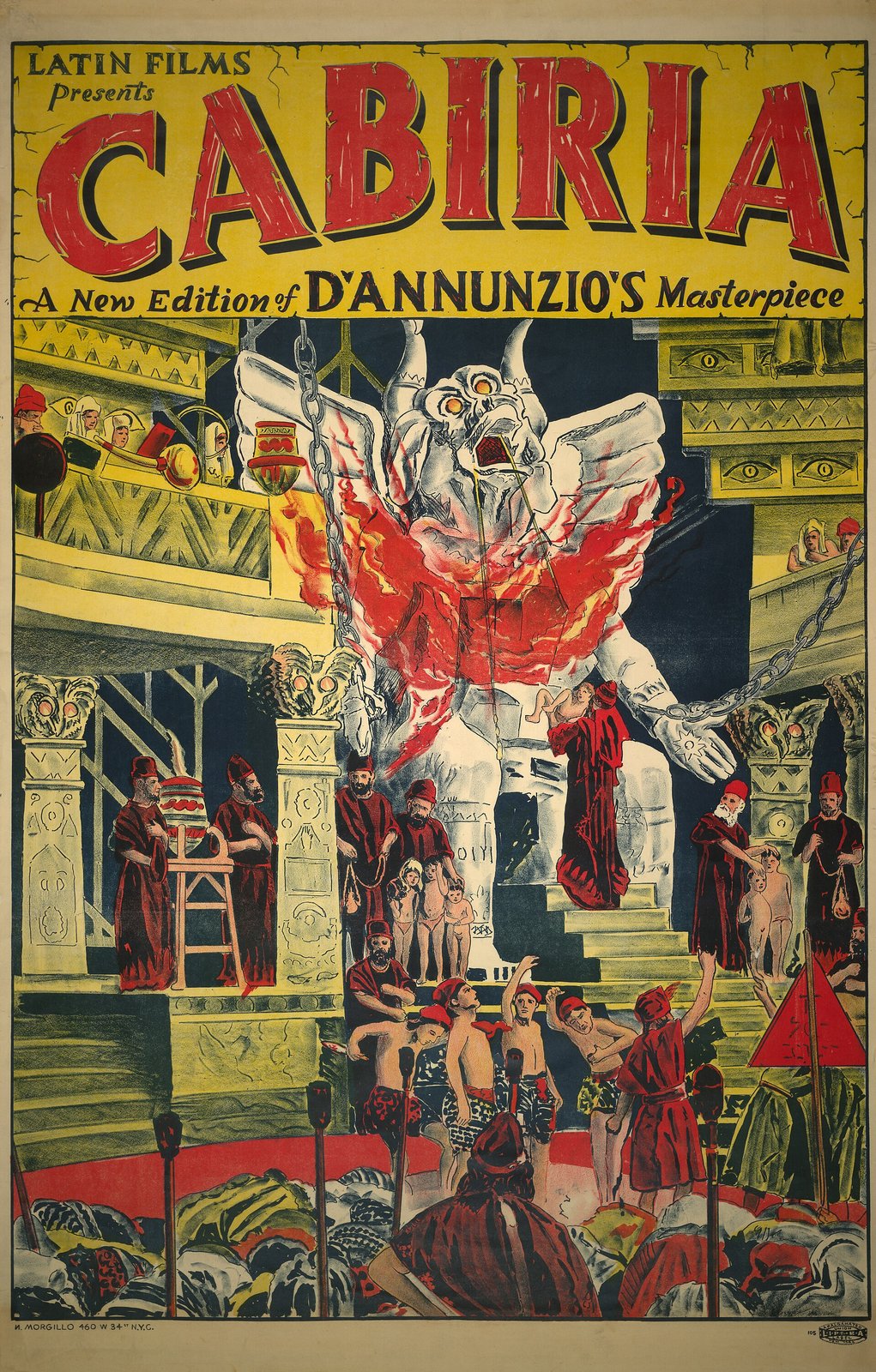
From the nineteenth century the name became an image again, and then a metaphor. Gustave Flaubert's novel Salammbô (1862), set in Carthage, gave the sacrifice to Moloch its most lurid modern scene: a towering bronze god, a furnace, priests, drums and a crowd. The Italian film Cabiria (1914) built the temple of Moloch on screen, and in Fritz Lang's Metropolis (1927) a worker's vision turns a factory machine into the open jaws of Moloch, swallowing lines of exhausted labourers. In 1955 Allen Ginsberg read the first part of Howl in San Francisco; its second part names Moloch as the god of an industrial, military and conformist America — Moloch whose mind is pure machinery, Moloch whose blood is running money — after Ginsberg had seen, in a visionary state, the facade of a San Francisco hotel as the face of the idol. In 2014 a large reconstruction of the Moloch from Cabiria stood at the entrance of an exhibition on Carthage at the Colosseum in Rome, a display that drew wide attention and many readings of its own.
Where the Vault Leaves It
What can be said with confidence is narrow and still terrible. The Hebrew Bible condemns a rite in which children were passed through fire at Topheth and calls its recipient Molek; at Carthage and across the Phoenician west, thousands of children were cremated and buried with vows to Baal Hammon and Tanit, and most specialists now think many of them were sacrificed. Everything beyond that — whether Moloch was a god at all, whether the biblical and Punic rites were one practice, what the idol looked like, how many children died, and what the name has meant since — is argued, inherited or imagined, and the Vault records each reading as it is held, without deciding between them.
Appearance
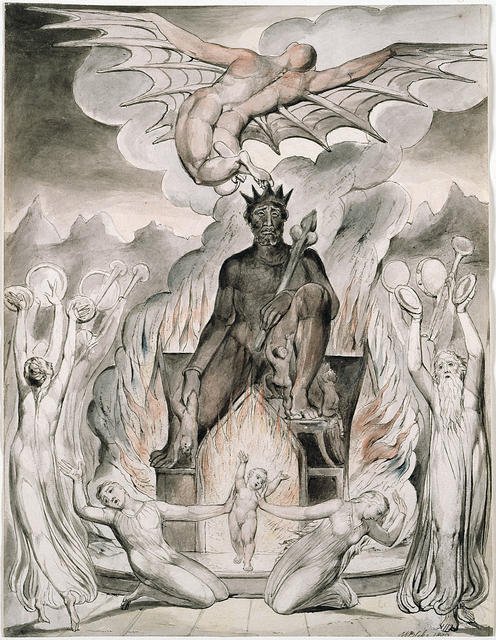
In the Bible none: the text never describes him. In the medieval and modern image, a hollow bronze figure with the head of a bull or calf, a human body, arms outstretched palms up over a fire burning within or beneath it, sometimes with seven chambers in the body
Powers
- Receiving the firstborn and the vow
- Dominion through fear and sacrifice
- Fire that consumes rather than purifies
- Kingship over the land of tears
- Binding a community through shared complicity
Also Known As
Molech, Molek, Molekh, Moloch of the Ammonites, Prince of the Land of Tears
Attributes
- Sacrifice
- Fire
- Kingship
- The vow
- Dread
Symbolic Correspondences
- Elements: Fire
- Colours: Bronze, the red of the furnace, black
- Numbers: Seven — the chambers of the medieval image
- Associations: The Valley of Hinnom and Topheth, Gehenna, the molk-offering, Carthage, Baal Hammon and Tanit, Kronos and Saturn, drums, the bull, the crown (melek), Milton's Pandemonium
The Figure, Symbol by Symbol
- The Name: Melek, King: The three consonants M-L-K say only king. Whether a god, a title or the name of an offering, Moloch is first of all an office — the one who rules and to whom something is owed. If the Masoretes voiced it with the vowels of shame, the name itself became the prophets' verdict.
- The Bull's Head: Absent from the Bible and added in medieval commentary, the calf or bull belongs to the old storm and sky gods of the Levant, Baal among them. In the image it stands for raw, unreasoning power: strength without conscience, appetite without speech.
- The Outstretched Arms: In the Greek accounts of the Carthaginian Kronos the hands are held out, palms up and sloping, so that what is laid on them rolls into the fire. The gesture of a throne or an embrace becomes the mechanism of the offering — the most quoted and most chilling detail of the whole image.
- The Fire Within: Fire in most traditions purifies and transforms. Here it is the medium of the vow: what is given is not returned changed but taken entirely. Topheth may itself mean fireplace, and Gehenna inherited its flames.
- The Drums: Rashi derived Topheth from tof, drum, and Plutarch speaks of flutes and drums drowning the cries. Read symbolically, the drums are the noise a community makes so that it does not have to hear what it is doing.
- The Seven Chambers: In the Yalkut Shimoni the idol holds seven compartments for flour, birds, sheep, ram, calf, ox and finally a child — a ladder of offerings with the human at the top. It is the medieval imagination ranking sacrifice by price.
- The Valley: A real place outside Jerusalem that became, through its name Gehenna, the word for hell itself. Few names show so clearly how a rite remembered with horror can turn a piece of ground into a theology.
Reading the Whole
Read as a whole, the image of Moloch is not a portrait but a composite built over two thousand years, and each layer says something about the age that added it. The prophets supplied a place, a rite and a curse; the Greek historians a bronze statue with outstretched hands; the medieval commentators a bull's head, a furnace and seven chambers; Milton a voice that would rather burn than yield; Flaubert and the cinema a spectacle; Ginsberg and the modern essayists a machine. Beneath all of them lies the same structure — something precious given into a fire in exchange for rain, victory or survival, with a community gathered to watch and drums to cover the sound.
That is why the figure has outlived every attempt to pin down its history. Whatever Moloch was in the eighth century BCE, the image now carries a single idea with great force: an exchange in which the price is the future itself. Each age has found its own fire to place it in, and the readings recorded here are the record of that search.
Theological Significance
In the Hebrew Bible Moloch is less a god with a theology of his own than a counter-image: the clearest example of everything the covenant was meant to exclude. The laws of Leviticus set his rite beside the gravest offences and assign it the most public punishment; the prophets use it to measure how far Judah had fallen; and the sentence in Jeremiah in which God says the practice never entered his mind draws the sharpest possible line between the God of Israel and the gods of fire. Wherever Moloch appears in the text, he marks a border.
The Binding of Isaac
Many readers, ancient and modern, see the same border in the story of Abraham and Isaac in Genesis 22, where a father is commanded to offer his son, raises the knife and is stopped, and a ram is offered instead. Some scholars read the story as a memory of a time when child sacrifice belonged to the religious world of the region and as a founding argument for ending it; others insist that it is about obedience and faith alone. The story never names Moloch, but in later interpretation the two are often read together as the rite and its refusal.
The Theology of the Vow
The Punic inscriptions show the rite from the other side. They speak not of a hungry idol but of a vow kept: a gift promised in a crisis and paid when the god heard the dedicant's voice. Read this way, the sacrifice was an exchange inside a relationship — the costliest thing a person could give, offered for the survival of a household or a city. Moloch's long afterlife as a symbol has kept that logic of exchange alive more than any doctrine about the god himself.
Practical Application
Moloch has no established place in the working practice of modern demonolatry or of the left-hand path. No grimoire gives his seal or enn, no tradition preserves a rite of invocation, and the only ritual ever attached to his name is the one the ancient sources condemn. Within the Vault the figure is therefore approached as a subject of study and contemplation, not as a spirit to be called; any working that offers a living being to any entity lies outside everything the Vault keeps.
As a contemplative figure Moloch is used as a mirror for the logic of sacrifice: a question about what a person, a household or a society is prepared to give up in exchange for security, success or belonging, who decides the price, and who pays it. Writers from Ginsberg to the modern essayists have used the name in exactly this way, and the reflection can be carried out in a journal, in meditation or in conversation without any ritual at all.
Modern Interpretations
Few ancient names have been put to so many modern uses. Moloch has become a literary symbol, a term of political criticism, a concept in game theory and a central figure in modern theories about hidden power, and the readings below are recorded as their proponents hold them.
The Machine That Consumes
Since the industrial age the name has been used for systems that consume human lives to keep themselves running: factories in nineteenth-century social criticism, the war machine of the First World War, the city machine of Metropolis, and above all Ginsberg's Howl, in which Moloch is the money, the prisons, the armies and the conformity of post-war America. On this reading Moloch needs no altar; he is the logic of any order that treats people as fuel, and the sacrifices are labour, health, attention and the futures of the young.
The Coordination Trap
In 2014 the psychiatrist and essayist Scott Alexander published Meditations on Moloch, which read Ginsberg's god as a name for a precise problem: situations in which every participant acts sensibly for themselves and all of them together produce an outcome nobody wants. Arms races, the tragedy of the commons described by Garrett Hardin in 1968, races to the bottom between companies or states, social media platforms competing for attention at the expense of their users, nations that cannot stop emitting because their rivals will not, and the fear that competition will push the development of artificial intelligence past the point of safety are all, in this reading, faces of Moloch. Elinor Ostrom, who received the Nobel Prize in Economics in 2009, is often cited in the same discussion for showing how small communities can sometimes escape such traps. The essay made Moloch a common term in technology and rationalist circles.
Moloch and the Powerful
A widespread body of writing holds that elites still pay homage to Moloch, whether as a god, a symbol or a working principle of power. Its most frequently cited example is the Cremation of Care, a theatrical ceremony held each summer since the late nineteenth century at the Bohemian Grove in California, a private retreat whose members have included presidents and business leaders. In it an effigy representing care is burned before a large owl figure, and the broadcaster Alex Jones filmed the ceremony in 2000. Proponents read the owl, the fire and the effigy as a Moloch rite or as a ritual of shedding conscience before exercising power; the club describes the ceremony as a dramatic tradition symbolising the setting aside of everyday worries. Other examples cited in the same literature include the Moloch reconstruction at the Colosseum in 2014 and bull imagery in financial districts.
Saturn and the Black Sun
Another current, found in modern esoteric writing, identifies Moloch with Saturn as the black or night sun: a dark aspect of the solar god linked to Kronos devouring his children, to the alchemical transformation of lead into gold, to the Saturnalia and to cults of sacrifice and initiation said to have continued in secret from antiquity. Its authors draw on the ancient identification of Baal Hammon with Kronos and Saturn and on the Saturn star-name in Amos, and extend them into a hidden history of their own.
Across these readings one thread holds: Moloch is understood less as a figure to be worshipped than as a name for a bargain in which something precious is given up to keep a larger order alive — and each reading places that bargain in a different part of the world.
Sources & Historical Texts
- Hebrew Bible — Leviticus 18:21; 20:2–5
- Hebrew Bible — 1 Kings 11:5–7, 33; 2 Kings 16:3; 21:6; 23:10
- Hebrew Bible — Jeremiah 7:31; 19:5; 32:35; Isaiah 30:33; 57:9; Amos 5:26
- New Testament — Acts 7:43
- Mishnah Megillah 4:9
- Kleitarchos (4th c. BCE), quoted in a scholion on Plato's Republic
- Diodorus Siculus — Library of History 20.14
- Plutarch — On Superstition 13
- Tertullian — Apology 9
- Rashi — commentary on Jeremiah 7:31; Yalkut Shimoni
- Punic molk inscriptions from Carthage and North Africa
- John Milton — Paradise Lost, Books I–II (1667)
- Jacques Collin de Plancy — Dictionnaire Infernal
- Aleister Crowley — 777
- Otto Eissfeldt — Molk als Opferbegriff im Punischen und Hebräischen und das Ende des Gottes Moloch (1935)
- George C. Heider — The Cult of Molek: A Reassessment (1985)
- John Day — Molech: A God of Human Sacrifice in the Old Testament (1989)
- Lawrence E. Stager and Samuel R. Wolff — Child Sacrifice at Carthage (1984)
- Gustave Flaubert — Salammbô (1862)
- Allen Ginsberg — Howl (1955)
- Scott Alexander — Meditations on Moloch (2014)