The Nephilim

- Category
- Biblical Giants / Hybrid Beings
- Origin
- The Hebrew Bible (Genesis 6:1–4; Numbers 13:33); the Book of the Watchers in 1 Enoch (3rd century BCE), the Book of Jubilees and the Aramaic Book of Giants from Qumran; later Jewish, Christian and Manichaean tradition
History & Lore
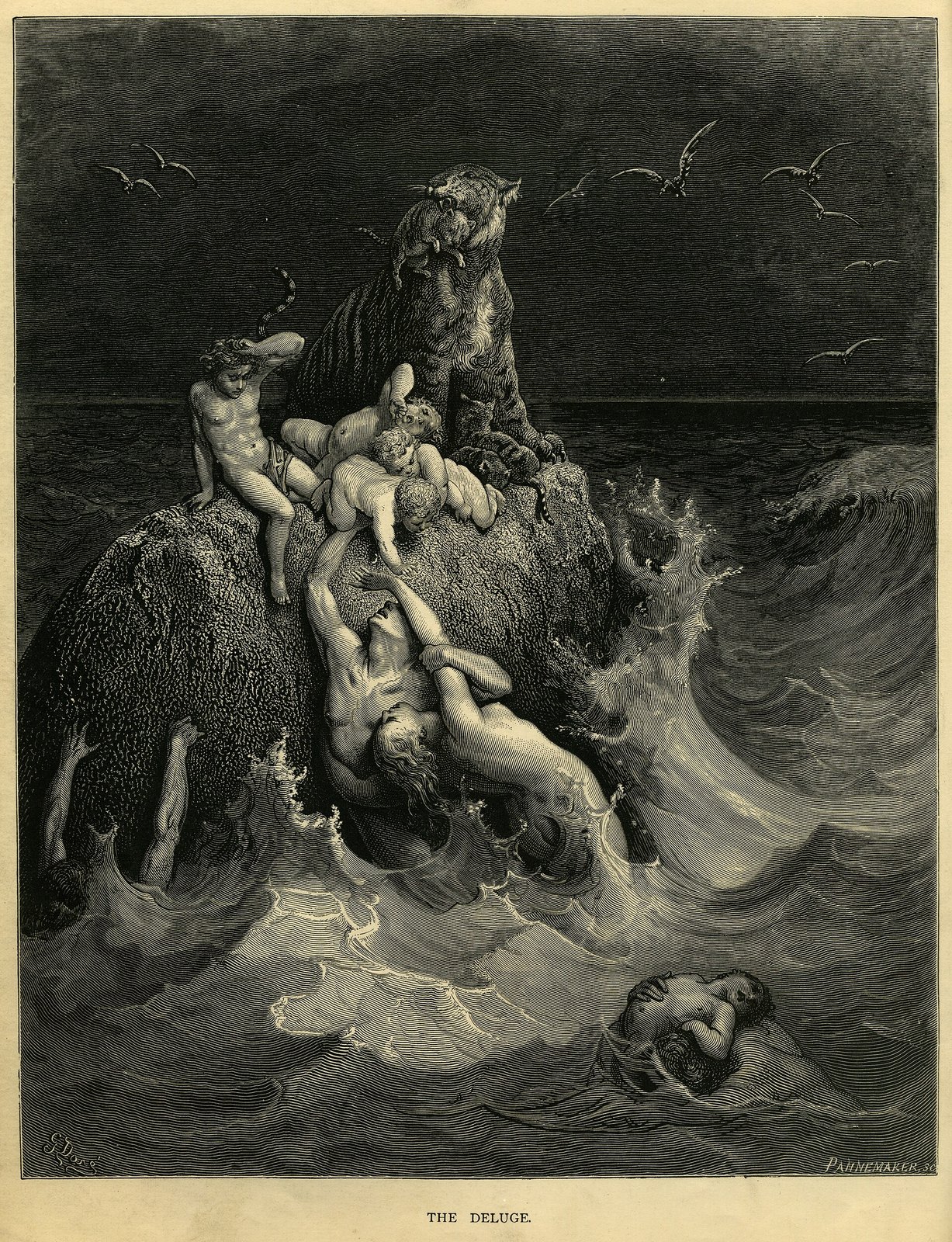
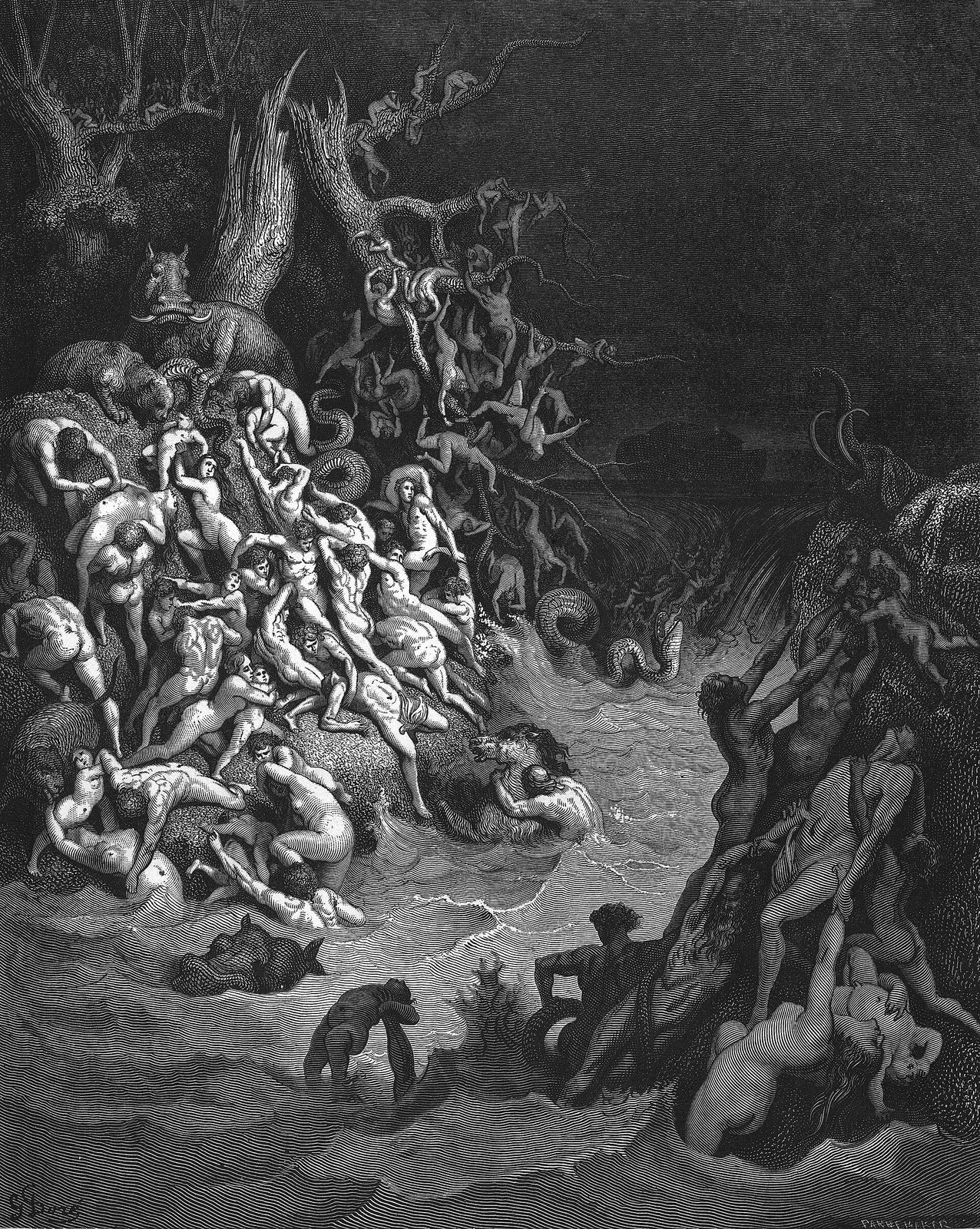
The Nephilim are named only twice in the Hebrew Bible: in Genesis 6:4, where they appear on the earth when the 'sons of God' take the 'daughters of men', and in Numbers 13:33, where Israelite spies claim to have seen them in Canaan and felt like grasshoppers beside them. The Greek Bible made them giants, and the Book of the Watchers in 1 Enoch made them the monstrous children of fallen angels, destroyed before the flood. Their bodies died, but according to 1 Enoch 15–16 their spirits did not: they became the evil spirits that roam the earth, one of the oldest accounts anywhere of where demons come from.
The Nephilim occupy four verses of Genesis and a single line of Numbers, and yet they have cast one of the longest shadows in the history of religion. They appear without introduction, are named in passing and vanish beneath the waters of the flood — only to resurface among the giants that Israel's spies saw in Canaan, beside the iron bed of King Og, in the visions of the Book of Enoch, and in the claim, made by Jewish and Christian writers alike, that the spirits of these giants still walk the earth as demons. Their fathers, the angels called Watchers, have an entry of their own in the Vault; this entry follows the children. It is a history of very little text and a great deal of interpretation, and the two are worth keeping apart.
The Word and Its Meanings
Nephilim is a Hebrew plural, and almost everything about it is uncertain. Most readers connect it with the verb naphal, to fall, which allows several meanings: the fallen ones, those who fell from heaven, those who fall upon others in battle, or those who make others fall. Others derive it from the Aramaic naphil, giant, the name Aramaic also gave to the constellation Orion, whose bands Job 38:31 says no human can loosen. The translators of the Septuagint chose gigantes, giants, and with one word joined the Nephilim to the Gigantes of Greek myth, the sons of Earth who fought the gods. Later Greek versions tried to be more literal: Symmachus rendered the word as the violent ones, and Aquila's choice has been read either as the fallen or as those who fall upon. Luther's Bible, still in its 1912 revision, has Tyrannen, tyrants. Giant, fallen one, attacker, tyrant: the translations already contain the later debates.
The Four Verses of Genesis
Genesis 6:1–4 stands between the genealogy of Adam's line and the story of the flood. When humans began to multiply and daughters were born to them, the sons of God — bene ha-elohim — saw that the daughters of men were beautiful and took wives from among all they chose. God then declares that his spirit will not abide in man for ever and that his days shall be a hundred and twenty years. Only then come the Nephilim: they were on the earth in those days, and also afterward, when the sons of God came in to the daughters of men and they bore children to them — the mighty men which were of old, men of renown, in the words of the King James Version. The Hebrew does not say plainly that the Nephilim were the children of these unions; it may only mean that they lived at the same time. Many scholars regard the passage as the fragment of an older myth of heroes born of gods and women, compressed almost to silence. What it leaves out — who the sons of God were, what the Nephilim did, why the episode precedes the flood — is exactly what later readers set out to supply.
Who Were the Sons of God
Three readings have competed for two thousand years. The oldest known takes the sons of God as angels or divine beings, as the same phrase means in Job 1:6 and 38:7; it is shared by 1 Enoch, Jubilees, Philo and Josephus, by the Codex Alexandrinus of the Septuagint, which reads angels of God, and by most Christian writers of the first centuries. A second made them human nobles: the Targum Onkelos speaks of the sons of the great ones, and Genesis Rabbah 26:5 records that Rabbi Shimon bar Yochai cursed anyone who called them sons of God in the divine sense. A third, the Sethite reading, holds that the pious descendants of Seth married the daughters of Cain's line. It is first attested in the Chronographiae of Julius Africanus in the early third century, was taken up by Ephrem the Syrian and John Chrysostom, and became standard in the West through Augustine's City of God (XV 23), which held that angels, being spirits, could not beget children of flesh. In 1962 Meredith Kline proposed a royal variant in which the sons of God were early kings claiming divine descent and taking harems. Modern critical scholarship has largely returned to the first reading as the plain sense of the text, whatever one makes of it.
Grasshoppers in Their Own Sight
The Nephilim are named once more. In Numbers 13 twelve spies are sent from the wilderness of Paran to explore Canaan. Ten bring back what the text calls an evil report: the land devours its inhabitants, all the people in it are of great stature, and there we saw the Nephilim, the sons of Anak, who come from the Nephilim — and we were in our own sight as grasshoppers, and so we were in their sight (13:32–33). The clause linking the Anakim to the Nephilim is widely regarded as an explanatory addition. The report is told as a failure of trust — Joshua and Caleb dissent, and the generation that believed it dies in the wilderness — so the only witnesses to Nephilim after the flood are men the narrative itself calls unreliable. Deuteronomy fills out the picture: Anakim, Emim and Zamzummim are all reckoned among the Rephaim, tall peoples dispossessed by Israel or its neighbours (Deuteronomy 2:10–11, 20–21), and Joshua 11:21–22 records that Anakim survived only in Gaza, Gath and Ashdod.
Og, Goliath and the Remnant of the Rephaim
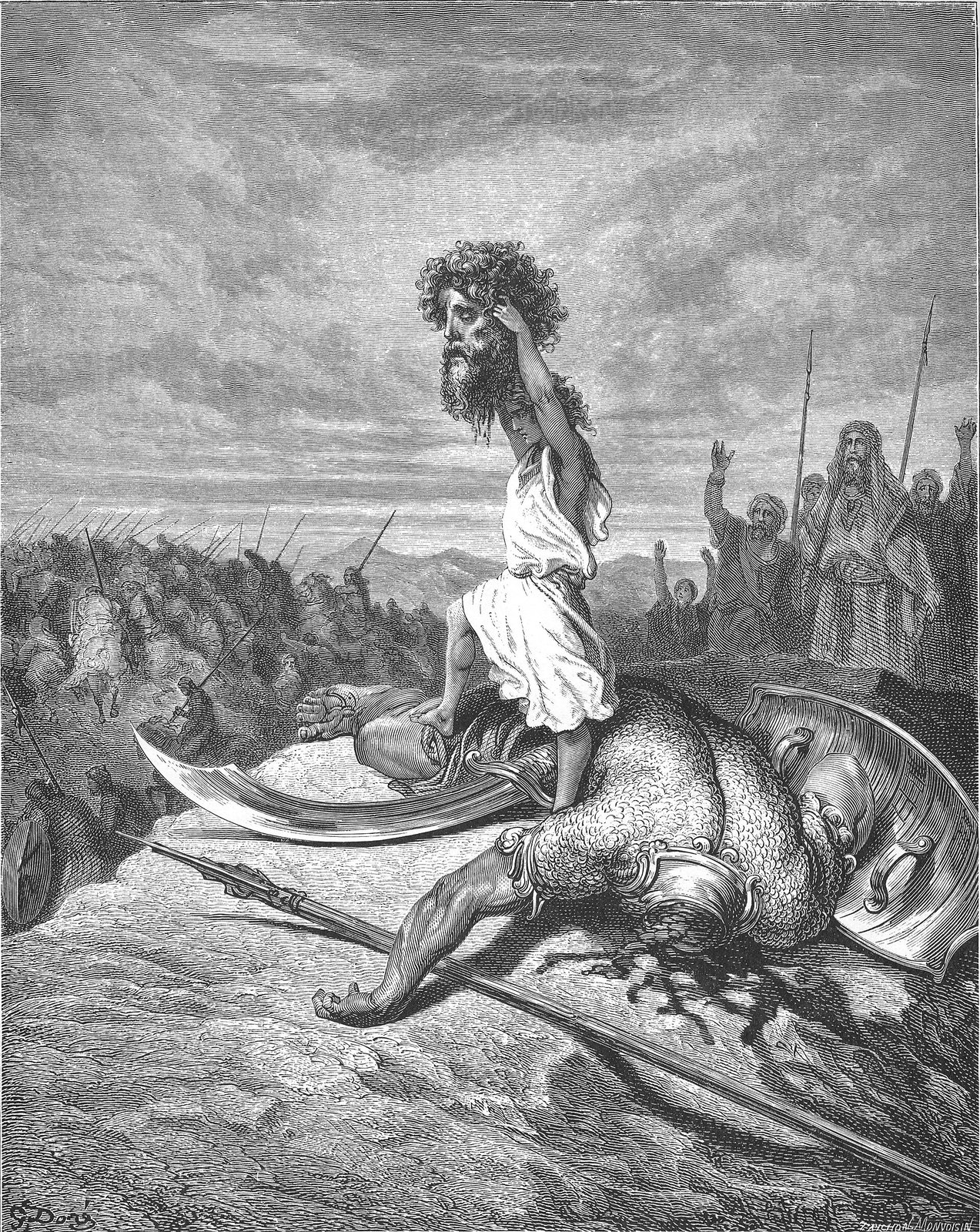
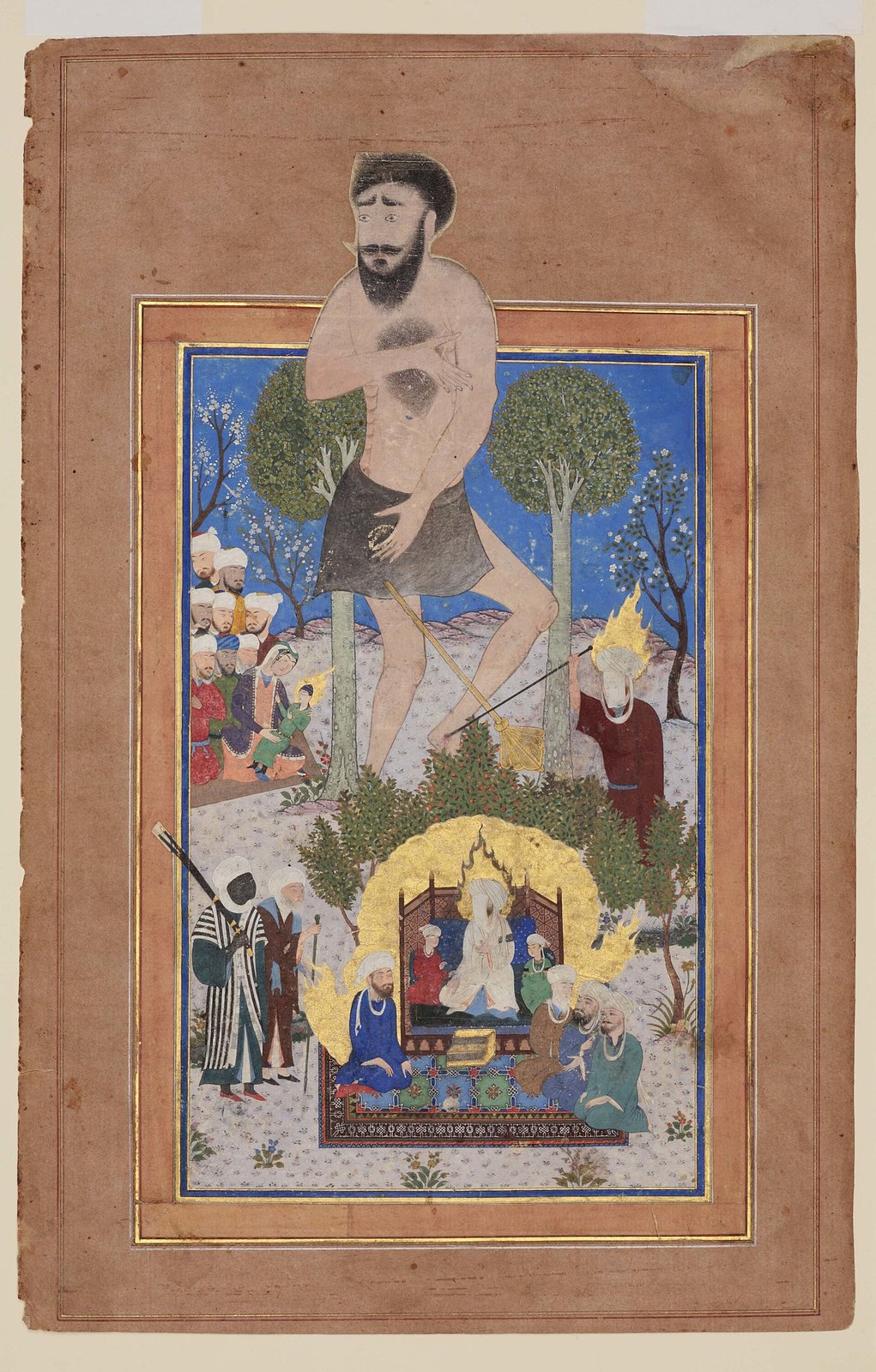
The last named giants of the Bible stand in this line. Deuteronomy 3:11 says that Og, king of Bashan, alone remained of the remnant of the Rephaim, and points to his bedstead of iron — nine cubits long and four wide, by the cubit of a man — still to be seen in Rabbah of the Ammonites. Goliath of Gath, one of the towns where the Anakim lingered, stands six cubits and a span tall in the Masoretic text of 1 Samuel 17:4, but four cubits and a span, about two metres, in the Septuagint and in the Qumran manuscript 4QSamuel-a. Second Samuel 21:15–22 lists further warriors of Gath descended from ha-rapha, among them a man with six fingers on each hand and six toes on each foot. The word Rephaim has a second meaning: in Isaiah 14:9 and 26:14 and in Psalm 88:11 it names the shades of the dead, and the related rpum of Ugarit were deified ancestors. Rabbinic tradition went further with Og. The Babylonian Talmud makes him and Sihon sons of Ahijah, son of Shemhazai, one of the fallen angels (Niddah 61a), and has him survive the flood beside the ark (Zevachim 113b); Pirqe de-Rabbi Eliezer seats him on a beam under the ark's gutter, fed by Noah in return for a promise of service.
The Children of the Watchers
The Book of the Watchers, chapters 1–36 of 1 Enoch and probably composed in Aramaic in the third century BCE, turns the four verses of Genesis into a full narrative. How two hundred Watchers under Shemihazah descended on Mount Hermon, swore their oath and taught forbidden arts is told in the Vault's entry on the Watchers; here the concern is what they fathered. The women conceived and bore great giants, whose height the Ethiopic text gives as three thousand ells (1 Enoch 7:2). They consumed everything people produced, and when people could no longer sustain them, they turned against humanity and devoured it, and began to sin against birds, beasts, reptiles and fish, eating one another's flesh and drinking blood (7:3–5). A Greek version preserved by the Byzantine chronicler George Syncellus speaks of three generations: the great giants begot the Nephilim, and the Nephilim begot the Elioud. The earth itself accuses them (7:6), the archangels carry the complaint before God (chapter 9), and the sentence follows: Gabriel is sent against the bastards and the children of fornication, to set them against one another so that they destroy each other in battle (10:9). The later Animal Apocalypse (1 Enoch 85–90) retells the story as fallen stars that mate with cows and beget elephants, camels and asses.
From Giants to Evil Spirits
The decisive turn comes in chapters 15 and 16, in God's answer to the Watchers through Enoch. Because the giants were born of spirit and flesh, they cannot simply die as humans do. Now the giants, who are produced from the spirits and flesh, shall be called evil spirits upon the earth, and on the earth shall be their dwelling, as R. H. Charles translated 1 Enoch 15:8. Evil spirits have gone out from their bodies; they afflict, oppress, destroy, attack and do battle, bring trouble on the earth, take no food and yet hunger and thirst, and rise up against men and women because they have proceeded from them (15:9–12). From the day of the giants' slaughter, the spirits that went out of their bodies may destroy without incurring judgment until the day of the great consummation (16:1). This short passage is one of the oldest explicit theories in Jewish literature of where demons come from: not the fallen angels themselves, who lie bound until the judgment, but the disembodied ghosts of their half-human children, condemned to roam the world they once devoured.
Jubilees and the Tenth Part
The Book of Jubilees, a retelling of Genesis and Exodus from the second century BCE, shares this view and adds a sequel. In Jubilees 4 and 5 the angels who came down to teach humanity justice take wives, their sons are given a sword to kill one another, and the fathers are bound in the depths of the earth. In chapter 7 Noah reminds his sons that the Watchers' children, here called Naphidim, killed each other in a chain of violence: the giants killed the Naphil, the Naphil killed the Eljo, and the Eljo killed mankind. After the flood unclean demons begin to mislead and kill Noah's grandsons, and Noah prays that they be imprisoned (10:1–6). God orders them all bound, but Mastema, the chief of the spirits, pleads that some be left to him, since without them he cannot exercise the authority of his will over the sons of men. A compromise is granted: a tenth part remains under Mastema, and nine parts go down to the place of condemnation (10:7–9). The angels then teach Noah the healing of the diseases these spirits cause, and Noah writes it in a book and gives it to Shem (10:10–14).
The Book of Giants
Among the Aramaic manuscripts found at Qumran are fragments of a separate work, the Book of Giants, identified by J. T. Milik and published in 1976, with a full edition by Loren Stuckenbruck in 1997. Its main witnesses are 4Q530, 4Q531 and 4Q532. Here the giants have names and inner lives. Ohyah and Hahyah, sons of Shemihazah, are troubled by dreams: in one a garden of trees is ruined by water and fire, in another the Ruler of Heaven descends, thrones are set and books are opened. The giants send Mahaway flying across the world to Enoch, who reads the dreams as a sentence of destruction and answers with a tablet that calls them to repentance. Gilgamesh, the hero of the Mesopotamian epic, is named among the giants, and a figure called Hobabish recalls Humbaba, the monster of the Cedar Forest. The work did not end with Qumran. In the third century CE the prophet Mani made a Book of Giants one of the scriptures of his religion; fragments in Middle Persian, Parthian, Sogdian and Old Turkic were found at Turfan in Central Asia and published by W. B. Henning in 1943, with Ohyah and Hahyah renamed Sam and Nariman after heroes of Iranian legend.
Proud Giants of Old
Outside Enoch the giants became a byword for strength without wisdom. The Greek text of Ezekiel 32:27 turns the warriors lying in the underworld into the giants who fell of old, apparently reading from of old where the Hebrew has of the uncircumcised. Sirach 16:7 says God did not forgive the ancient giants who revolted in their might; the Wisdom of Solomon (14:6) recalls that when the proud giants perished, the hope of the world escaped on a raft; and Baruch 3:26–28 describes the giants famous from the beginning, great in stature and expert in war, whom God did not choose and who perished because they had no wisdom. Josephus says in Jewish Antiquities I 73 that many angels of God lay with women and begot sons who were insolent and despised every good, like those the Greeks call giants. An anonymous author, probably Samaritan, known as Pseudo-Eupolemus and preserved in Eusebius (Preparation for the Gospel IX 17), made giants the survivors of the flood and the builders of the Tower of Babel.
Spirits of the Giants, Demons of the World
The Enochic theory of demons did not stay in sectarian scrolls. The Songs of the Sage from Qumran (4Q510–511) were recited to frighten away the spirits of the destroying angels, the spirits of the bastards, demons and Lilith — bastards being an Enochic name for the giants. Early Christian apologists adopted the scheme openly. Justin Martyr's Second Apology (chapter 5), written around 150 CE, says that the angels were captivated by love of women and begot children, who are those that are called demons. Athenagoras (Plea for the Christians 24–25) calls the souls of the giants the demons who wander about the world, and Lactantius (Divine Institutes II 14) distinguishes heavenly from earthly demons, the latter born of the angels' union with women. The Testament of Solomon, a work of late antiquity, lets a demon introduce himself as the spirit of a giant who died in the massacre in the age of the giants (chapter 17). Augustine closed this line for Western theology by adopting the Sethite reading, though he still believed there had been giants and reported seeing on the shore at Utica a human molar so large it could have been cut into a hundred of ours (City of God XV 9).
Ancient Astronauts and Giant Bones
In the twentieth century the Nephilim entered a new literature. Erich von Däniken's Chariots of the Gods? (1968) read Genesis 6 as a memory of visitors from space, and Zecharia Sitchin's The 12th Planet (1976) took Nefilim to mean those who came down and identified them with the Anunnaki of Mesopotamian myth, travellers from a planet he called Nibiru; Assyriologists and biblical scholars, among them Michael Heiser, rejected both his reading of the texts and his astronomy. Alongside runs a long history of supposed physical proof. The Cardiff Giant, a gypsum figure buried and then dug up in New York State in 1869, was exposed as a hoax commissioned by George Hull. The best-known image of a giant skeleton in an excavation was made in 2002 for a photo-manipulation contest on the website Worth1000 and later circulated as a National Geographic discovery, which the society publicly denied in 2007. The claim that the Smithsonian Institution destroyed thousands of giant skeletons goes back to an article on a satirical fake-news site in 2014. No human skeleton beyond the known range of growth disorders has ever been documented; the evidence for the Nephilim remains textual.
Where the Vault Leaves It
The secure record is short. Genesis names the Nephilim once, Numbers once more through the mouths of frightened spies, and the Greek Bible makes them giants; everything else — the three thousand ells, the names Ohyah and Hahyah, Og on the beam of the ark, the bones in the photographs — belongs to interpretation, legend or fabrication. The Vault nevertheless gives the Nephilim a particular place, because the Book of the Watchers offers one of the oldest answers to the question of where demons come from: the spirits of the giants, born of angel and woman, belonging neither to heaven nor fully to death, left to wander the earth. In the Vault's reading, many of the restless and hungry spirits of later demonology stand in this line. That reading is the Vault's own, built on 1 Enoch 15–16 and its afterlife in Jubilees, Qumran and the early apologists; it is recorded here beside the historical, theological and sceptical readings, as one interpretation among them and not as a finding.
Appearance
Genesis gives no description beyond mighty men of renown; in Numbers they are so tall that the spies seemed like grasshoppers beside them; 1 Enoch gives their height as three thousand ells. After death, in the Enochic tradition, they have no body at all: spirits that hunger and thirst without eating
Powers
- Strength and stature beyond human measure
- Mastery of war
- Devouring the labour and the flesh of humanity
- Surviving bodily death as spirits
- Afflicting humans with sickness, torment and temptation
Also Known As
Nefilim, The Giants, The Mighty Men of Old (Gibborim), The Fallen Ones, Gigantes, Naphidim, Children of the Watchers
Attributes
- Giant stature
- Mixed descent
- Violence
- Insatiable hunger
- The restless spirit
Symbolic Correspondences
- Elements: Earth and water — born of the earth's corruption and destroyed in the flood
- Colours: The red of shed blood, the grey of bone and stone, the dark of the flood waters
- Numbers: Two hundred fathers; three thousand ells; a hundred and twenty years (Genesis 6:3); three generations, giants, Nephilim and Elioud; the tenth part left to Mastema; Og's bed of nine by four cubits; Goliath's six cubits and a span; six fingers and six toes
- Associations: The Watchers and Mount Hermon, the flood, Anak and the Anakim, the Rephaim and the shades of the dead, Og of Bashan, Goliath of Gath, Mastema, Gilgamesh and Humbaba, the Greek Gigantes, the constellation Orion, the origin of demons
The Figure, Symbol by Symbol
- The Name: Those Who Fell: Whether naphal means fallen from heaven, fallen in battle or falling upon others, the name carries a downward motion. The Nephilim are beings defined by a descent they did not choose: their fathers came down, and they themselves fell into the flood and below.
- The Mixed Birth: Born of spirit and flesh, the giants belong fully to neither order. 1 Enoch makes this the root of their fate: too fleshly for heaven, too spiritual to die, they are the first beings in the tradition with no proper place.
- The Hunger: The giants first eat what people produce, then people, then one another; their spirits hunger and thirst without eating. Appetite that cannot be satisfied is their defining trait in life and after it.
- The Grasshoppers: We were in our own sight as grasshoppers, and so we were in their sight. The spies' words make the giant partly a matter of perception: fear measures the enemy and shrinks the self in the same breath.
- The Flood: Water ends the age of the giants in Genesis, in Enoch and in Wisdom of Solomon. It does not end the giants: they survive as Og, as Anakim, as spirits — the flood washes the world without washing it clean.
- The Tenth Part: In Jubilees nine parts of the spirits are bound and one part is left to Mastema. Evil, in this picture, is not abolished but rationed: a remainder allowed to test humanity until the end.
- The Iron Bed: Og's bedstead, on display in Rabbah, is the only object in the Bible offered as physical proof of a giant. It anticipates every later reliquary of giant bones, from Augustine's tooth at Utica to the doctored photographs of the internet.
Reading the Whole
Read as a whole, the Nephilim are a figure of excess: too large, too strong, too hungry, too mixed. Each source fixes a different excess. Genesis is interested in renown, the fame of the mighty men of old; Numbers in fear, the land that devours its inhabitants; Enoch in appetite and blood; Baruch and Sirach in strength without wisdom; the apologists in the restless afterlife of a spirit that has no home. Beneath all of them lies the same structure — a boundary crossed between heaven and earth, and offspring who carry that crossing in their bodies.
That is why the figure has outlived the debate over who the sons of God were. Whatever the four verses originally meant, the Nephilim now stand for what remains when an order is broken and cannot be fully repaired: something that cannot belong anywhere, cannot be satisfied, and does not end with death. The readings recorded here are the record of how that remainder has been named.
Theological Significance
In Genesis the Nephilim belong to the run-up to the flood. Placed between the generations of Adam and the decision to destroy the world, the episode of the sons of God and the daughters of men marks a breach of the boundary between heaven and earth, and the limit of a hundred and twenty years that follows is God's answer to it. Whether the Nephilim are the cause of the flood or only its witnesses, they mark the moment when the created order is judged too corrupted to continue.
Two Stories of the Origin of Evil
The Hebrew Bible traces human sin to Adam and Eve in Eden. The Enochic tradition offers a second account: evil enters the world from above, through the Watchers' transgression and the violence of their children, and persists through the spirits of the giants. Scholars such as Paolo Sacchi and Gabriele Boccaccini have described this as the core of an Enochic Judaism that stood beside the Mosaic tradition in the Second Temple period. In this account humans are less the authors of evil than its victims, and demons have a history, a genealogy and an appointed end.
Strength Without Wisdom
Sirach, the Wisdom of Solomon and Baruch use the giants as a counter-image to wisdom. Great in stature and skilled in war, they were not chosen and perished because they had no understanding. In these books the giants are not demons but a lesson: power, fame and size are no substitute for the knowledge of God, and the age that relied on them was the age that drowned.
Giants and the Test of Trust
In Numbers and Deuteronomy the giants of Canaan are a test. The spies who saw Nephilim and felt like grasshoppers are condemned not for lying about the giants but for fearing them, and the conquest of Og and of the Anakim becomes proof that the God of Israel is stronger than any giant. David's victory over Goliath carries the same theology into the story of the monarchy: the giant falls before the one who trusts.
Practical Application
The Nephilim have no established place in the working practice of modern demonolatry or of the left-hand path. No grimoire gives their seals, no tradition preserves a rite of invocation, and the only ritual texts associated with them in antiquity, such as the Songs of the Sage from Qumran, were written to drive their spirits away. Within the Vault the figure is therefore approached as a subject of study and contemplation, and as a key to the older demonological traditions that descend from 1 Enoch, rather than as a spirit to be called.
As a contemplative figure the Nephilim offer several questions: what a person inherits from the transgressions of those who came before; what hunger cannot be satisfied however much is consumed; and how fear makes others into giants and oneself into a grasshopper. These questions can be pursued in a journal, in meditation or in conversation, by reading Genesis 6, Numbers 13 and 1 Enoch 15 side by side, without any ritual at all.
Modern Interpretations
Few figures with so little text behind them have been put to so many modern uses. The Nephilim appear in critical scholarship as a fragment of ancient myth, in alternative history as evidence of visitors from space, in end-times preaching as a returning threat, and in fiction as a ready-made race of half-angels; the readings below are recorded as their proponents hold them.
Visitors From the Sky
The ancient astronaut literature, from Erich von Däniken in 1968 to Zecharia Sitchin's The 12th Planet in 1976 and its many successors, reads the sons of God as extraterrestrials and the Nephilim as the result of their contact with humans, sometimes as genetic engineering. Some later authors connect the story with modern accounts of alien abduction and hybrid beings. Scholars of the Hebrew Bible and of Mesopotamia reject these readings, and the translations on which they rest; their popularity owes more to the openness of the four verses than to anything in them.
As in the Days of Noah
In parts of evangelical and conspiracy literature the Nephilim are expected to return. Drawing on the words of Jesus that the coming of the Son of Man will be as in the days of Noah (Matthew 24:37), authors argue that the corruption before the flood — angels mingling with humans — will be repeated before the end, through hybrid bloodlines, demonic visitors or technology. A more scholarly current, associated above all with the biblical scholar Michael Heiser's The Unseen Realm (2015), defends the angelic reading of Genesis 6 as the plain sense of the text and places it within a wider biblical picture of rebellious divine beings, without the conspiracy claims.
Demigods and the Deluge
Comparative scholarship reads Genesis 6:1–4 alongside other ancient stories in which a race of demigods is ended by catastrophe. In an article of 1987, Ronald Hendel compared it with Greek traditions in which Zeus brings about the end of the age of heroes, and with Mesopotamian flood stories; others point to Gilgamesh, two-thirds divine, and to the Gigantes and Titans. On this reading the Nephilim are a fragment of a shared Mediterranean and Near Eastern myth that Israel's writers reduced to a few lines.
Nephilim in Fiction and Music
The name has become common property of popular culture. The English band Fields of the Nephilim, founded in 1984, took it for its gothic rock; Cassandra Clare's series The Mortal Instruments, beginning with City of Bones in 2007, calls its half-angelic demon hunters Nephilim; the video game Darksiders (2010) makes its riders Nephilim, children of angels and demons; and the television series Supernatural gave the name to a central character from 2017. Darren Aronofsky's film Noah (2014) shows the Watchers themselves as fallen angels encased in stone, a reminder of how easily fathers and children are confused.
Across these readings one thread holds: the Nephilim are understood less as a people of the past than as a name for what happens when heaven and earth mix, and each reading decides for itself whether that mixture is a threat, a promise or a story.
Sources & Historical Texts
- Hebrew Bible — Genesis 6:1–4
- Hebrew Bible — Numbers 13:32–33; Deuteronomy 2:10–11, 20–21; 3:11; Joshua 11:21–22
- Hebrew Bible — 1 Samuel 17:4; 2 Samuel 21:15–22; Ezekiel 32:27 (Septuagint)
- 1 Enoch 6–16 — the Book of the Watchers (c. 3rd century BCE); 1 Enoch 85–90 — the Animal Apocalypse
- George Syncellus — Chronography (c. 800), Greek excerpts of 1 Enoch
- Book of Jubilees 4–5, 7 and 10 (2nd century BCE)
- The Book of Giants — Qumran fragments 4Q203, 4Q530–532, 1Q23, 2Q26, 6Q8
- Damascus Document (CD) II 17–19; Songs of the Sage (4Q510–511)
- Sirach 16:7; Wisdom of Solomon 14:6; Baruch 3:26–28
- Philo of Alexandria — On the Giants
- Flavius Josephus — Jewish Antiquities I 73
- Pseudo-Eupolemus, in Eusebius — Preparation for the Gospel IX 17
- Justin Martyr — Second Apology 5
- Athenagoras — Plea for the Christians 24–25
- Julius Africanus — Chronographiae (early 3rd century), fragments
- Lactantius — Divine Institutes II 14
- Augustine — City of God XV 9 and XV 23
- Testament of Solomon 17
- Targum Onkelos and Genesis Rabbah 26 on Genesis 6:2
- Babylonian Talmud — Niddah 61a; Zevachim 113b; Pirqe de-Rabbi Eliezer 23
- Manichaean Book of Giants — Turfan fragments, ed. W. B. Henning (1943)
- J. T. Milik — The Books of Enoch: Aramaic Fragments of Qumrân Cave 4 (1976)
- Loren T. Stuckenbruck — The Book of Giants from Qumran (1997)
- Ronald S. Hendel — Of Demigods and the Deluge (1987)