Choronzon

- Category
- Enochian Demon
- Origin
- The angelic diaries of John Dee and Edward Kelley (Cracow, 1584; printed by Meric Casaubon, 1659); Aleister Crowley and Victor Neuburg's working of the tenth Aethyr in Algeria (1909) and Crowley's Thelemic doctrine of the Abyss; later Typhonian, chaos-magic and popular tradition
History & Lore
Choronzon first appears as Coronzon, a single name in John Dee's record of his angelic conversations: the mighty devil who envied Adam in paradise and brought about his fall. More than three centuries later Aleister Crowley called him up in the Algerian desert with the poet Victor Neuburg and made him the Dweller in the Abyss — not a person at all, Crowley insisted, but dispersion itself, the scattering of the self that every initiate must pass through before surrendering it. Since then he has been read as the terror of ego death, as a gate to the nightside of the Tree of Life, as the raw energy of the ego, and as a demon of chaos in comics and film.
Choronzon is a demon with two births, more than three hundred years apart. The first is a single sentence in the spirit diaries of the Elizabethan scholar John Dee, where an angel names the mighty devil who envied Adam in paradise and caused his fall. The second is an afternoon in the Algerian desert in December 1909, when Aleister Crowley and the poet Victor Neuburg drew a circle and a triangle in the sand and called up the being Crowley would make the Dweller in the Abyss: not a person, he insisted, but dispersion itself, the last thing an initiate meets before the self is surrendered. Between those two moments there is almost nothing; after the second there is a great deal — Thelemic doctrine, Kenneth Grant's Typhonian current, the chaos magicians, a comic-book duel in hell. To follow Choronzon is to watch a name with almost no history acquire one very quickly, and to keep apart what the records say from what the twentieth century made of them.
Cracow, April 1584
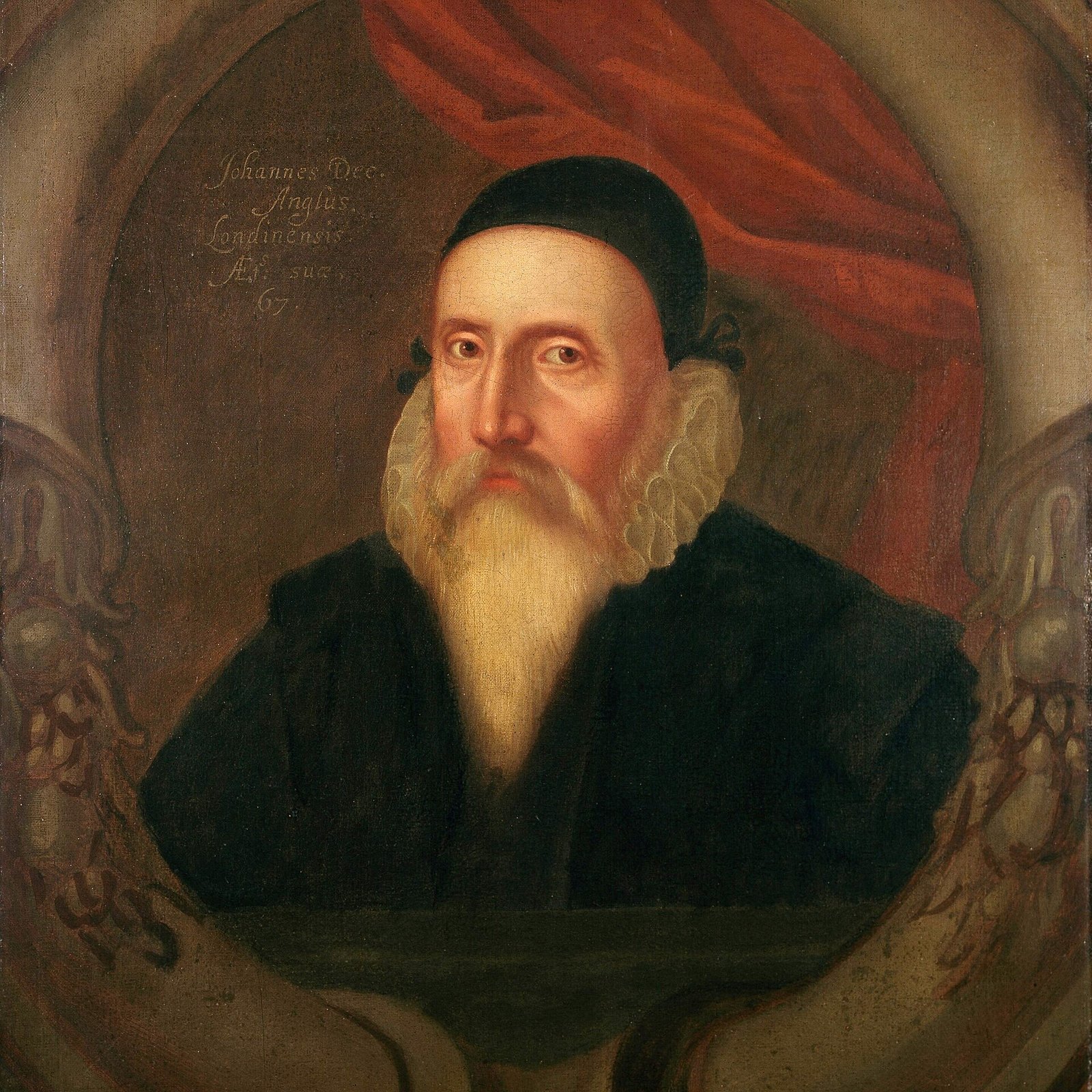
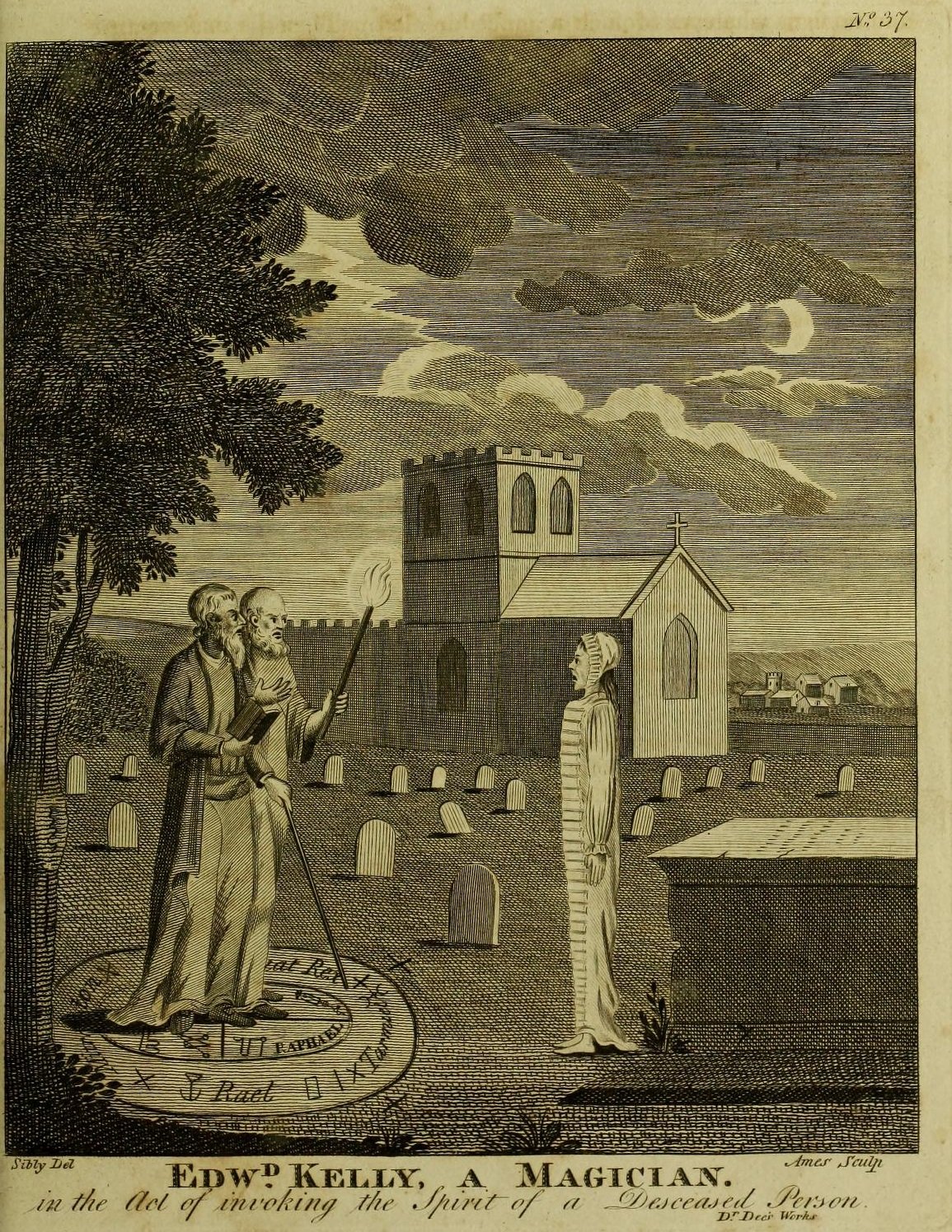
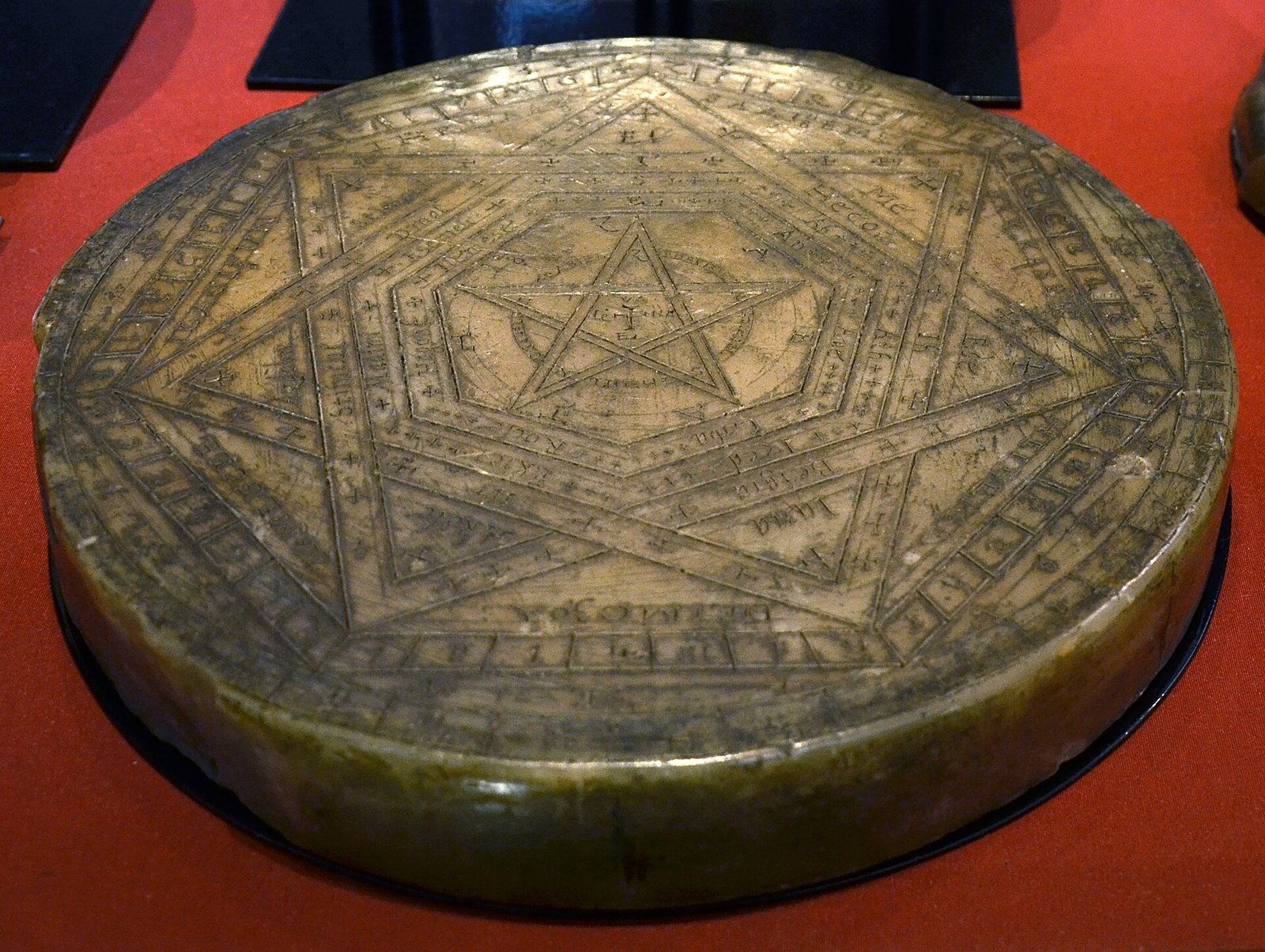
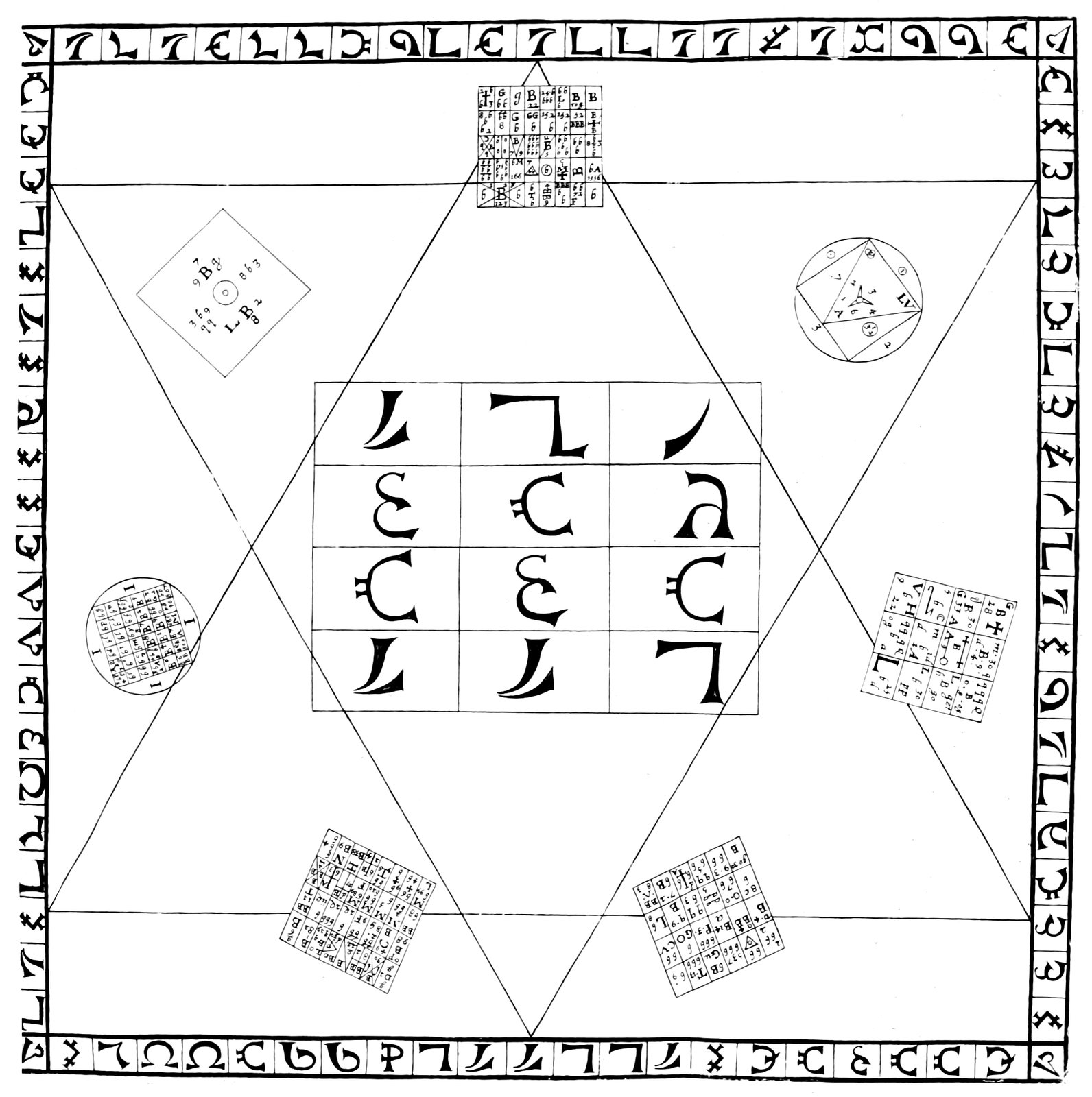
From 1582 the mathematician, astrologer and adviser to Elizabeth I John Dee (1527–1608/09) held regular sessions with the scryer Edward Kelley (1555–1597), who gazed into a stone and reported what angels showed and told him while Dee wrote it down. In 1583 the two travelled to Central Europe with the Polish nobleman Albert Łaski, and in the spring of 1584, in Cracow, they received the Calls or Keys of what Dee called the angelic language, today usually known as Enochian. Kelley doubted the whole enterprise, and on Saturday 21 April 1584 he put his questions to the angels Gabriel and Nalvage: was this language known anywhere in the world? Gabriel's answer is a short myth of the fall. Adam in his innocence spoke this tongue, shared the society of the angels and spoke with God himself, until Coronzon — for so, the angel says, is the true name of that mighty Devil — envied his felicity, saw that his lower part was frail, assailed him and prevailed. Adam lost the garden and the language, was driven out into an earth covered with brambles and, being as dumb, had to learn by necessity the speech Kelley called Hebrew. Dee recorded the session as he recorded all of them, with the date, the hour and every question asked; the name does not return anywhere else in the printed edition. That is the whole of Coronzon in Dee's records: one name, one envy, one fall.
From Coronzon to Choronzon
The diaries remained in manuscript until 1659, when the scholar Meric Casaubon published a large part of them as A True and Faithful Relation of What Passed for Many Yeers Between Dr. John Dee and Some Spirits, from the originals in the library of Sir Thomas Cotton; the passage stands on page 92, and Casaubon's purpose was to show that Dee had been deceived by evil spirits. The printed spelling is Coronzon. The linguist Donald Laycock noted in The Complete Enochian Dictionary (1978) that Dee's own manuscript, Cotton Appendix XLVI, gives the form Coronzom. In the late nineteenth century the Hermetic Order of the Golden Dawn absorbed Dee's Enochian tablets and Calls, copied from his manuscripts in the British Museum, into its curriculum for adepts, largely through the work of S. L. MacGregor Mathers, and through it the material reached Aleister Crowley, who joined the order in 1898 and later printed his own version of the system as Liber Chanokh in The Equinox. The spelling with an h became standard through Crowley, whose Hebrew spelling of the name gives the number 333. His commentary credits Kelley with calling the demon the first and deadliest of all the powers of evil; the published record itself has only the mighty Devil of Gabriel's answer.
The Thirty Aethyrs
The last of the nineteen Enochian Calls is the Call of the Aethyrs: with a change of a single name it opens thirty Aethyrs or Aires, spiritual regions counted from the thirtieth, nearest the earth, to the first. Crowley tried it in Mexico in 1900 and obtained visions of the thirtieth and twenty-ninth before setting the work aside. In November 1909 he took it up again in Algeria, travelling south from Algiers with Victor Neuburg (1883–1940), a young poet and his pupil, who had joined Crowley's order, the A∴A∴, as a Probationer under the motto Omnia Vincam. The method was simple: Crowley recited the Call, gazed into a large golden topaz set in a wooden cross, and described what he saw and heard, while Neuburg wrote it down. In this way they worked through the remaining Aethyrs in about four weeks, a series Crowley published in 1911 as The Vision and the Voice, a special supplement to The Equinox, volume I, number 5. Crowley later counted the journey as the time he himself crossed the Abyss and took the grade of Master of the Temple.
The Rite of the Tenth Aethyr
The tenth Aethyr, called ZAX, was held to be accursed, and for it alone the procedure was changed. The record dates the working to 6 December 1909, between two and a quarter past four in the afternoon, in a lonely valley of fine sand in the desert near Bou Saâda. Neuburg sat in a circle traced in the sand and fortified with divine names, armed with a magical dagger and bound by an oath to strike at anything that tried to break in, even if it wore the shape of his teacher. Outside it lay a triangle bearing the name of Choronzon, with MI-CA-EL written in its angles. Three pigeons were killed at the angles of the triangle, and the text insists that no drop of their blood fall outside it, or Choronzon could manifest in the universe. Crowley then withdrew, wrapped in a black robe, and recited the Call in secret. Where exactly he sat is one of the puzzles of the record: the instructions place the seer within the triangle, while a note describes him seated in a secret place, and readers still argue whether the demon was called into an empty triangle or into Crowley himself.
The Voice of Dispersion
What followed reads less like a vision than a quarrel. The demon begins with the words Zazaz, Zazas, Nasatanada Zasas, which Crowley's commentary calls the traditional words that open the Abyss, with which Adam was said to have opened the gates of hell. It declares itself the Master of Form, then I am I, a being shut up with its treasure against the world, and curses, boasts, pleads and threatens by turns. It appears to Neuburg as a woman he had loved in Paris, then as a penitent begging to lie at his feet, then imitates Crowley's voice asking for water. My name is three hundred and thirty and three, it says, and that is thrice one. The text gives the key to it all in one word: Choronzon is Dispersion, and cannot fix his mind upon any one thing for any length of time. The tenth Aethyr, it says, is the world of adjectives, with no substance in it; the demon's malice is not that of a being but a quality, because the one who boasts I am I has in truth no self.
The Fight in the Circle
While Neuburg argued and wrote, the demon was quietly pushing sand over the edge of the circle. Once the circle was breached it began dictating lines from the old song Tom o' Bedlam to keep the scribe busy, then sprang into the circle and threw him to the ground. The record says the two struggled there, that Neuburg called on the name Tetragrammaton and forced the demon back into its triangle with anger and threats, and that he then repaired the circle. The session dragged on with further taunts, temptations and a request for something to cover the demon's nakedness, until Crowley took a holy ring and wrote the name BABALON — in the words of the text, the victory over Choronzon — and the manifestation ended. A great fire was lit to purify the place, and circle and triangle were destroyed. In a note of his own Neuburg drew the lesson he had learned too late: Choronzon fears concentration and silence above all things, and whoever would command him should will in silence.
What Happened in the Desert
No one but the two men was present, and the account is theirs. The Aethyr was edited and revised the next day; Crowley later wrote that the greatest precautions had been taken to keep silence about the rite of evocation, and warned in his commentary that to call forth Choronzon, unless one be wholly above the Abyss, is to ensure the most appalling and immediate catastrophe. Neuburg is said to have insisted afterwards that he had fought something real, yet the writer Arthur Calder-Marshall reported that Neuburg told him a quite different story in later years. Jean Overton Fuller's biography of Neuburg (1965) dwells on the hold Crowley had over his pupil, and the historian Alex Owen reads the Algerian workings as an exploration of the self as much as of spirits; believers read the tenth Aethyr as an evocation that succeeded all too well. Neuburg broke with Crowley in 1914 and later, as editor of a poetry column in the Sunday Referee, printed some of the first poems of the young Dylan Thomas.
The Dweller in the Abyss
Crowley built the afternoon into his doctrine. In his system the Abyss is the gulf that separates the three highest spheres of the Tree of Life from everything below, the divide between the ideal and the actual. Its dweller is Choronzon, but, as Crowley wrote in his Confessions, he is not really an individual: the Abyss is empty of being, and the shapes that arise in it mistake themselves for selves. To cross, the adept must give up everything he is — in the imagery of The Vision and the Voice, pour his blood into the cup of Babalon, who dwells in Binah beyond the gulf — and appear on the far side as a Master of the Temple. The one who refuses, who shuts himself up in his own ego as Choronzon does in the vision, becomes in Crowley's terms a Black Brother, the worst failure his system knows. The Vault's entry on Thelema returns to this doctrine, because it marks the point at which Crowley and the Left-Hand Path part company.
Kenneth Grant and the Nightside
After Crowley's death the figure moved into the work of Kenneth Grant (1924–2011), who had served as Crowley's secretary in 1945 and from the early 1970s led his own Typhonian branch of the O.T.O. In the Typhonian Trilogies, above all Nightside of Eden (1977), Grant mapped the Tunnels of Set, paths on the dark side of the Tree of Life corresponding to the Qliphoth, and in Typhonian writing the Abyss and the hidden sphere Daath within it become a doorway to that nightside rather than only a gulf to be crossed. In this current Choronzon is the warden of a threshold as much as an obstacle. Grant drew freely on dreams, on Lovecraft's fiction and on parallels between distant traditions; even sympathetic Thelemic readers have criticised him for linking symbols too readily, and his Choronzon is best taken as his own.
The Choronzon Club and Chaos Magic
The name was claimed early. Cecil Frederick Russell (1897–1987), an American who had lived at Crowley's Abbey of Thelema at Cefalù in 1920 and 1921, founded a group in 1922 that he called the Choronzon Club and advertised as a short cut to initiation. In 1931 it was renamed the G.B.G., based in Chicago, and it was dissolved in 1938, though Russell went on teaching and his pupil Louis Culling published its curriculum in the 1960s. Decades later the chaos magicians, who set experiment and belief as a tool against fixed doctrine, gave the demon a more ambivalent role. A rite circulated under Peter J. Carroll's name as The Mass of Choronzon invokes the magician's own swollen ego in the god-form of Choronzon, after a first invocation of the formless Kia, in order to cast the whole will upon reality at once; its calls are adapted from those of the first and tenth Aethyrs. Here Choronzon stands for the ego's energy rather than its enemy, though chaos magic has no single doctrine of him.
Choronzon in Fiction
Much of the demon's modern fame comes from popular culture. An episode of the British anthology series Hammer House of Horror, Guardian of the Abyss (1980), turns on a cult that uses a scrying mirror to summon Choronzon. In The Sandman #4, A Hope in Hell (1989), written by Neil Gaiman, Choronzon is the demon chosen to face Dream in a duel of wits in hell for the return of his helm; each names a form that defeats the last, until the demon chooses anti-life and Dream answers that he is hope. The 2022 Netflix adaptation keeps the duel but has Lucifer face Dream in Choronzon's place. Beyond these the name recurs in games, music and fantasy fiction, usually as a generic arch-demon of chaos with little of the Enochian or Thelemic background left.
Where the Vault Leaves It
What the records establish is narrow. Dee's diary for 21 April 1584 contains one angelic sentence naming Coronzon as the mighty devil who envied Adam; Crowley and Neuburg's account of 6 December 1909 describes a ritual in the Algerian desert in which a voice calling itself Choronzon raged, tempted and struck, and from which Crowley drew a doctrine of the Abyss. Whether anything spoke through Crowley that afternoon, whether the scene was an ordeal of two minds under great strain, and whether Choronzon is a demon, a law of the psyche or a literary invention, the sources cannot settle. For the Vault the figure matters as the place where Thelema demands the surrender of the self and the Left-Hand Path refuses it, and the Vault records both positions, and every other reading, as they are held.
Appearance
In Dee's record none: the angel names him and gives no description. In The Vision and the Voice he has no form of his own, because he is the maker of all form, and takes many: a beautiful woman, a wise and holy man, a writhing serpent, a penitent at the scribe's feet, the voice of Crowley himself
Powers
- Scattering concentration and will
- Taking any form to tempt or terrify
- Imitating trusted voices
- Wearing down boundaries by distraction
- Dissolving the self that will not let go
Also Known As
Coronzon, Coronzom, That mighty Devil, Dweller in the Abyss, Demon of Dispersion, 333
Attributes
- Dispersion
- The Abyss
- Deception
- Chaos
- The broken boundary
Symbolic Correspondences
- Elements: No classical element of his own; in the 1909 vision the sand and dry wind of the desert, and in Crowley's analysis of the name ZAX the Dragon's Head, Taurus (Earth) and Spirit
- Colours: Black, the seer's robe and the black fire of hatred in the vision; the red of the pigeons' blood; the pale gold of the desert sand
- Numbers: 333, the value of the name in Crowley's Hebrew spelling, called thrice one in the vision; 10, the Aethyr ZAX; 3, the triangle and the three slain doves
- Associations: The Abyss, Daath, the tenth Aethyr ZAX, the triangle of evocation, the desert near Bou Saâda, Babalon and Binah, the Black Brotherhood, the fall of Adam and the lost angelic language, Kenneth Grant's Tunnels of Set
The Figure, Symbol by Symbol
- The Name: Coronzon: In Dee's record the name belongs to the envious devil who caused Adam's fall and cost him the angelic tongue. From the start Choronzon is the enemy of a language in which word and thing were one — fitting for a demon who, centuries later, fights with nothing but words.
- 333, Thrice One: Crowley's Hebrew spelling of the name gives 333, and the demon calls it thrice one. Read as a number of the Abyss, it is unity broken into repetition: one, and one, and one, never adding up to a whole.
- The Triangle: In the Solomonic tradition the triangle outside the circle is where a spirit is made to appear and is held. Choronzon calls himself Master of the Triangle, and the whole working turns on whether the boundary between the two figures holds.
- The Circle of Sand: The scribe's protection was drawn in sand, and the demon broke it by covering its edge with more sand. It is the record's clearest image of dispersion: no frontal assault, only the slow blurring of a boundary.
- The Three Slain Doves: The pigeons killed at the angles of the triangle are, in the demon's own words, his threefold blasphemy, yet their blood shall make fertile the sand. Desecration and promise are held together in a single image.
- I Am I: Choronzon's boast is the voice of a self that has shut itself up with its treasure. In Crowley's doctrine this is precisely the self that must be surrendered in the Abyss; on the Left-Hand Path the same words can be heard as a declaration of sovereignty.
- The Name of Babalon: The manifestation ends when the seer writes BABALON, called in the text the victory over Choronzon. Against dispersion stands the cup that receives everything given to it: not a weapon but a surrender that leaves the demon nothing to scatter.
Reading the Whole
Read as a whole, the symbolism of Choronzon is a symbolism of boundaries. Dee's angel sets him at the first boundary of all, between innocence and the fall, between the speech of angels and the stammering of exile. Crowley's record sets him at a boundary drawn in sand, between a circle and a triangle, and shows him winning not by force but by blurring the line: talk, pity, flattery, a handful of sand at a time. The doctrine built on that afternoon sets him at the last boundary of the self, where everything a person holds on to is either given away or torn apart.
That is why the figure has outlived its thin historical record. Whatever happened near Bou Saâda, the image of Choronzon carries one idea with unusual precision: that the self is most endangered not by an enemy but by its own scattering, and that the answer lies in silence, concentration or surrender. Each tradition that has taken up the name has decided differently which of those it means, and the readings recorded here are the record of that choice.
Theological Significance
In Dee's record Coronzon has a precise theological place: he is the adversary of the first man, the envious power whose assault caused the fall and cost Adam the language of the angels. In Crowley's system the same name stands for something almost opposite to a personal devil — not a rebel against God but the absence of any centre at all. Between the two lies a shift from a Christian story of sin to a mystical psychology of the self.
The Envy of Paradise
Gabriel's account follows Genesis and the old tradition of the devil's envy, familiar since the Wisdom of Solomon (2:24), where death enters the world through the envy of the devil. What is new is its focus on language: the fall is told as the loss of a perfect speech in which names and things were one, and the Enochian revelation as its partial return. Coronzon is thus the enemy of meaning itself, the power that broke the bond between word and world — a thread that runs on into Crowley's vision, where the demon is the master of empty talk.
The Abyss Between Two Worlds
In Crowley's Qabalah the Abyss divides the supernal triad of Kether, Chokmah and Binah from the seven lower spheres, and only an adept who has given up every claim to separate existence can cross it. Choronzon is what remains of a self that will not let go: a cluster of thoughts, images and impulses with no centre, mistaking itself for a person. The theology is mystical rather than moral. Evil here is not rebellion but disintegration, and salvation is not obedience but surrender.
Babalon and the Cup
Opposite Choronzon stands Babalon, the figure Crowley drew from the Whore of Babylon in Revelation 17 and set in Binah, beyond the Abyss. In the vision her name ends the manifestation; in the doctrine her cup receives the blood of the adept who has given up everything, and so takes in the self that Choronzon would have scattered. The two form a pair — dispersion and reception, the self torn apart and the self given away — and Thelemic writers often read the difference between them as the whole meaning of initiation.
Practical Application
Choronzon has no grimoire seal, no traditional enn and no recognised rite of invocation beyond the 1909 working and its chaos-magic adaptations. Crowley's own commentary warns that calling him forth, for anyone not wholly above the Abyss, ensures the most appalling and immediate catastrophe, and Thelemic orders treat the encounter as a stage of inner initiation rather than an operation to repeat. Within the Vault the figure is therefore approached as a subject of study and contemplation, not as a spirit to be called; the blood sacrifice of the 1909 rite lies outside everything the Vault keeps.
As a contemplative figure Choronzon is useful precisely because his description is psychological. Neuburg's note names the remedy as concentration and silence, and the demon's method as distraction: talk, argument, pity, flattery, sudden fear. The figure can serve as a mirror for whatever scatters attention — inner chatter, endless argument with oneself, the urge to answer every provocation — and the work against it needs no evocation at all, only plain practices such as meditation, a magical diary or a period of chosen silence.
Modern Interpretations
Since Crowley, Choronzon has been read less as a being than as a process, and the modern interpretations differ chiefly in what they take that process to be. The readings below are recorded as their proponents hold them.
Ego Death and Dissolution
The most widespread reading, Thelemic in origin, treats Choronzon as the experience of ego dissolution: the terror, confusion and fragmentation that can accompany deep meditation, psychedelic experience or severe crisis, when the ordinary sense of self falls apart. Crowley's commentary already speaks this way, describing the demon as a bundle of elements held together for a moment by the energy of the Call and driven by fear of its own dissolution. Many practitioners compare the encounter with what psychology calls depersonalisation or psychotic disintegration, and read the warnings of the tenth Aethyr as warnings about the limits of the mind.
The Scattered Mind
A related, more secular reading takes Choronzon as the name of a state of attention: the distracted, endlessly talking mind that cannot hold one thought. Writers in this vein point out that the demon's weapon in the record is not force but chatter, and that the scribe nearly fell because he argued; they find in the tenth Aethyr a description of modern distraction as much as of an old devil.
Gate and Engine
Kenneth Grant's Typhonian current and some chaos magicians turned the figure around. For the first, the Abyss that Choronzon guards is a gate to the nightside of the Tree, to be explored rather than merely crossed; for the second, Choronzon can stand for the raw energy of the ego, invoked deliberately as in The Mass of Choronzon. More orthodox Thelemites criticise both as a misreading of Crowley's warnings.
The Left-Hand Path Reading
On the Left-Hand Path the figure is read against Crowley. If the goal is the preservation and strengthening of the individual self, then the refusal to dissolve in the Abyss — the very act Crowley called the mark of a Black Brother — is not failure but choice, and Choronzon's I am I sounds less like madness than like a declaration. The Setians in particular define their path against Crowley's demand for self-surrender.
Across these readings one thread holds: Choronzon names the moment when the self meets its own disintegration, and each tradition decides differently whether to surrender to that moment, explore it, use it or refuse it.
Sources & Historical Texts
- John Dee — spirit diaries, Cracow, 21 April 1584 (British Library, Cotton Appendix XLVI)
- Meric Casaubon (ed.) — A True and Faithful Relation of What Passed for Many Yeers Between Dr. John Dee and Some Spirits (1659), p. 92
- Wisdom of Solomon 2:24
- Donald C. Laycock — The Complete Enochian Dictionary (1978)
- Aleister Crowley — The Vision and the Voice (Liber 418), The Equinox I:5 (1911), the tenth Aethyr ZAX
- Aleister Crowley — The Vision and the Voice, with commentary, ed. Karl Germer (1952)
- Aleister Crowley — One Star in Sight, in Magick in Theory and Practice (1929)
- Aleister Crowley — The Confessions of Aleister Crowley
- Arthur Calder-Marshall — The Magic of My Youth (1951)
- Jean Overton Fuller — The Magical Dilemma of Victor Neuburg (1965)
- Kenneth Grant — Nightside of Eden (1977)
- C. F. Russell — Znuz is Znees: Memoirs of a Magician (1970)
- Peter J. Carroll — The Mass of Choronzon
- Neil Gaiman — The Sandman #4, A Hope in Hell (1989)