Adam and Eve
- Category
- Biblical First Humans
- Origin
- The Hebrew Bible (Genesis 1–5); Second Temple and rabbinic Jewish tradition, the Life of Adam and Eve, the New Testament and the Qur'an; Gnostic retellings in the Nag Hammadi library
History & Lore
Adam and Eve are the first human couple of Genesis: made from the ground and from the man's side, set in the garden of Eden, forbidden one tree, persuaded by a serpent, and sent out into a world of labour, pain and death. The Hebrew text tells the story in a few pages and never calls the serpent Satan or the act a fall. Jewish legend added Lilith and a devil who refused to bow, Paul and Augustine turned the story into the doctrine of original sin, the Gnostics made the serpent a teacher and Eve the bearer of knowledge, and modern readers have found in it everything from the first act of patriarchy to the birth of the self.
Few stories have been retold as often as the one about a man, a woman, a garden, a tree and a snake, and few are as short. The account in Genesis takes up barely three chapters, names almost nothing and explains even less. It does not say why the tree was planted where it was, what kind of fruit it bore, who the serpent was or why God's warning that the eaters would die on that day did not come true in the way it seemed to promise. Into these silences poured more interpretation than almost any other text has received: law and legend, doctrine and heresy, painting, poetry and polemic. For some, Adam and Eve explain why human beings suffer and die; for others, why women were subordinated; for others again, how the human being first became a self. To follow them honestly is to keep the short text and its long afterlife apart, and to see how much of what everyone knows about Eden was never written in Genesis at all.
Two Stories of the Beginning
Genesis opens with two accounts of creation that modern scholarship has long assigned to different hands. The first, Genesis 1:1 to 2:4a, belongs to the Priestly source: in six ordered days God speaks the world into being, and on the sixth says, Let us make humankind in our image, after our likeness. Humanity is created male and female together, blessed and told to be fruitful, multiply, fill the earth and subdue it (1:26–28). The second, from Genesis 2:4b, is the older or at least differently voiced non-Priestly narrative, traditionally ascribed to the Yahwist. Here the LORD God forms the man from the dust of the ground, breathes into his nostrils the breath of life, plants a garden in Eden, brings him the animals to name, and finally builds the woman from his side while he sleeps. The two accounts differ in order, in the name of God and in their picture of the sexes, and the attempt to reconcile them produced some of the most influential legends in the tradition. The division itself goes back to the source criticism of the eighteenth and nineteenth centuries, to which Julius Wellhausen gave its classic form in 1878; the dating of both strands is still debated, and the Priestly account is usually placed in or after the Babylonian exile.
Adam, Adamah and the Mother of All Living
The names are puns before they are names. Adam is the ordinary Hebrew word for a human being, and the story derives him from the adamah, the tilled ground; for most of Genesis 2 and 3 the text speaks of ha-adam, the human, with the article, and only gradually does the word become a personal name. The woman is called ishshah because she was taken from ish, man (2:23), and only after the curse does the man give her a name of her own: Chawwah, Eve, because she was the mother of all living (3:20), linking the name with the Hebrew word for life. The rib of the traditional translations is a word that elsewhere means side, and some interpreters, ancient and modern, read the first human as a single being later divided. The Midrash Genesis Rabbah (8:1) already says that Adam was created with two faces, Philo of Alexandria distinguished the heavenly human of Genesis 1 from the earthly one of Genesis 2, and Genesis Rabbah (20:11) plays on the closeness of Eve's name to the Aramaic word for serpent.
The Garden and Its Two Trees
Eden in Hebrew suggests delight; a related word in Sumerian and Akkadian means steppe or plain. The Greek translators rendered the garden as paradeisos, a word of Persian origin meaning a walled park, and so gave the West the word paradise. Four rivers flow from it, two of them the Tigris and the Euphrates (2:10–14), and Ezekiel (28:13) knows Eden as the garden of God, set with precious stones. In the middle stand two trees: the tree of life and the tree of the knowledge of good and evil (2:9), and only the second is forbidden, with the warning that on the day the man eats of it he will die (2:17). The text never names the fruit. The apple belongs to the Latin West, where malum means both apple and evil; Jewish tradition preferred other candidates, and a baraita in the Babylonian Talmud (Berakhot 40a) records Rabbi Meir's opinion that it was the vine, Rabbi Nehemiah's that it was the fig, from whose leaves the couple made their coverings, and Rabbi Judah's that it was wheat. What the knowledge of good and evil means is just as open: moral judgement, sexual awareness, divine omniscience, or simply everything.
The Serpent Who Was Not Yet Satan
The serpent enters as one of the creatures God had made, more cunning than any other beast of the field (3:1); the Hebrew word for cunning, arum, echoes the word for the couple's nakedness, arummim, a verse earlier. It speaks, it questions, it tells the woman that she will not die but that her eyes will be opened and she will be like God, knowing good and evil (3:5). Serpents had long been bound up with life and its loss: in the Epic of Gilgamesh a snake steals the plant of renewed youth while the hero bathes. The serpent of Eden is right in the narrow sense: the couple do not die that day, their eyes are opened, and God himself says that the human has become like one of us (3:22). Nowhere in Genesis is the serpent called Satan or a fallen angel; it is punished as an animal, condemned to crawl on its belly and eat dust. The identification came later. The Wisdom of Solomon (2:24) says that through the devil's envy death entered the world; Revelation (12:9; 20:2) calls Satan that ancient serpent; and the rabbinic Pirke de-Rabbi Eliezer (13) has the angel Samael ride the serpent as his mount.
Curse, Garments and the Cherubim
The judgement is pronounced in a set order. The serpent is cursed and set at enmity with the woman and her offspring (3:14–15), a verse Christian tradition from Irenaeus onward read as the first announcement of the gospel. The woman will bear children in pain, desire her husband, and he will rule over her (3:16). The ground is cursed for the man's sake, and he will eat bread by the sweat of his face until he returns to the ground, for dust you are and to dust you shall return (3:17–19). Then God makes garments of skins and clothes them (3:21), and sends them out of the garden lest they reach out and eat from the tree of life and live forever (3:22–23). East of Eden he stations the cherubim and a flaming sword that turns every way, to guard the way to the tree of life (3:24). Outside, Eve bears Cain and Abel, then Seth (4:1–2, 25), and Adam lives nine hundred and thirty years (5:5).
Lilith, the First Wife
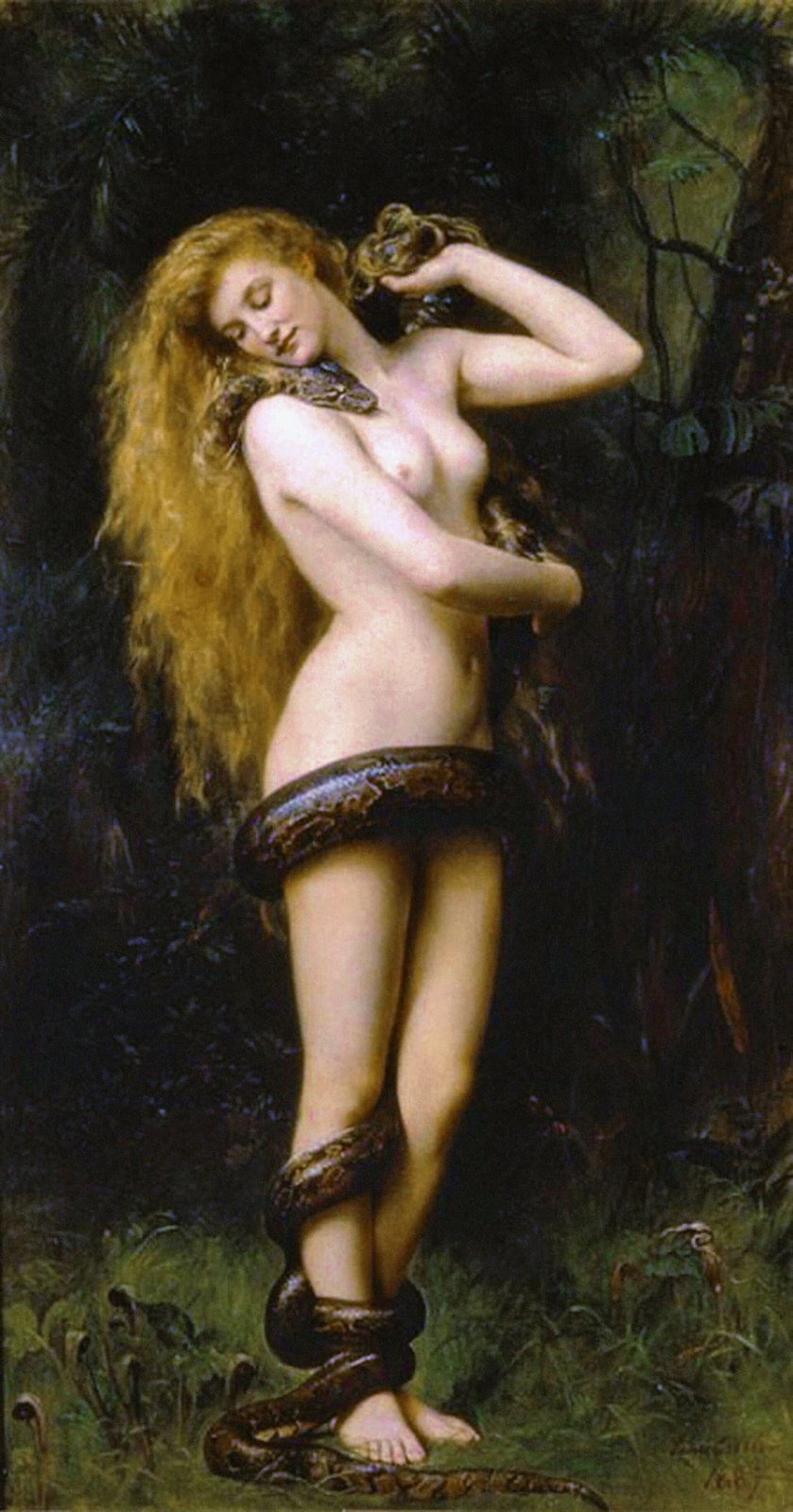
Because Genesis 1 creates male and female together and Genesis 2 makes the woman afterwards, some readers concluded that there had been a woman before Eve. The rabbis of Genesis Rabbah (22:7) speak of a first Eve. Lilith herself is far older as a demon: the Hebrew Bible mentions a lilit once, among the creatures of the desolate land in Isaiah 34:14, and the Babylonian Talmud knows her as a long-haired, winged night spirit, though not as Adam's wife. That role first appears in the Alphabet of Ben Sira, a satirical Hebrew work usually dated between the eighth and tenth centuries. There Lilith is made from the earth like Adam, refuses to lie beneath him because they are equal, speaks the ineffable Name and flies away; three angels, Senoy, Sansenoy and Semangelof, find her by the Red Sea, and she agrees to spare newborns protected by their names. Later Kabbalah, from the Treatise on the Left Emanation of Isaac ha-Kohen in thirteenth-century Castile onward, made her the consort of Samael, and the modern world made her a heroine; a Jewish feminist magazine founded in 1976 took her name. For the Vault, Lilith is the true first woman: made from the same earth as Adam, his equal, and the first to refuse to submit.
The Life of Adam and Eve and the Refusal
Between the Bible and the rabbis stands a cluster of retellings known as the Life of Adam and Eve, preserved in a Greek version usually called the Apocalypse of Moses and in Latin, Armenian, Georgian and Slavonic forms; they were probably composed between the first and fourth centuries CE, and whether their origin is Jewish or Christian is debated. They follow the couple after the expulsion: their penance standing in the rivers Jordan and Tigris, Eve's second deception by Satan disguised as an angel of light, Adam's sickness and death, and the darkening of sun and moon at his passing. The Latin Life (12–16) gives the devil's own explanation of his enmity. When Adam was created in God's image, the archangel Michael commanded the angels to worship him; the devil refused to worship one who was lesser and later than himself, was cast down with his followers, and in envy brought about Adam's expulsion. The same story appears in the Qur'an: God tells the angels to prostrate themselves before Adam and all do except Iblis (2:34), who says, I am better than he; you created me from fire and him from clay (7:12), and is driven out to lie in wait for humankind (7:11–18).
Paul, Augustine and the Inherited Fall
In the Hebrew Bible Adam and Eve are almost never mentioned again after Genesis 5. Jesus ben Sira writes that sin began with a woman and because of her we all die (Sirach 25:24), and the First Letter to Timothy (2:13–14) argues from Eve's deception that women should not teach. The apocalypse known as 4 Ezra, written after the destruction of the Temple in 70 CE, laments: O Adam, what have you done (7:118), for the fall was not his alone but that of all who came from him. But it was Paul who made Adam the hinge of a theology. In Romans 5:12–21 sin came into the world through one man, and death through sin, and so death spread to all; Christ is the counterpart who reverses it, and in 1 Corinthians 15:22 and 45 he is the last Adam. Augustine, writing against the Pelagians in the early fifth century, built on a Latin text that rendered Romans 5:12 as in whom all have sinned. For him all humanity was present in Adam, and the guilt of the first sin and the disorder of desire were passed on through generation; the Council of Carthage in 418 and later the Council of Trent in 1546 made the doctrine binding in the West. Alongside it ran the paradox sung in the Easter proclamation Exsultet: O happy fault, felix culpa, that earned so great a Redeemer.
The Gnostic Garden
The most radical rereading comes from the Gnostic texts found at Nag Hammadi in 1945, which tell the story from the other side. In the Apocryphon of John the rulers build the body of Adam, and Christ, appearing as an eagle on the tree of knowledge, awakens the couple to eat. In the Hypostasis of the Archons the spiritual woman awakens Adam, who greets her as the mother of the living, and when the rulers pursue her she passes into the tree; then the spiritual female principle enters the serpent, the Instructor, who tells the woman she will not die. On the Origin of the World makes Eve of Life, the daughter of Sophia, the one who raises Adam, and calls the beast that instructs her the wisest of all creatures. The groups the church fathers called Ophites, from ophis, snake, honoured the serpent; Irenaeus (Against Heresies I 30) reports that some of them held Sophia herself became the serpent, and Epiphanius (Panarion 37) that they let a snake crawl over their bread. In these readings the forbidding god is the jailer and Eve the first to know.
Eden in Paint and Verse
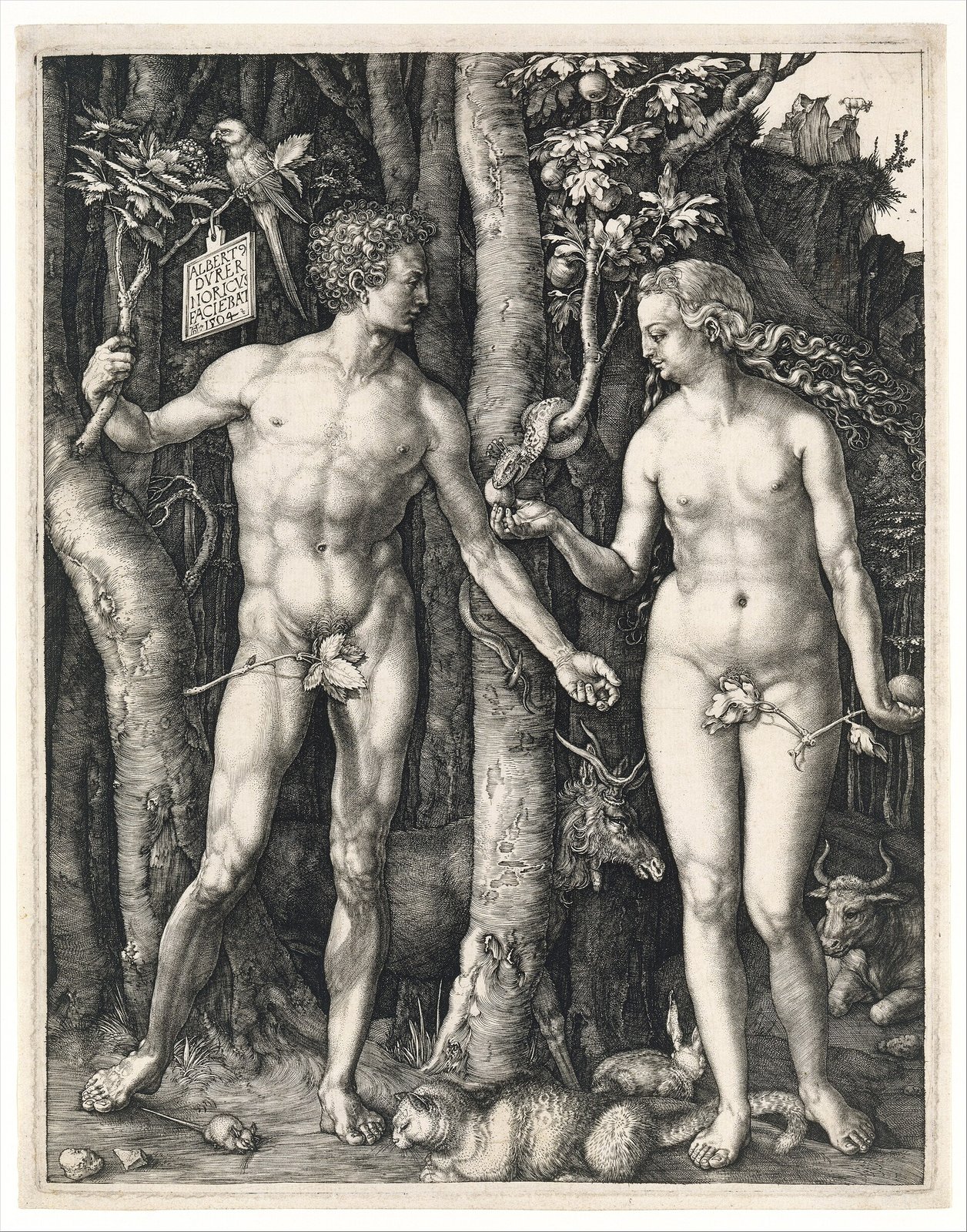
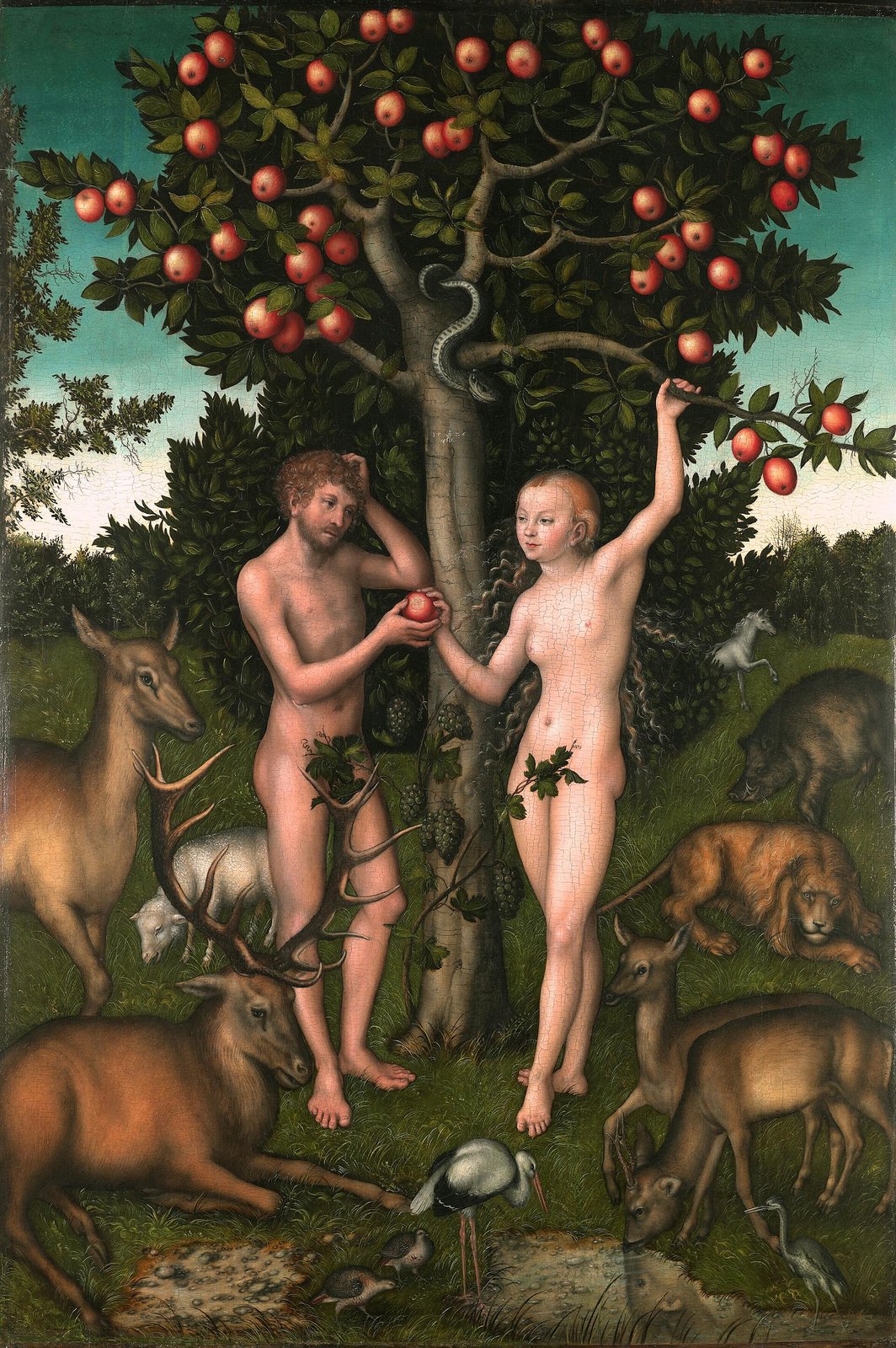
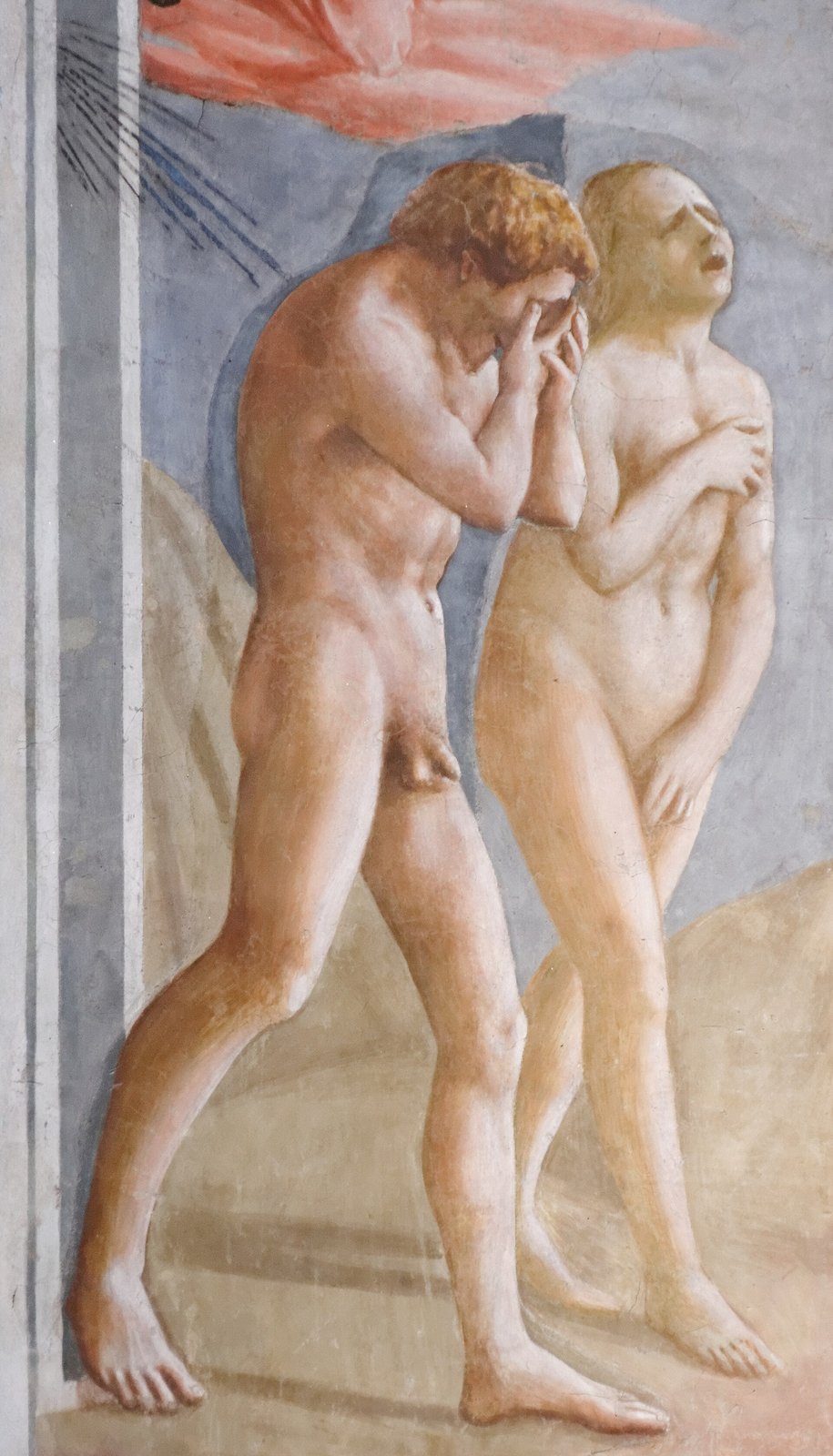
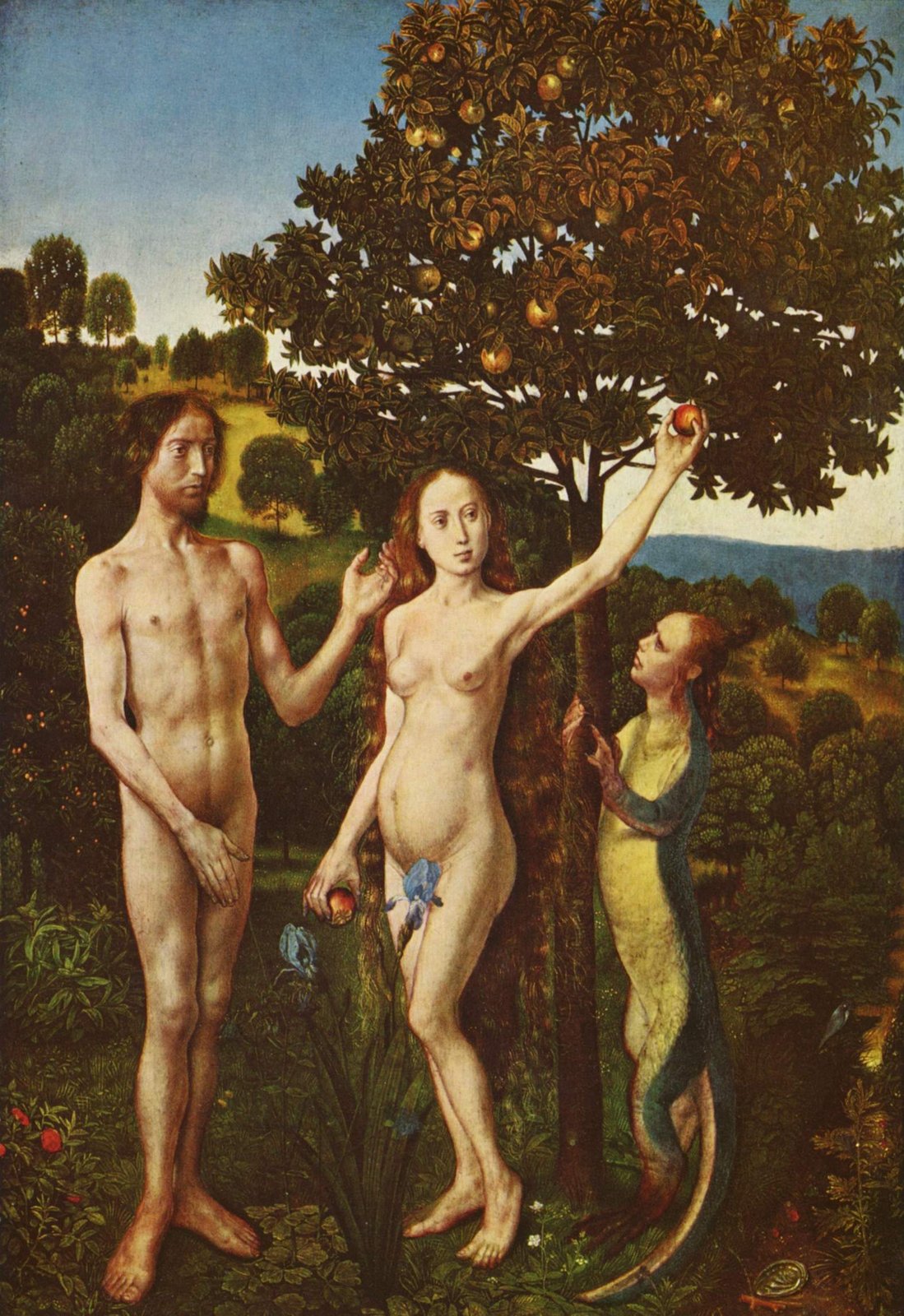
Christian art made Adam and Eve its chief excuse for the nude. In Masaccio's Expulsion in the Brancacci Chapel in Florence, painted about 1425, the couple leave the gate in raw grief, Eve's mouth open in a cry. Albrecht Dürer's engraving of 1504 sets them as ideal bodies built on studied proportions, with a tablet bearing his name hanging from a branch; Lucas Cranach the Elder and his workshop painted the couple dozens of times, and Hieronymus Bosch set God presenting Eve to Adam in the left wing of his Garden of Earthly Delights. On the Sistine Chapel ceiling, completed in 1512, Michelangelo painted the creation of Adam with the outstretched finger and, in the same field as the temptation, a serpent with a woman's upper body, a medieval convention that gave the tempter Eve's own face. In 1667 John Milton published Paradise Lost, in ten books and from 1674 in twelve, which made Satan enter the serpent, gave Eve a dream of temptation and Adam a choice to fall with her for love, and ended with the pair walking hand in hand out of Eden, the world all before them.
Where the Vault Leaves It
What the text says is less than what is usually believed. Genesis tells of a human made from the ground and a woman from his side, a garden with two trees, a forbidden fruit, a speaking serpent, shame, judgement and exile; it does not say apple, Satan, fall or original sin. Each of these was added by later readers with their own questions: rabbis asking what the tree was, apocalyptic writers asking where evil came from, Paul and Augustine asking why Christ had to die, Gnostics asking who made this world, feminists asking who wrote the story and why. The Vault records that the same scene has been read as a crime, a tragedy, a necessary step and a liberation, and keeps each reading as it is held, without deciding between them.
Appearance
In Genesis none beyond their nakedness and the fig-leaf coverings and garments of skin. In Christian art two nude figures beside a tree, Eve usually holding the fruit, the serpent coiled in the branches, often with a woman's head or upper body; after the expulsion, the couple driven past an angel with a sword
Powers
- Naming the living creatures (Genesis 2:19–20)
- Dominion over the earth (Genesis 1:28)
- The choice to obey or to know
- Bearing and passing on life
- Carrying the image of God and, in Gnostic myth, the stolen light
Also Known As
The First Humans, Adam HaRishon, Chawwah (Hawwah), Adam and Hawwa, The First Parents, Primal Man and Woman
Attributes
- The first human pair
- Earth and breath
- Knowledge and its price
- Nakedness and shame
- Exile
- Mortality
Symbolic Correspondences
- Elements: Earth (Adam from the adamah, the ground) and breath (the breath of life breathed into his nostrils); water in the four rivers of Eden
- Colours: The green of the garden; the red earth that later commentators heard in adam and adom, red; the gold or red of the fruit in Western painting
- Numbers: Two (the pair); four (the rivers of Eden); six (the sixth day of creation); 930 (the years of Adam's life, Genesis 5:5)
- Associations: The garden of Eden, the tree of life, the tree of the knowledge of good and evil, the serpent, the fig leaf, the cherubim and the flaming sword, Lilith, Iblis, Seth, Paul's last Adam, Mary as the new Eve, the Gnostic Instructor, Paradise Lost
The Figure, Symbol by Symbol
- The Dust and the Breath: The human is made of two things: ground that can be worked and breath that comes from God. The story names the creature after the earth, adamah, and sends it back there at the end — the most compact statement in the Bible of what a human being is.
- The Side: The word translated rib usually means side. Read with Genesis 1, where male and female are created together, it suggests a single human divided in two, and the rabbis' two-faced Adam and Plato's divided beings in the Symposium are often cited beside it.
- The Two Trees: Life and knowledge stand side by side, and only knowledge is forbidden. Once the humans have knowledge, life is guarded from them. The pairing has been read as the price of awareness: to know is to know that one dies.
- The Fruit: Unnamed in Hebrew, an apple only because of a Latin pun on malum, a fig, grape or wheat in rabbinic opinion. The object stays empty so that each reader can fill it with what they think is forbidden.
- The Serpent: A creature of the field, shrewd and talkative, later the devil's mask, in Gnostic texts the Instructor. Snakes shed their skin and were signs of renewal and of hidden wisdom across the ancient Near East, which made the serpent fit both tempter and teacher.
- The Fig Leaf and the Skins: First the humans cover themselves with leaves they have sewn; then God clothes them in skins. Shame and care appear in the same scene, and clothing becomes the first sign of a life outside the garden.
- The Cherubim and the Sword: Composite guardians, related to the winged protective beings of Mesopotamian palaces, stand at the east gate with a turning blade of fire. The way back is not destroyed but guarded, and the hope of return runs through all later tradition.
Reading the Whole
Read as a whole, the image of Adam and Eve is a portrait of the human condition drawn in the smallest possible space: earth and breath, a pair, a boundary, a voice that questions the boundary, a choice, shame, work, pain, death and a closed gate behind. Every element is plain enough to be universal and vague enough to be filled with meaning, and every age has filled it differently — with law, with sin, with sexuality, with the hidden light of the Gnostics or with the awakening of reason.
That is why the figures have never settled into a single meaning. Whether the scene at the tree is read as rebellion, seduction, maturity or liberation, it remains the place where the human being first says no to a command and learns what that costs. The readings collected here are the record of how differently that moment has been judged.
Theological Significance
For Judaism, Christianity and Islam, Adam and Eve stand at the beginning of humanity and of its relationship with God, but the three traditions draw very different conclusions from the same scene. In Judaism the story explains mortality and the hard conditions of life without a doctrine of inherited guilt; human beings are born with both a good and an evil inclination and remain free to choose. In the Qur'an Adam repents and is forgiven (2:37), no soul bears the burden of another (6:164), and Islamic tradition counts Adam as the first of the prophets.
Original Sin and Its Rivals
In Western Christianity Augustine's reading became decisive: the first sin damaged human nature itself, and every human being inherits both its guilt and its consequences until grace restores them. The Eastern churches, following Greek fathers such as Irenaeus, speak instead of ancestral sin, an inheritance of mortality and weakness rather than of personal guilt, and Irenaeus pictured Adam and Eve as children who were meant to grow towards God and stumbled on the way. The Reformers sharpened Augustine; Pelagius and his heirs, then many modern theologians, softened him.
The New Adam and the New Eve
From Paul onward Christ is read as the second Adam who undoes the disobedience of the first, and from Justin Martyr and Irenaeus in the second century Mary is the new Eve whose obedience reverses Eve's. The cross was said to stand where the tree had stood, and medieval legend made its wood grow from a seed of paradise that Seth placed in his dead father's mouth. The same parallel produced the darker side of the tradition: Tertullian called women the devil's gateway, and the blame laid on Eve shaped Christian teaching about women for centuries.
Practical Application
Adam and Eve are not invoked in the practice of demonolatry or of the left-hand path, and no grimoire or tradition of ritual is attached to their names. Within the Vault the story is used instead as a foundational text for reflection: the place where the questions of obedience, knowledge, shame and freedom are posed in their oldest Western form, and the source from which the figures of the serpent, Lilith, Lucifer and the Gnostic Sophia all draw part of their meaning.
As a contemplative exercise the scene at the tree can be read slowly, line by line, in several versions — Genesis, the Life of Adam and Eve, the Qur'an, the Hypostasis of the Archons and Milton — with the question each version asks of the reader: what is the forbidden thing, who forbids it, who invites, and what is lost and gained by reaching for it. The exercise needs no ritual and can be carried out in a journal or in conversation.
Modern Interpretations
Modern readers have taken the story of Eden apart and reassembled it in many directions. Historical criticism dissolved Adam and Eve as historical persons for most scholars, and the readings that followed treat them as myth in the strong sense: a story that says something true about human beings without describing an event. The readings below are recorded as their proponents hold them.
The Fall as Awakening
Immanuel Kant, in his Conjectural Beginning of Human History (1786), read the expulsion as humanity's step from the guardianship of instinct into the freedom of reason — a fall for the individual, progress for the species. Friedrich Schiller went further in 1790 and called this departure from instinct the happiest and greatest event in human history. Erich Fromm, in You Shall Be as Gods (1966), read the disobedience as the beginning of human freedom, and Goethe's Mephistopheles writes the serpent's promise, Eritis sicut Deus, in a student's album in Faust.
Eve Reread
Feminist exegesis returned to the Hebrew text. Elizabeth Cady Stanton's The Woman's Bible (1895–1898) attacked the use of Genesis against women, and Phyllis Trible, in God and the Rhetoric of Sexuality (1978), argued that the earth creature of Genesis 2 is not yet male, that the woman is its completion rather than its afterthought, and that the rule of the man over the woman in 3:16 is described as a consequence of disobedience, not prescribed as God's order. Carol Meyers (1988) read Eve against the life of women in early Israelite farming households.
The Luciferian Reading
Esoteric and luciferian authors read the scene as the first act of the self: the moment a creature stops obeying and starts to know, at the price of paradise. Helena Blavatsky's The Secret Doctrine (1888) treated the serpent of Genesis as a bringer of wisdom; modern luciferian writers identify it with Lucifer the light-bringer and make Eve the first initiate, often drawing on the Gnostic Instructor. No ancient text honours the serpent as Lucifer the light-bringer; the link is a modern synthesis.
Across these readings one thread holds: the story is no longer read as the record of a lost perfection but as a mirror in which each age sees what it thinks it means to become human — and the price it believes that costs.
Sources & Historical Texts
- Hebrew Bible — Genesis 1:26–28; 2:4b–3:24; 4:1–2, 25; 5:1–5
- Hebrew Bible — Isaiah 34:14 (lilit); Ezekiel 28:13
- Septuagint and Deuterocanonical books — Sirach 25:24; Wisdom of Solomon 2:23–24
- New Testament — Romans 5:12–21; 1 Corinthians 15:22, 45; 1 Timothy 2:13–14; Revelation 12:9; 20:2
- Philo of Alexandria — On the Creation of the World (1st c. CE)
- Life of Adam and Eve (Latin Vita) and Apocalypse of Moses (Greek), c. 1st–4th c. CE
- Qur'an — Surah 2:30–39; 7:11–25; 20:115–123
- Rabbinic literature — Babylonian Talmud, Berakhot 40a; Genesis Rabbah 8:1; 20:11; 22:7; Pirke de-Rabbi Eliezer 13
- Alphabet of Ben Sira (8th–10th c. CE)
- Nag Hammadi — Apocryphon of John; Hypostasis of the Archons; On the Origin of the World; Testimony of Truth
- Irenaeus — Against Heresies I 30 (c. 180 CE); Epiphanius — Panarion 37
- Augustine — The Literal Meaning of Genesis; The City of God XIII–XIV (5th c. CE)
- Exsultet, Easter proclamation (felix culpa)
- John Milton — Paradise Lost (1667; second edition 1674)
- Immanuel Kant — Mutmaßlicher Anfang der Menschengeschichte (1786)
- Friedrich Schiller — Etwas über die erste Menschengesellschaft nach dem Leitfaden der mosaischen Urkunde (1790)
- Elizabeth Cady Stanton et al. — The Woman's Bible (1895–1898)
- Erich Fromm — You Shall Be as Gods (1966)
- Phyllis Trible — God and the Rhetoric of Sexuality (1978)
- Carol Meyers — Discovering Eve (1988)