God (The Creator)
- Category
- Supreme Deity
- Origin
- The creation myths of Mesopotamia, Egypt, Greece and India; the Hebrew Bible and the monotheism of Judaism, Christianity and Islam; Greek and later Western philosophy and mysticism
History & Lore
The Creator is the answer many cultures have given to the oldest question there is: why is there anything at all, and who or what made it so. In the myths of Babylon, Egypt, Greece and India the world is shaped by gods who are themselves born from something earlier; in Judaism, Christianity and Islam one God calls everything into being, in the developed doctrine out of nothing. Philosophers turned the Creator into a first cause, an unmoved mover or nature itself, mystics looked for a Godhead beyond the God who creates, the Gnostics split the maker of the world from the highest God, and the left-hand path asks what place, if any, a creator leaves for the self. This entry follows the idea, not one religion's God, and it says openly where the Vault stands: God, in the Vault's reading, is not a being above the world but existence itself and the divinity in everyone, to be recognised and lived rather than worshipped.
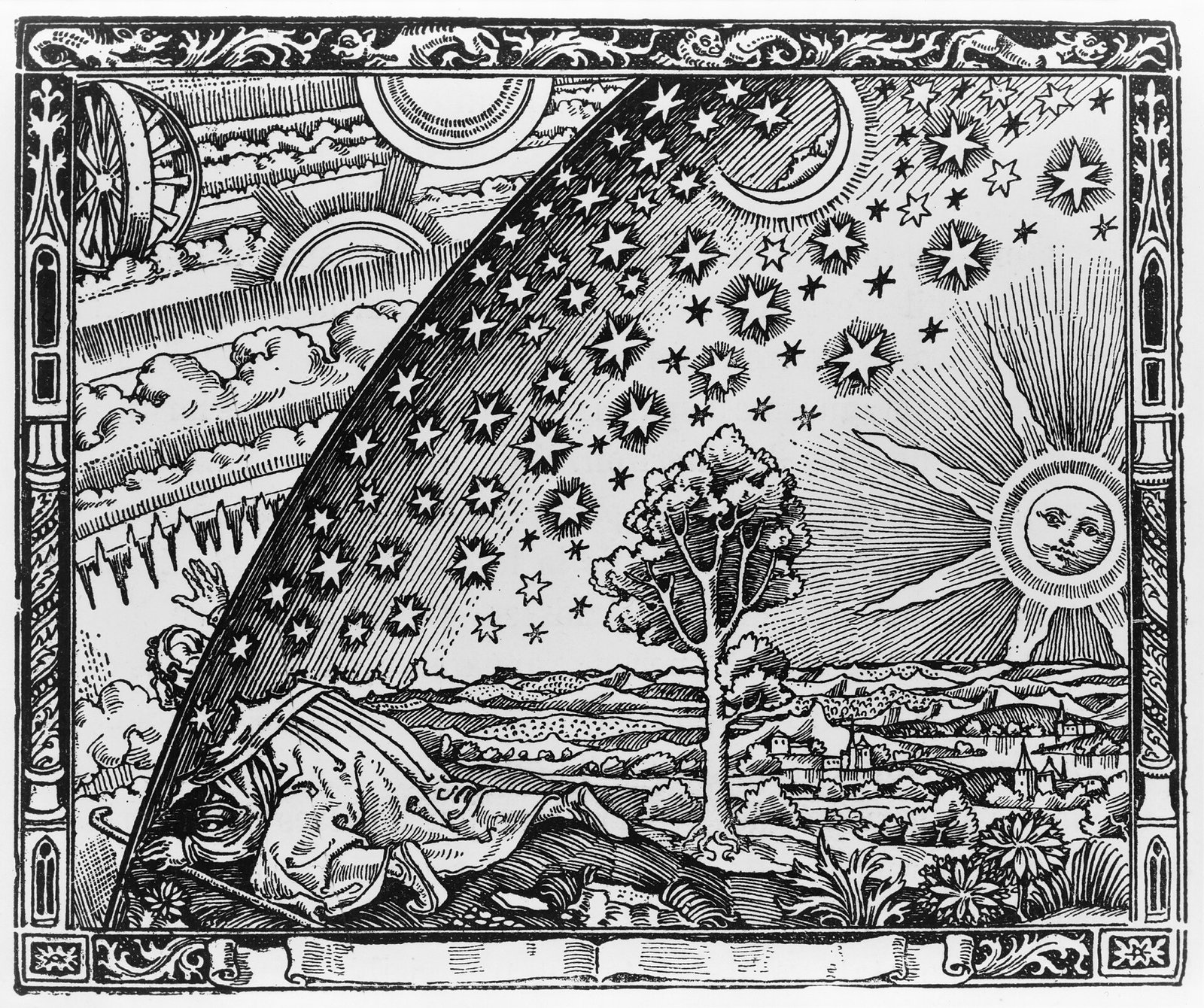
Almost every culture that has left a record has told a story about how the world began, and most of those stories have someone or something at their source. The idea of a Creator is therefore not one belief but a family of answers to the same question, and the answers differ more than the single word God suggests. Some creators are craftsmen who shape what already exists, some are born from chaos and fight it, some speak and the world appears, and some are so far beyond the world that it is unclear whether they made it at all. This entry follows that idea through myth, scripture, philosophy and mysticism. The God of Israel as a historical figure, Jesus Christ, Adam and Eve, and the Gnostic Demiurge each have their own entries in the Vault and are touched on here only where the idea of creation passes through them.
Before There Was a Heaven
The Babylonian epic Enuma Elish takes its name from its first words, when on high the heaven had not been named. Composed in the second millennium BCE, perhaps in the reign of Nebuchadnezzar I in the twelfth century, and recited at the New Year festival in Babylon, it begins with two primeval waters mingling, Apsu the sweet and Tiamat the salt. Generations of gods are born from them, conflict follows, and the young god Marduk defeats Tiamat in battle, splits her body like a fish for drying and makes the sky from one half and the earth from the other. From the blood of her ally Kingu, at Marduk's design, the god Ea creates humankind to bear the labour of the gods. Copies from the library of Ashurbanipal at Nineveh were published by George Smith in 1876 as The Chaldean Account of Genesis, and the parallels with the Bible caused a sensation. Here creation is victory and order wrested from chaos, and the creator is himself a latecomer among the gods.
Atum, Ptah and the Creative Word
Egypt knew several creation accounts side by side. In the tradition of Heliopolis the creator Atum rises from the dark waters of Nun onto the first mound of earth and brings forth the first divine couple, Shu and Tefnut; the Pyramid Texts say he did so by masturbation (Utterance 527) or by spitting and sneezing (Utterance 600). The so-called Memphite Theology, carved on the Shabaka Stone around 710 BCE and given to the British Museum in 1805, claims to copy a worm-eaten older text and makes Ptah of Memphis the creator who brought everything into being by what his heart conceived and his tongue commanded: creation by thought and word. Scholars once dated its content to the Old Kingdom; many now place it in the New Kingdom or in Shabaka's own time. Around the middle of the fourteenth century BCE the pharaoh Akhenaten went further and honoured the sun disc Aten as the sole maker of all things, a reform often called the first monotheism and abandoned soon after his death.
Chaos, Night and a God Who May Not Know
Greek myth has no creator of the world at all. In Hesiod's Theogony, around 700 BCE, the first thing that comes to be is Chaos, a yawning gap, followed by Gaia the earth, Tartaros and Eros; from these the gods are born, and the sky god Ouranos, his son Kronos and finally Zeus rule in turn. The gods belong to the world rather than standing before it. The Indian tradition contains one of the most searching creation texts ever written, the hymn of creation in the tenth and latest book of the Rigveda (10.129), the Nasadiya Sukta. It begins with a time when there was neither non-being nor being, asks what covered all and where, and ends by saying that the one who looks down on it in the highest heaven surely knows, or perhaps he does not know. Later Hindu thought developed both a personal creator, Brahma, and Brahman, the absolute from which all things arise and into which they return.
Two Beginnings in Genesis
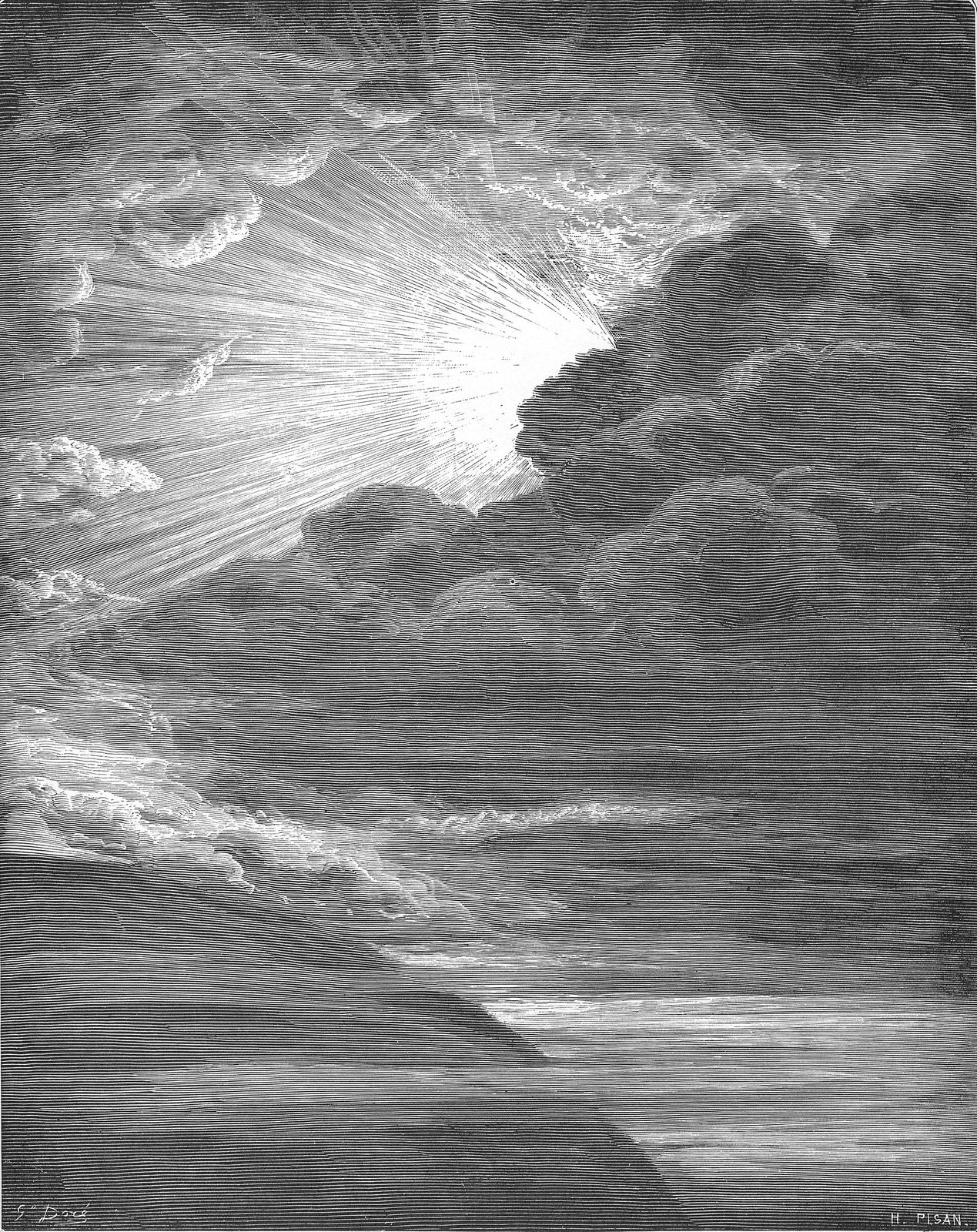
The Bible opens with two creation accounts. The first, Genesis 1:1–2:4a, usually assigned by scholars to the Priestly source of the sixth or fifth century BCE, shows God, Elohim, creating heaven and earth by command in six days and resting on the seventh; the Hebrew verb bara, to create, is used only with God as its subject. The earth is at first tohu wa-bohu, formless and void, darkness lies over the deep, tehom, and God speaks: let there be light. The second account, Genesis 2:4b–25, older in the view of many scholars, has a different order and a different tone: the LORD God forms the human being from the dust of the ground, breathes the breath of life into his nostrils and plants a garden. In 1895 Hermann Gunkel compared the deep of Genesis 1 with Tiamat and traced a battle with chaos in passages such as Psalm 74:13–14 and Isaiah 51:9, where God crushes the sea monster Rahab; the closeness of tehom and Tiamat is still debated. What is new in Genesis 1 is the absence of any struggle: one God, no rival, a world that comes into being because it is spoken.
Out of Nothing
Whether Genesis teaches creation out of nothing is itself disputed; the first verse can also be read as when God began to create, with formless matter already present, and the Wisdom of Solomon (11:17) speaks of a world made from formless matter. The formula appears in Second Maccabees 7:28, where a mother tells her son that God did not make heaven and earth out of things that existed, and Paul speaks of a God who calls into being the things that are not (Romans 4:17). The doctrine of creatio ex nihilo, creation out of nothing, was worked out in the second century CE against Platonist philosophers and Gnostic teachers who assumed an eternal matter; Gerhard May traced this development in 1978. Theophilus of Antioch and Irenaeus of Lyon formulated it around 180, and Tertullian defended it around 200 against the painter Hermogenes. The Fourth Lateran Council made it binding doctrine in 1215. Its point is theological as much as cosmological: nothing exists beside God that he did not make, and nothing limits him.
One God in Three Traditions
Judaism confesses the one God in the Shema, Hear, O Israel, the LORD our God, the LORD is one (Deuteronomy 6:4), and in the words of Isaiah 45:7 God forms light and creates darkness, makes peace and creates evil, leaving no second power beside him. Medieval Jewish thinkers such as Maimonides insisted that God can be described only by what he is not, and the Kabbalah spoke of the infinite Ein Sof. Christianity confesses in the Nicene Creed one God, maker of heaven and earth, and teaches that all things were made through the Word (John 1:3); God is one being in three persons, and Augustine argued in the eleventh book of his Confessions that time itself was created with the world, so that there was no before. Islam centres everything on tawhid, God's absolute oneness. Sura 112 says that God is one, the eternal refuge, who neither begets nor is begotten, and to whom none is equal; when he wills a thing he says to it be, and it is (36:82). Tradition counts ninety-nine most beautiful names of God, among them al-Khaliq, the Creator, al-Bari, the Maker, and al-Musawwir, the Shaper (59:24).
The God of the Philosophers
Greek philosophy arrived at a first principle by argument rather than story. In the Timaeus, written around 360 BCE, Plato describes a divine craftsman, the demiurge, who shapes a pre-existing chaos into an ordered cosmos while looking to an eternal model; the Vault's entry on the Demiurge follows how the Gnostics transformed him. Aristotle's god in the twelfth book of the Metaphysics creates nothing: the world is eternal, and the unmoved mover moves it as an object of love, a thought that thinks itself. Plotinus in the third century CE placed the One beyond being, from which mind and soul flow as light flows from the sun. Christian, Jewish and Muslim thinkers fused these ideas with scripture. Anselm offered his ontological argument in the Proslogion around 1078, and Thomas Aquinas gave five ways to God in the Summa Theologiae (I, q. 2, a. 3): from motion, from efficient causes, from contingency, from degrees of perfection and from the order of nature. Thomas held that reason alone cannot prove the world had a beginning; that it did was, for him, a truth of faith.
From Spinoza to Darwin
The modern age took the Creator apart and put him together again in new forms. Baruch Spinoza, expelled from the Amsterdam Jewish community in 1656, identified God with the one infinite substance in his Ethics, published in 1677, and used the formula God or Nature, Deus sive Natura. The deists from Herbert of Cherbury (De Veritate, 1624) onward kept a creator but no revelation: a maker who set the world going under rational laws and did not interfere. Leibniz answered the problem of evil in his Theodicy of 1710 by arguing that God had created the best of all possible worlds; after the Lisbon earthquake of 1755 Voltaire mocked the claim in Candide (1759). David Hume's Dialogues Concerning Natural Religion, published posthumously in 1779, took apart the argument from design, and Immanuel Kant's Critique of Pure Reason (1781) argued that no proof of God's existence can succeed, since existence is not a real predicate, keeping God only as a postulate of practical reason. William Paley's Natural Theology (1802) revived the design argument with a watch found on a heath, which implies a watchmaker. Charles Darwin, who admired Paley as a student, offered in On the Origin of Species (1859) a natural mechanism for the appearance of design, and wrote to Asa Gray in 1860 that he could not believe a beneficent and omnipotent God had designedly created parasitic wasps.
The God Beyond God
Mystics in all three monotheisms pressed past the Creator toward something more hidden. Meister Eckhart, the Dominican preacher who died around 1328, distinguished God, who acts and creates and is named in relation to creatures, from the Godhead, the silent ground in which there is no work and no name, and in one sermon prayed to God to be rid of God. In 1329 Pope John XXII condemned twenty-eight of his propositions. Jacob Böhme spoke of an Ungrund, a groundless abyss before God, and the Lurianic Kabbalah of the sixteenth century imagined creation as God's contraction, tzimtzum, making room for a world. The Gnostic systems of the second century drew the sharpest line of all: beyond everything stands an unknowable highest God, while the world was made by an ignorant or arrogant lesser power, Yaldabaoth, who in the Apocryphon of John boasts that he is God and there is no other, words borrowed from Isaiah. Marcion separated the just God of the law from the good Father proclaimed by Jesus. The Vault's entries on the Pleroma, Barbelo, Sophia and the Demiurge follow that story further.
The Creator and Modern Science
In 1927 the Belgian priest and physicist Georges Lemaître derived an expanding universe from Einstein's equations, and in 1931 he proposed that it began from a primeval atom. Fred Hoyle, who rejected the idea, called it the Big Bang on BBC radio in 1949. When Pope Pius XII suggested in 1951 that science had confirmed the moment of creation, Lemaître urged caution and kept physics and theology apart. Since the 1990s the Intelligent Design movement, with Michael Behe's Darwin's Black Box (1996), has argued that certain biological structures are too complex to have evolved; in Kitzmiller v. Dover in 2005 a United States federal court ruled that it is not science and may not be taught as such in public school science classes. Most scientists and most theologians today treat the question of a creator as one that physics neither proves nor refutes.
The Creator on the Left-Hand Path
The left-hand path defines itself partly against the creator. In Stephen Flowers' distinction, set out in Lords of the Left-Hand Path (1997), the right-hand path seeks union with God or the universe, while the left-hand path seeks to preserve and exalt the individual self. Anton LaVey's Satanic Bible (1969) denies any creator and makes Satan a symbol of the carnal self and of nature; the Temple of Set, founded in 1975, honours Set not as maker of the cosmos but as the principle of isolate consciousness, the gift that sets the self apart from nature. Luciferian and Gnostic-inspired currents reverse the story of Eden, reading the serpent as the liberator and the creator who forbade knowledge as a jailer. Demonolatry takes yet another position. In the tradition set out by S. Connolly and others, and in the Vault's own pages on the Nine Divinities, Satan is not a rebellious creature of God but the supreme divine force from which all demonic energy flows, the primordial power of existence itself; the place other religions give the Creator is held, in this practice, by Satan and the demons as his aspects.
God as Existence Itself
The Vault's own reading begins where the mystics and philosophers left the Creator behind. God, as the Vault understands the word, is not a being, not a ruler above the clouds and not a man in heaven who made the world from outside and watches over it. God is existence itself: the fact that anything is at all, the universe in its whole extent, the energy that surrounds and runs through everything, and the divinity that lives in each one of us. This is a reading and not a finding of history, but it does not stand alone. Some of the oldest and most searching traditions have said something very close to it.
The Upanishads say it most directly. In the Chandogya Upanishad (6.8.7 and the passages that follow) the sage Uddalaka Aruni teaches his son Shvetaketu that the subtle essence of all things is the real and the self, and closes each lesson with tat tvam asi, that you are. The Brihadaranyaka Upanishad (1.4.10) gives the words aham brahmasmi, I am Brahman, and adds that whoever knows this becomes the All, while whoever worships another deity, thinking that it is one and he another, does not know. The Advaita Vedanta of Shankara in the eighth century built a whole philosophy on this identity of Atman, the self, with Brahman, the absolute. The Hermetic writings of the first centuries CE speak the same language in Greek: in Corpus Hermeticum XI the divine Mind tells Hermes that unless he makes himself like God he cannot know God, for like is known only by like (XI.20), and Corpus Hermeticum XII calls God the All and says that in the All there is nothing that is not God (XII.22–23). Plotinus taught that the soul must first become godlike to see the divine, as no eye ever saw the sun without becoming sunlike (Enneads I.6.9), and called the final vision the flight of the alone to the alone (VI.9.11).
Western thought reached the same place by other routes. Meister Eckhart preached in the sermon Qui audit me that the eye in which I see God is the same eye in which God sees me, one eye, one seeing, one knowing and one loving, and spoke of a ground of the soul in which God and the soul are one. Spinoza's Ethics states in Part One, Proposition 15, that whatever is, is in God, and nothing can be or be conceived without God; God or Nature names one reality, not two. In 1828 Karl Christian Friedrich Krause, in his Vorlesungen über das System der Philosophie, gave the name panentheism to the view that everything is in God without God being exhausted by the world. And in the first volume of his Systematic Theology, published in 1951, Paul Tillich wrote that God is being itself, not a being, and that it is as atheistic to affirm the existence of God, as of one thing beside others, as it is to deny it.
For the left-hand path this reading has a clear consequence. If God is existence itself and the divinity in every person, then the divine is not worshipped from below and no one submits to it, because there is no one above to submit to. It is recognised in oneself and lived. This is what the Vault means by self-deification: not the hubris of someone who declares himself master of the universe, but the awakening of someone who sees that the divine was never anywhere else. The reading keeps what Flowers names as the mark of the left-hand path, since what is recognised is the divinity of this particular self, awake and responsible, not its dissolution into the All. And it meets demonolatry as described above: where Satan is understood as the primordial force of existence itself and the demons as his aspects, the practitioner works with powers that are not foreign to him but part of the same existence that he is.
Where the Vault Leaves It
What history can establish is that the Creator is one of humanity's oldest and most varied ideas: a warrior who carves the world from chaos, a craftsman, a word, an unmoved mover, the one substance, a watchmaker, a hidden ground beyond all names, an ignorant demiurge, or a force the demonolater calls Satan. Whether any of these answers is true lies beyond what history can decide, and the Vault records each conception as its tradition holds it, with respect for those who believe.
The Vault itself does not stand neutral. For the Vault, God is not a being above the world but existence itself and the divinity in everyone. That is the Vault's reading, drawn from the Upanishads, the Hermetica, Plotinus, Eckhart, Spinoza, Krause and Tillich, and not a fact that history can prove; but it is held without hesitation. The divine is not to be worshipped and not to be obeyed. It is to be recognised in yourself and in everything that is, and to be lived.
Appearance
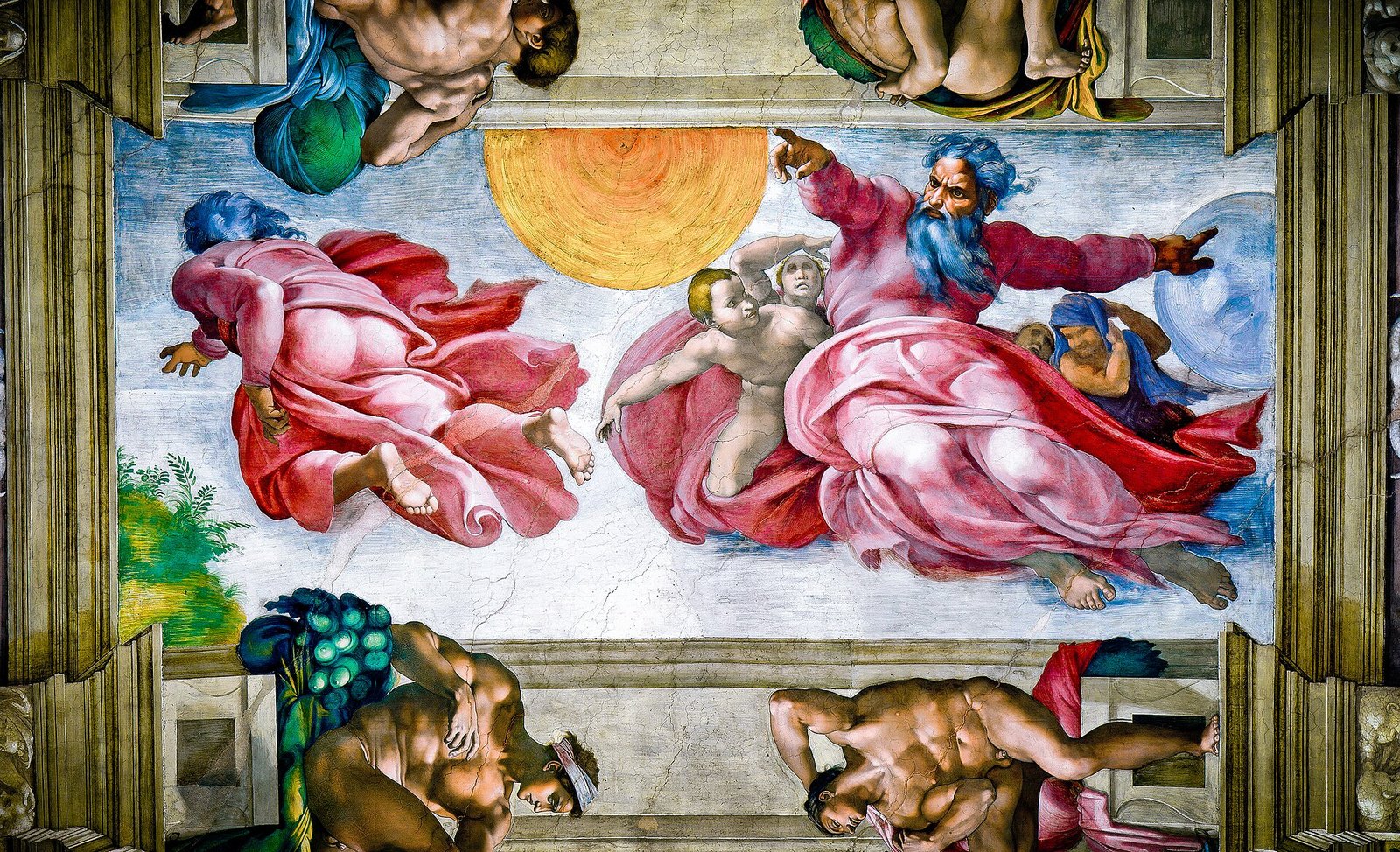
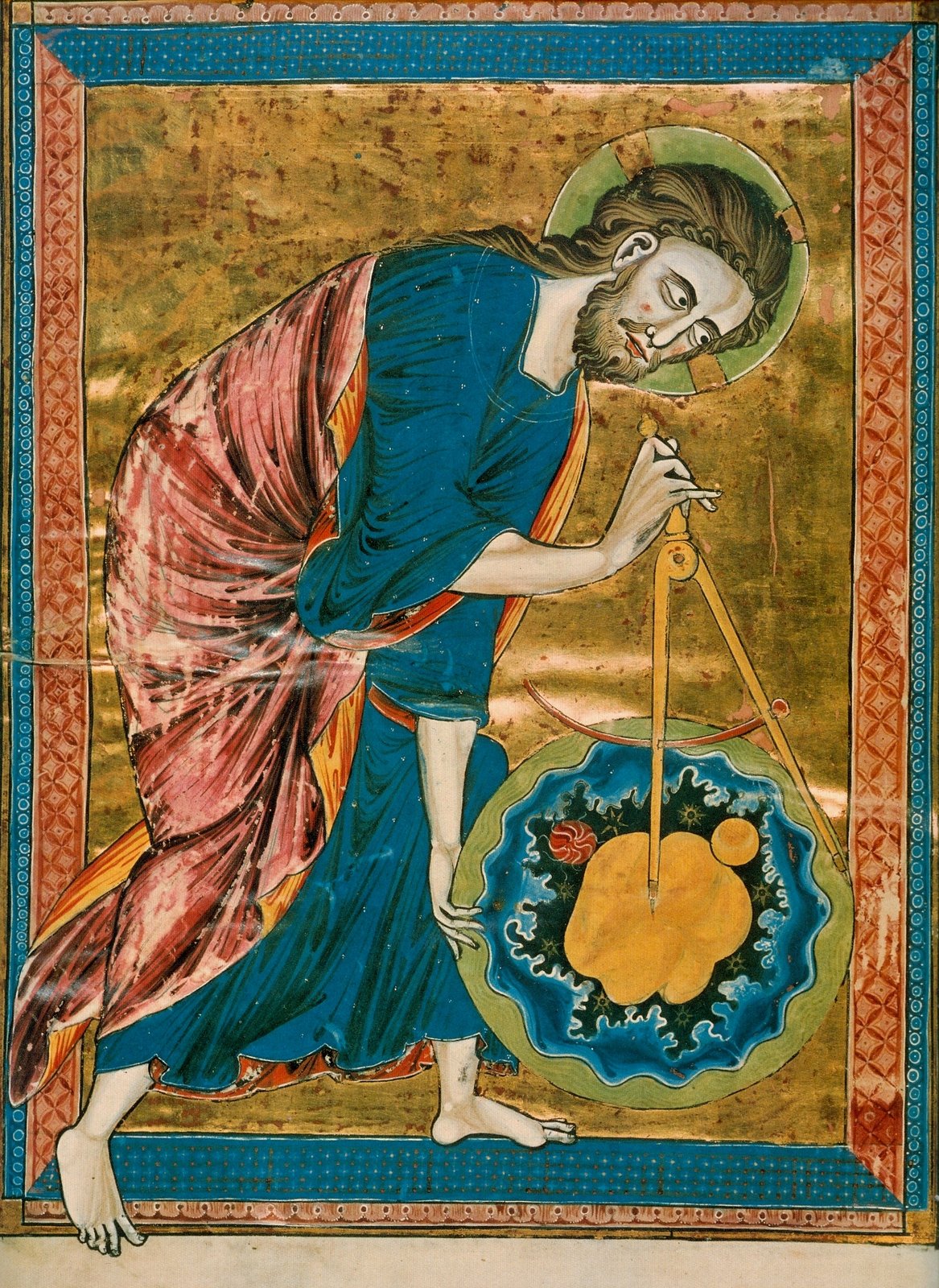
In Judaism and Islam none: the prohibition of images forbids any likeness of God. In Christian art from the Middle Ages onward an old man with a white beard, after the Ancient of Days in Daniel 7:9, often with a compass or an outstretched hand; elsewhere light, a hand from the clouds, an eye in a triangle or a burning bush. In Egypt Atum as a crowned man and Ptah as a mummiform figure with a straight beard
Powers
- Calling the world into being
- Ordering chaos into cosmos
- Sustaining all that exists
- Setting law and measure
- Revelation
- Providence and judgement
Also Known As
The Almighty, The Supreme Being, The First Cause, The Absolute, Maker of Heaven and Earth, The Unmoved Mover, Al-Khaliq, The Ground of Being
Attributes
- Creation
- Unity
- Omnipotence
- Eternity
- Transcendence
- Providence
Symbolic Correspondences
- Elements: None and all: the creator stands before the elements; in the myths water and darkness come first, and light is the first work
- Colours: White and gold for light and eternity; the black of the primeval darkness
- Numbers: One for unity; three for the Christian Trinity; six and seven for the days of creation and the day of rest; ninety-nine for the names of God in Islam
- Associations: The primeval waters and the first mound, Marduk and Tiamat, Ptah and the word, Chaos, the six days and the sabbath, creatio ex nihilo, the unmoved mover, the One, the watchmaker, the Godhead, the Demiurge, the Big Bang
The Figure, Symbol by Symbol
- The Word: Ptah creates by heart and tongue, the God of Genesis says let there be light, the Gospel of John speaks of the Word through whom all things were made, and the Quran of God saying be, and it is. Creation by speech makes the world an expression of a mind rather than the product of a struggle.
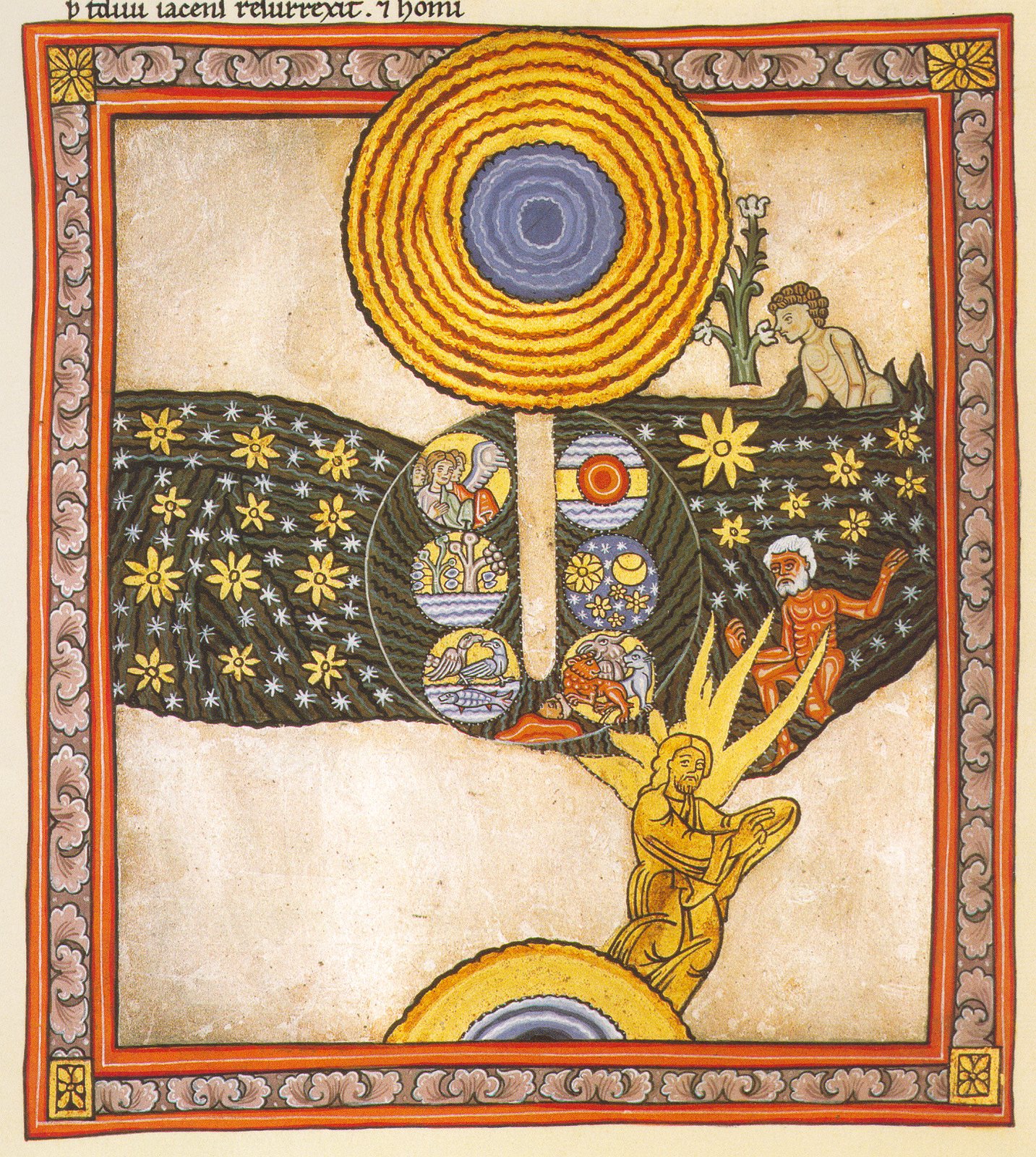
- The Waters: Apsu and Tiamat, Nun, the tehom of Genesis, the dark of the Nasadiya hymn: in almost every account the formless comes first, usually as water and darkness. The creator is the one who sets a boundary in it.
- The First Mound: Atum rises on the first hill above the waters of Nun, and Egyptian temples recalled that hill in their raised sanctuaries. The image is the first place that is firm: a point from which order can spread.
- The Light: Let there be light is the first work in Genesis, and the sun disc of Akhenaten was the sole maker of all things. Light stands for the moment in which something can be seen and distinguished at all.
- The Compass: Proverbs 8:27 speaks of God setting a circle on the face of the deep; medieval Bibles show God measuring the world with a compass, and William Blake's Ancient of Days of 1794, showing his figure Urizen, is often read as a critique of a creator who only measures and limits. The compass marks the creator as architect.
- The Outstretched Hand: From the hand reaching out of the clouds in early Christian art to Michelangelo's Creation of Adam on the Sistine Chapel ceiling, painted around 1511, the hand is how art shows a power it may not depict: the gap between two fingers holds the whole relation between maker and made.
- The Seventh Day: The creator of Genesis rests, and the sabbath remembers it. A world that is finished and declared good is a different world from one that must be won anew from chaos every year, as in Babylon.
Reading the Whole
Read as a whole, the symbols of the Creator describe two movements: something formless at the beginning, water, darkness, chaos or nothing, and an act that sets a boundary in it, whether by battle, craft, word or thought. The traditions differ in where they place the creator. In Babylon he is a young god who wins the right to rule, in Genesis the one who speaks and has no rival, in philosophy a cause or a principle, in mysticism a ground deeper than any name, in Gnosis a lesser power beneath a hidden God.
That is why the image has never settled into one form. Every age has asked the same question about the beginning and has answered it with the materials it had, myth, scripture, argument or equation, and the symbols recorded here are the traces those answers left behind.
Theological Significance
For the monotheistic religions the Creator is not one doctrine among others but the ground of all of them. If everything that exists was made by God, then the world is good in principle, it belongs to someone, and human beings are creatures who owe their existence to another. Ethics, worship and hope all follow from that relationship, and so do the hardest questions.
The Problem of Evil
If one God is all-powerful and all-good, why is there suffering? The question was formulated as a dilemma that the Christian writer Lactantius attributed to Epicurus, and it runs from the book of Job through Augustine's view of evil as the absence of good to Leibniz's Theodicy of 1710, which coined the word, and into the modern debate after the Holocaust. Dualistic systems such as Zoroastrianism or Gnosis escape it by giving evil its own source; strict monotheism has to answer it from within.
Transcendence and Immanence
Theology has always had to hold two things together: a creator who is wholly other than the world and a creator who is present in every part of it. Negative theology from Pseudo-Dionysius to Maimonides stresses the first, pantheism from Spinoza onward collapses the two, and panentheism and process theology since Alfred North Whitehead's Process and Reality (1929) try to say that the world is in God without God being exhausted by the world.
The Demiurge as Counter-Image
The Gnostic separation of the highest God from the maker of the world shows by contrast what the mainstream traditions affirm. Irenaeus wrote against the Gnostics precisely to insist that the God who made the world and the God who saves it are one and the same, and much of what later became orthodox doctrine about creation was formulated in that dispute.
Practical Application
The Creator as a being has no place in the working practice of demonolatry or of the left-hand path as an entity to be called; no grimoire treats God as a spirit to be invoked, and the traditions that honour him do so through prayer and worship in their own communities, which the Vault respects and does not imitate. In the Vault's own reading there is nothing to summon from outside in any case: if God is existence itself and the divinity in everyone, the divine is not called down but recognised, and the work is one of awareness rather than of worship.
In practice that recognition can be trained without any ritual at all. In meditation, attention rests on the plain fact of one's own existence, on breath, body and the world around, with tat tvam asi as a sentence to sit with; in a journal the question becomes where one still places the divine outside and above oneself, and what changes in freedom and responsibility once it is taken as one's own. In demonolatry the same recognition is approached through Satan as the primordial force and through the demons as his aspects, worked with in partnership as powers of the same existence.
Modern Interpretations
Since the nineteenth century the Creator has been criticised, reinterpreted and defended more intensely than at any time before, and the readings below are recorded as their proponents hold them.
God as Projection
Ludwig Feuerbach argued in The Essence of Christianity (1841) that God is humanity's own nature projected outward and worshipped as something alien. Karl Marx, Friedrich Nietzsche, whose madman announces the death of God in The Gay Science (1882), and Sigmund Freud in The Future of an Illusion (1927) developed the critique in different directions. On this reading the Creator says more about the people who imagine him than about the origin of the world.
The Ground of Being
Twentieth-century theologians such as Paul Tillich answered that God is not a being beside others, not even the highest, but being itself, the ground of being. Carl Gustav Jung, in Answer to Job (1952), treated the image of God as a psychic reality that changes with human consciousness. Both readings move the Creator from the beginning of time into the depth of the present.
The New Atheism and Its Critics
At the start of the twenty-first century authors such as Richard Dawkins in The God Delusion (2006) treated the Creator as a scientific hypothesis and rejected it, while philosophers and theologians replied that the classical God was never meant as one explanation among others. The revived cosmological argument of William Lane Craig, drawn from medieval Islamic kalam, stands at the centre of the same debate.
The Self as Creator
Esoteric and left-hand path currents shift the creative power to the individual. Aleister Crowley's Liber Oz of 1941 declares that there is no god but man, and many modern magical traditions understand the practitioner as co-creator or creator of his own world, while demonolatry places that power in Satan and works with it in partnership rather than claiming it for the self. The Vault's own reading, set out in the main text, joins these lines: the creative power is neither handed to a being above the world nor claimed by a self against it, because existence itself is divine and every self is a part of it.
Across these readings one thread holds: the Creator is understood as the answer to the question of where everything comes from, and each reading places that answer somewhere else, in heaven, in nature, in the mind or in the self.
Sources & Historical Texts
- Enuma Elish (Babylonian, 2nd millennium BCE; copies from Nineveh, 7th c. BCE)
- Pyramid Texts — Utterances 527 and 600 (Fifth and Sixth Dynasties, c. 2400–2200 BCE)
- Shabaka Stone / Memphite Theology (c. 710 BCE, British Museum EA 498)
- Great Hymn to the Aten (14th c. BCE)
- Hesiod — Theogony (c. 700 BCE)
- Rigveda 10.129 (Nasadiya Sukta)
- Chandogya Upanishad 6.8.7; Brihadaranyaka Upanishad 1.4.10
- Hebrew Bible — Genesis 1:1–2:4a; 2:4b–25; Deuteronomy 6:4; Isaiah 45:5–7
- 2 Maccabees 7:28; Wisdom of Solomon 11:17
- New Testament — John 1:1–3; Romans 4:17
- Quran — Sura 112; 36:82; 59:22–24
- Plato — Timaeus (c. 360 BCE)
- Aristotle — Metaphysics, Book XII
- Corpus Hermeticum XI.20 and XII.22–23 (2nd–3rd c. CE)
- Plotinus — Enneads I.6.9; VI.9.11 (ed. Porphyry, c. 301 CE)
- Theophilus of Antioch — To Autolycus II (c. 180 CE); Irenaeus — Against Heresies (c. 180 CE)
- Tertullian — Against Hermogenes (c. 200 CE)
- Augustine — Confessions XI (c. 400 CE)
- Fourth Lateran Council (1215)
- Thomas Aquinas — Summa Theologiae I, q. 2, a. 3 (1265–1274)
- Meister Eckhart — German sermons (early 14th c.)
- Baruch Spinoza — Ethics, Part I, Proposition 15 (1677)
- Gottfried Wilhelm Leibniz — Theodicy (1710)
- David Hume — Dialogues Concerning Natural Religion (1779)
- Immanuel Kant — Critique of Pure Reason (1781)
- William Paley — Natural Theology (1802)
- Karl Christian Friedrich Krause — Vorlesungen über das System der Philosophie (1828)
- Charles Darwin — On the Origin of Species (1859)
- Georges Lemaître — papers of 1927 and 1931
- Paul Tillich — Systematic Theology, Vol. I (1951)
- Gerhard May — Schöpfung aus dem Nichts (1978)
- Stephen E. Flowers — Lords of the Left-Hand Path (1997)
- S. Connolly — The Complete Book of Demonolatry (2006)