Yahweh (YHWH)
- Category
- Hebrew Deity
- Origin
- The southern Levant (Edom, Seir, Midian) and the kingdoms of Israel and Judah, attested with certainty from the 9th century BCE and possibly in Egyptian lists of the 14th; the Hebrew Bible; Judaism and Christianity; later Gnostic, Kabbalistic and esoteric tradition
History & Lore
Yahweh is the scholarly reconstruction of YHWH, the four-letter personal name of the God of Israel, which stands nearly seven thousand times in the Hebrew Bible and which Jewish tradition has for more than two thousand years not pronounced, reading Adonai, my Lord, or saying HaShem, the Name. Inscriptions attest him from the ninth century BCE, and the oldest biblical poems have him come from the deserts south of Judah. Historians trace how this god merged with El, contended with Baal, was worshipped beside Asherah and, through reform and exile, came to be confessed as the one God. Gnostics later identified him with the Demiurge, Christian scholars produced the hybrid form Jehovah, and poets, mystics and occultists have read the name as a word of power, a father, a tyrant or the ground of being.
Few names have been written more often and spoken less. Four Hebrew consonants, YHWH, stand nearly seven thousand times in the Hebrew Bible as the personal name of the God of Israel, and for more than two thousand years most of the people who read them aloud have deliberately said something else. The name belongs first of all to living faith: to Judaism, which guards it, and to Christianity, which inherited it in translation. This entry does not judge that faith. It follows the name as history and scholarship trace it — from a word in an Egyptian list of nomad lands, through the inscriptions of Moab and Judah, the rivalry with Baal and Asherah and the slow formation of monotheism, to the Gnostics, poets and occultists who made the same God the hero or the adversary of their own stories. The general idea of a creator God and the figure of Christ have entries of their own; here the subject is the bearer of one particular name.
Four Letters and a Name
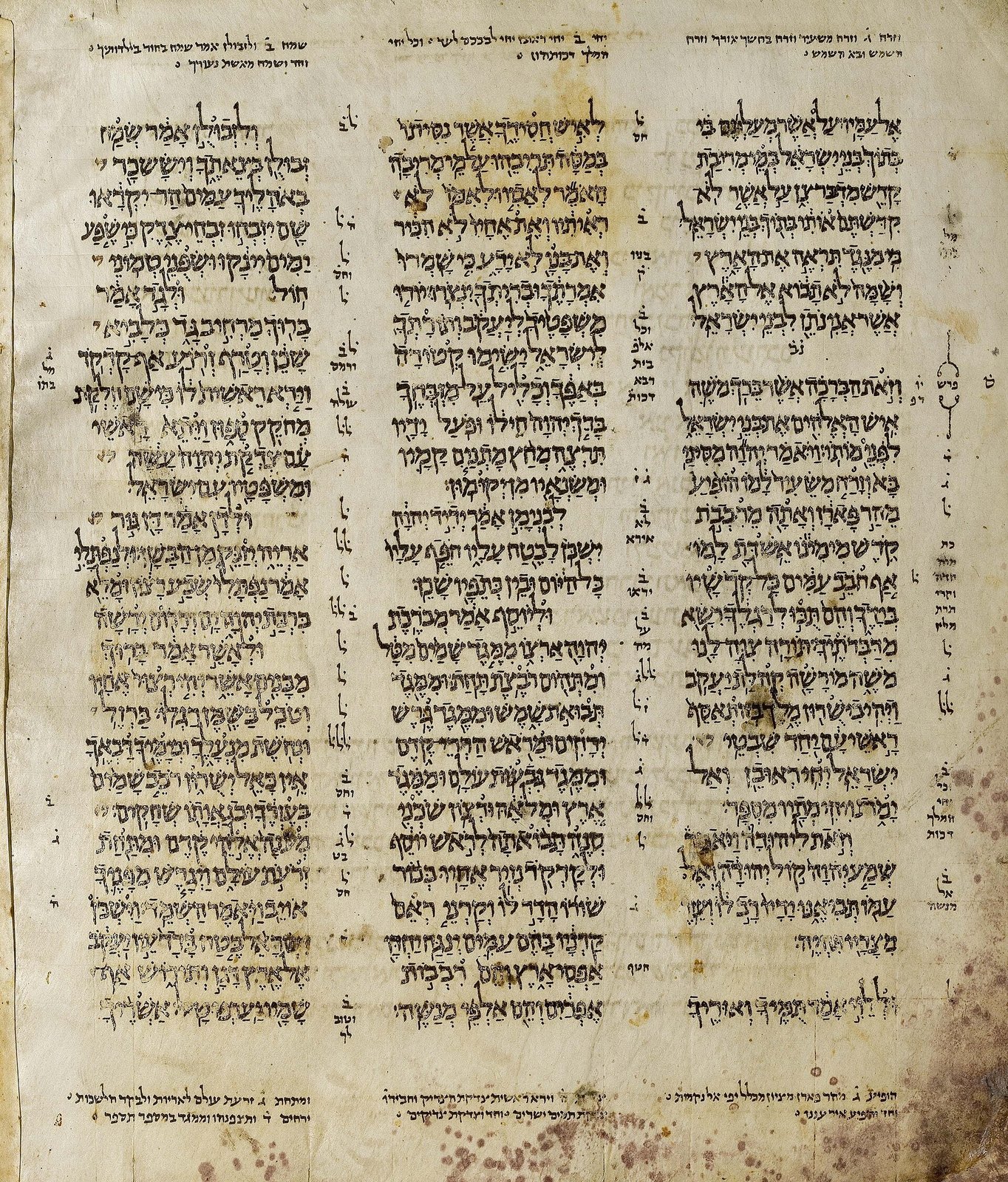
The name is written yod, he, waw, he — YHWH, known from its Greek description as the Tetragrammaton, the word of four letters. Hebrew was written without vowels, and when the Masoretic scribes added vowel signs in the early Middle Ages they did not supply the name's own. They marked it instead with the vowels of Adonai, my Lord, as a standing instruction to read that word in its place: a qere perpetuum, a reading that never changes. The pronunciation Yahweh is a scholarly reconstruction. It rests on Greek transcriptions such as Iaoue in Clement of Alexandria and Iabe, which Theodoret of Cyrrhus reports as the Samaritan form, on the short form Yah in Hallelujah, and on personal names ending in -yahu. Exodus 3 explains the name when Moses asks at the burning bush who has sent him: ehyeh asher ehyeh, rendered I AM THAT I AM by the King James Bible and equally translatable as I will be what I will be; verse 15 adds that this is my name for ever. Most scholars connect the name with the verb to be — he is, or he causes to be — while others derive it from a root meaning to blow or to fall, and no explanation is undisputed. Exodus 6:3 says that the patriarchs knew God as El Shaddai and not yet by this name, a tension that helped nineteenth-century critics separate a Yahwist from an Elohist source in the Pentateuch.
The Oldest Witnesses
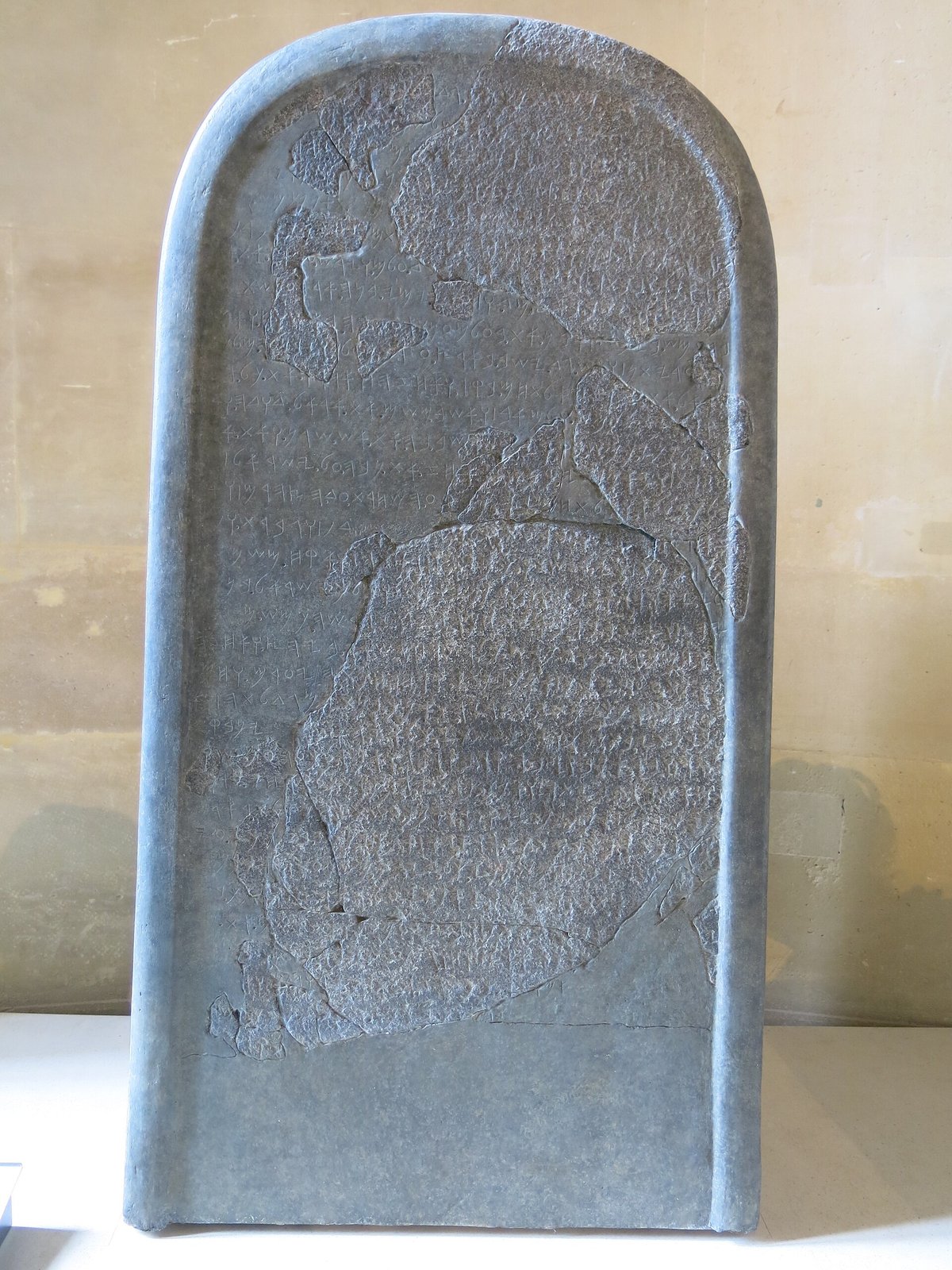
Outside the Bible the name appears earlier than most people expect, and in places they would not expect it. Topographical lists carved in the Nubian temple of Soleb under Amenhotep III in the fourteenth century BCE, and repeated at Amara West under Ramesses II, name a land of the Shasu, the nomads south and east of Canaan, followed by yhw. Whether this means a place, a tribe or a god is debated, but many scholars see in it the earliest trace of the name. The first certain attestation is Moabite: on the Mesha Stele, set up around 840 BCE and found at Dhiban in 1868, King Mesha of Moab boasts in lines 17–18 that he took the vessels of YHWH from Nebo and dragged them before his god Chemosh. Around 800 BCE travellers at Kuntillet ʿAjrud, a way station in the northeastern Sinai, wrote blessings by YHWH of Samaria and his Asherah and by YHWH of Teman and his Asherah; a tomb inscription of the eighth century BCE from Khirbet el-Qom near Hebron blesses a man named Uriyahu by YHWH and by his Asherah. Two tiny silver scrolls from Ketef Hinnom in Jerusalem, from around 600 BCE, carry a form of the priestly blessing of Numbers 6:24–26, the oldest surviving fragment of a biblical text. And in the fifth century BCE a Jewish garrison on the Nile island of Elephantine kept a temple of YHW, Yahu, whose papyri also name a goddess Anat-Yahu.
A God from the South
The oldest poems of the Bible agree on one striking detail: YHWH comes from the south. The Song of Deborah (Judges 5:4–5) has him go out from Seir and march from the field of Edom while the earth trembles and the mountains melt; the Blessing of Moses (Deuteronomy 33:2) has him come from Sinai, dawn from Seir and shine forth from Mount Paran; Habakkuk 3:3 brings God from Teman, the Holy One from Mount Paran. Together with the YHWH of Teman of Kuntillet ʿAjrud and the Shasu lists of Egypt, these lines point to the arid lands of Edom, Seir and Midian south of Judah rather than to Canaan. The Bible itself makes Moses the son-in-law of a Midianite priest, called Jethro or Reuel, who praises YHWH, offers sacrifices to God and advises Moses in Exodus 18, and Judges 1:16 calls Moses' father-in-law a Kenite. From these threads the Kenite or Midianite hypothesis, which arose in the nineteenth century and was developed above all by Karl Budde, concludes that Israel learned the worship of YHWH from herders and smiths of the southern deserts. The hypothesis has been revised many times and is rejected by some, but a southern origin of the god is today widely accepted.
Yahweh and El
In the Bible the God of Israel is called both YHWH and Elohim, a plural form used as a singular, and often El, the common Semitic word for god and the name of the head of the pantheon known from the texts of Ugarit. There El is the aged father of the gods, wise and enthroned, and Athirat — Asherah — is his consort. Many historians think that YHWH, a warrior god from the south, merged with El in Israel and took over his titles: El Elyon, God Most High, whose priest Melchizedek blesses Abraham in Genesis 14; El Shaddai; El Olam. A trace of an older distinction may survive in Deuteronomy 32:8–9. In the Masoretic text the Most High divides the nations according to the number of the sons of Israel; a Hebrew manuscript from Qumran (4QDeutj) reads sons of God, and the Septuagint has angels of God. In that older form the Most High assigns each nation to a divine being, and YHWH's portion is his people Jacob. Some scholars, among them Mark S. Smith, read this as a memory of YHWH as one of the sons of El; others hold that Elyon and YHWH were the same from the start. Psalm 82, in which God stands in the divine council and judges the gods, belongs to the same world. Another early title is YHWH Sebaoth, Lord of Hosts, used more than two hundred and fifty times: he is enthroned on the cherubim above the Ark (1 Samuel 4:4), the seraphim call him holy, holy, holy (Isaiah 6:3), and as Iao Sabaoth he became one of the most invoked names of the magical papyri of late antiquity. In the biblical account no statue sat on that throne, for Exodus 20:4 forbids any carved likeness, though the Bible remembers the golden calves that Jeroboam set up at Bethel and Dan (1 Kings 12:28–29).
Baal, Asherah and the Rivalry of Gods
Many of YHWH's titles and images are shared with Baal, the storm god of the Levant. Psalm 29 praises the voice of YHWH over the waters in terms that many scholars think adapt an older hymn to a storm god, and Psalm 68:4 calls him the one who rides through the deserts, or on the clouds, as Baal is called rider of the clouds at Ugarit. The Bible tells the story of this closeness as a contest. In 1 Kings 18 the prophet Elijah, whose name means my God is Yah, challenges the prophets of Baal on Mount Carmel; fire falls on YHWH's altar and the people cry out that YHWH is God. Asherah is a harder case. The inscriptions bless by YHWH and his Asherah, the Bible speaks of asherah poles beside altars, and 2 Kings 23 records that an image of Asherah stood in the temple of Jerusalem itself until Josiah burned it, together with the houses where women wove for her. Jeremiah 7 and 44 report families baking cakes for the Queen of Heaven. Whether Asherah was once worshipped as YHWH's consort or only as a cult object in his sanctuaries remains debated, but many historians now describe the religion of Israel and Judah before the exile as far more plural than the later texts allow.
From One God Among Many to the Only One
The Bible's own account presents the worship of YHWH alone as original and the other gods as later lapses; modern historians largely reverse the order. A movement demanding that Israel worship YHWH alone is visible in the prophets of the eighth century, Hosea above all. In 622 BCE, according to 2 Kings 22–23, a book of the law was found in the temple under King Josiah, who then removed the cult objects of Baal and Asherah, abolished the shrines outside Jerusalem and centralised worship in the capital; many scholars identify the book with an early form of Deuteronomy, whose Shema (Deuteronomy 6:4) declares: Hear, O Israel, YHWH is our God, YHWH is one. The decisive change came after the Babylonians destroyed Jerusalem and its temple in 587 or 586 BCE. In exile an anonymous prophet whose words are preserved in Isaiah 40–55, known as Deutero-Isaiah, went further than any before him: I am YHWH, and there is no other; besides me there is no god (Isaiah 45:5). In 45:7 the same God forms light and creates darkness, makes peace and creates evil — the most radical statement of monotheism in the Bible, which leaves no second power to blame. Thomas Römer's L'invention de Dieu (2014), in German Die Erfindung Gottes (2018), traces this path from a regional storm and war god to the one God of the world.
The Name That Is Not Spoken
In Second Temple Judaism the name became too holy for ordinary speech. According to the Mishnah (Yoma 6:2) the high priest pronounced it on the Day of Atonement, and the people who heard it fell on their faces; elsewhere it was replaced. The Mishnah (Sanhedrin 10:1) also cites Abba Saul's ruling that whoever pronounces the Name by its letters has no share in the world to come. After the destruction of the temple in 70 CE the pronunciation passed out of use. In prayer and scriptural reading Jews say Adonai; in everyday speech many say HaShem, the Name, and many write G-d even in other languages. Greek-speaking Judaism rendered the name as Kyrios, Lord, and the New Testament inherited the word. Most Christian Bibles keep the same custom: the King James Bible prints LORD in capitals, Luther HERR. In 2008 the Vatican's Congregation for Divine Worship directed that the name Yahweh should not be used or pronounced in Catholic liturgy, out of respect for Jewish practice. Behind the whole tradition stands the commandment not to take the name of YHWH in vain (Exodus 20:7).
Jehovah
The form Jehovah arose from the Masoretic convention itself: Christian scholars who read the consonants YHWH with the vowels of Adonai produced a hybrid that no Hebrew speaker had ever pronounced. The Dominican Raymund Martini already wrote Yohoua in his Pugio fidei around 1278, and the Franciscan Petrus Galatinus used Iehoua in his De arcanis catholicae veritatis of 1518, a work long but wrongly credited with inventing the form. William Tyndale put Iehouah into his English Pentateuch of 1530, and the King James Bible of 1611 used Jehovah in a handful of places such as Exodus 6:3. Scholarship replaced it with Yahweh in the nineteenth century, but Jehovah survives in hymns, in literature and above all in the name of the Jehovah's Witnesses, adopted in 1931 from Isaiah 43:10, ye are my witnesses, saith the LORD.
The Jealous God Becomes the Demiurge
The most radical reinterpretation came from within early Christianity. Several Gnostic schools of the second and third centuries identified the God of the Jewish scriptures, or at least the creator they describe, with a lesser maker of the world. In the Apocryphon of John the ruler Yaldabaoth repeats the jealous God of Exodus 20:5 and the there is no other of Isaiah 45 — the same lines on which Deutero-Isaiah built his monotheism became, in Gnostic eyes, proof of the creator's blindness. The Valentinian teacher Ptolemy, in his Letter to Flora, described the giver of the Law as neither the perfect God nor the devil but a just intermediate craftsman. Marcion of Sinope, expelled from the church in Rome in 144, set the just creator of the Law against the good and unknown Father of Jesus and removed the Jewish scriptures from his canon. The church rejected these teachings and held to the identity of the God of Israel with the Father of Christ, and the anti-Jewish edge of several of these readings has been criticised ever since. The Vault's entry on the Demiurge follows this tradition in detail.
Blake, Jung and the Historians
William Blake, who knew the Bible intimately and despised the God of moral law, observed in The Marriage of Heaven and Hell that in the Book of Job Milton's Messiah is called Satan, and wrote that the Jehovah of the Bible is no other than he who dwells in flaming fire. On his late engraving of the Laocoön he labelled the ancient group as Yah, written in Hebrew letters, and his two sons Satan and Adam, and his Urizen, the bearded lawgiver with the compasses, is widely read as a caricature of the same God. Carl Gustav Jung's Answer to Job (1952) treated YHWH as a psychological figure, a god of power not yet conscious of himself, who in the trial of Job is morally outstripped by a man and must become human to catch up. Historical criticism took another road, beginning with Julius Wellhausen's Prolegomena to the History of Israel (1883), which made the dating of the Pentateuch's sources the key to Israel's religion.
Names of Power and the Luciferian Reversal
Esoteric tradition approached the name as a force rather than a person. Jewish Kabbalah made the four letters the centre of its speculation on the divine names and the sefirot, and derived the Shem ha-Mephorash, the explicit name, from three verses of Exodus 14:19–21 as seventy-two names of three letters each. Christian Kabbalists of the Renaissance took this up: Johannes Reuchlin's De verbo mirifico (1494) argued that inserting the letter shin into YHWH yields YHSWH, read as the name of Jesus. Through Cornelius Agrippa and the grimoires the Tetragrammaton entered Western magic, inscribed on pentacles and circles of protection, and the Hermetic Order of the Golden Dawn assigned its four letters to fire, water, air and earth. Luciferian and Satanic readings usually take the opposite course and follow the Gnostics and Blake: if the god of Eden forbids knowledge and demands obedience, then the serpent who offers it, read as Lucifer, is the liberator, and YHWH becomes the archetype of the tyrant, the jealous father or the jailer of the world. These are modern constructions on ancient material; the Hebrew texts know no such opposition, and the Vault records them as readings, not as the history of the god.
Where the Vault Leaves It
What history can establish is that a god named YHWH was worshipped in Israel and Judah from at least the ninth century BCE, that his origins probably lie in the deserts to the south, that his cult grew up beside and in competition with El, Baal and Asherah, and that the conviction that he alone is God took shape over centuries, with the exile as its turning point. What the name means to those who pray to him lies beyond that history, and it is not the Vault's place to judge it: for Judaism it is the holy name guarded by silence, for Christianity the God whom Jesus called Father, and for the Gnostic, Blakean and luciferian currents a figure to be questioned. The Vault keeps these readings side by side, gives each its sources, and treats the name itself with the reticence of the tradition that has carried it longest.
Appearance
In the Hebrew Bible without image: at Horeb the people heard a voice but saw no form (Deuteronomy 4:12). In visions he is seen enthroned — above the cherubim, in the temple of Isaiah 6, in Ezekiel 1 as the likeness of a man in fire and rainbow light, as the Ancient of Days with garment and hair white as snow in Daniel 7; in theophanies as the burning bush, the pillar of cloud and fire, storm and earthquake, and the still small voice of 1 Kings 19:12
Powers
- Revealing himself by name
- Making and keeping covenant
- Storm, fire and the march from the south
- Judgment over nations and gods
- Compassion and forgiveness (Exodus 34:6–7)
Also Known As
YHWH, Jehovah, Adonai, HaShem, The Tetragrammaton, Yah, YHWH Sabaoth (Lord of Hosts), Ehyeh asher ehyeh, The Lord
Attributes
- The holy name
- Covenant
- Holiness
- Jealousy
- Justice and mercy
Symbolic Correspondences
- Elements: Fire, storm and cloud
- Colours: The gleam of fire and amber in Ezekiel 1, white in Daniel 7, the blue (tekhelet) of the priestly garments and the tassels, the gold of the Ark and the cherubim
- Numbers: Four — the letters of the Tetragrammaton; twenty-six — the numerical value of YHWH (10 + 5 + 6 + 5); seventy-two — the names of the Shem ha-Mephorash; three — the thrice-holy of Isaiah 6
- Associations: Sinai and Horeb, Seir, Edom and Teman, the burning bush, the Ark of the Covenant and the cherubim, the temple of Jerusalem, the Shema, El and Elyon, Baal and Asherah, Adonai and HaShem, Sabaoth, Jehovah, the Demiurge
The Figure, Symbol by Symbol
- The Four Letters: YHWH is written but not read. The name stands on the page and another word is spoken in its place, so that the holiest name of the Bible is present above all as a silence. Kabbalists and magicians later read the four letters as the structure of creation itself.
- I Am That I Am: The answer at the burning bush is a name and a refusal at once. Read as I am, it became for philosophers a name of pure being; read as I will be what I will be, it promises presence without allowing itself to be defined in advance.
- The Burning Bush: A fire that burns without consuming. Where Moloch's fire takes everything given to it, this one leaves its vessel intact, and the tradition has read it as the image of a holiness that can be near without destroying.
- The Storm from the South: The oldest poems show a god who marches out of Seir and Edom while mountains quake. The image keeps the memory of a warrior god of the desert, older than the temple and the law that later surrounded him.
- The Empty Throne: Above the cherubim of the Ark no statue sat. The empty seat between the wings turned the ban on images into an image of its own: rule that is present but cannot be possessed or carried away.
- Jealousy: The jealous God of Exodus binds a people as in a marriage and tolerates no rival. Jewish and Christian theology reads the word as the measure of an exclusive love; the Gnostics read it as the confession of an inferior ruler who knows that there is something above him.
- Jehovah: A name that never existed in Hebrew, born from the vowels of Lord written over the consonants of the Name. It shows how a tradition of reverence, read by outsiders, produced a new word that has lived its own life for five centuries.
Reading the Whole
Read as a whole, the symbolism of YHWH is a symbolism of absence and presence. There is no portrait, no statue that has survived, no myth of birth or death; there are fire, cloud, storm, an empty throne and a name that is written and not spoken. Every concrete image the neighbouring peoples gave their gods — the bull, the consort, the cult statue — appears in the history of YHWH and is in the end rejected or transformed, until what remains is a voice that speaks, commands and promises.
That is why the figure has been read in such opposite ways. For Judaism and Christianity the absence of image is the sign of a God beyond every human measure; for the Gnostics and their modern heirs the commanding voice is the voice of a ruler who will not be questioned; for the Kabbalists and magicians the four letters themselves are the power. The readings recorded here are attempts to fill the same silence.
Theological Significance
Theologically YHWH is the God who has a name. Where philosophers spoke of the divine and the surrounding peoples of many gods, the Hebrew Bible speaks of one who introduces himself, binds himself to a people by covenant and can be called upon. The covenant at Sinai, the Ten Commandments and the formula of Exodus 34:6–7 — merciful and gracious, slow to anger, abounding in steadfast love and faithfulness, yet not leaving guilt unpunished — define his character far more than any description of his appearance.
Holiness and Jealousy
Two words recur. Holy, qadosh, marks the distance between YHWH and everything else, as in the thrice-holy of Isaiah 6. Jealous, qanna, marks the exclusiveness of the bond: Exodus 34:14 says that YHWH, whose name is Jealous, is a jealous God. In the Bible this jealousy is the language of a marriage covenant rather than of envy, and the prophets Hosea, Jeremiah and Ezekiel use the image of an unfaithful spouse for Israel's turning to other gods. The Gnostics read the same word as proof of an inferior creator; Jewish and Christian theology reads it as the measure of a love that will not share.
One God, Three Traditions
Judaism, Christianity and Islam all claim the God of Abraham, but they relate to the name in different ways. Judaism keeps the Tetragrammaton as the holiest name and does not pronounce it. Christianity confesses the God of Israel as the Father of Jesus and, in the doctrine of the Trinity, as Father, Son and Spirit, while its Bibles read Lord where the name stands. The Quran does not use the Tetragrammaton; it calls God Allah and identifies him with the God of Abraham, Moses and Jesus. The Shema of Deuteronomy 6:4 remains the daily confession of Judaism, and in the Gospel of Mark (12:29) Jesus quotes it as the first of the commandments.
Practical Application
YHWH is not a figure of demonolatry, and the Vault does not treat him as a spirit to be invoked. For Judaism and Christianity he is the living God of their worship, and their own traditions of prayer, study and liturgy are the proper place for that relationship; the Vault offers no rites in his name and regards the ritual misuse of the holy name as disrespectful to the traditions that keep it.
In Western ceremonial magic the Tetragrammaton has long appeared on seals, circles and pentacles as a name of protection and authority, and the Vault records this as part of the history of magic rather than as an instruction. For study and reflection the figure is best approached through its sources: reading the old poems of the south, the Elijah cycle, Deutero-Isaiah and the Book of Job side by side, and asking how a people's understanding of its God changed through war, exile and argument.
Modern Interpretations
Modern readings of YHWH divide less along the line between belief and unbelief than over the question of what kind of figure he is: a deity with a history, a theological reality, a psychological archetype or a symbol of power. The readings below are recorded as their proponents hold them.
The God With a History
Historical-critical scholarship treats YHWH as a deity whose image changed over a thousand years: a storm and war god from the south, merged with El, separated from Baal and Asherah, and finally proclaimed the only God. Archaeology, comparative Semitic studies and the inscriptions of Kuntillet ʿAjrud and Khirbet el-Qom supply the material, and books such as Mark S. Smith's The Early History of God and Thomas Römer's Die Erfindung Gottes have brought the debate to a wide public. Many believers accept this history as the way revelation took shape in time; others reject its premises.
The Archetype of the Father
Depth psychology, following Jung's Answer to Job, reads YHWH as the image of a power that must become conscious of itself, and later writers in psychology and feminist theology have examined how the figure of a male, solitary and jealous God shaped ideas of authority. The rediscovered Asherah has become, for some feminist theologians and contemporary pagans, the symbol of a goddess the tradition suppressed.
The Tyrant and the Liberator
In Gnostic revival movements, in luciferian and Satanic writing and in much popular culture, YHWH is read as the Demiurge: the jealous ruler of a closed world, opposed by the serpent, Lucifer or Prometheus as bringers of knowledge. Philip Pullman's trilogy His Dark Materials (1995–2000), in which the Authority is an ancient angel who claimed to be the creator, is a well-known literary example. Its adherents see in this reading a critique of authority as such; critics point out that it often repeats, knowingly or not, ancient polemics that were also aimed at Judaism.
Across these readings one feature holds attention: a God who is known by a name, who speaks and demands, and who can therefore be argued with — by Job, by the Gnostics, by Blake and by the modern reader.
Sources & Historical Texts
- Hebrew Bible — Exodus 3:13–15; 6:2–3; 20:2–7; 34:6–7, 14
- Hebrew Bible — Deuteronomy 6:4; 32:8–9; 33:2; Judges 5:4–5; Habakkuk 3:3
- Hebrew Bible — 1 Kings 18; 2 Kings 22–23; Isaiah 6:3; 45:5–7; Psalms 29; 68:4; 82
- Egyptian lists of the Shasu lands — Soleb (Amenhotep III, 14th c. BCE) and Amara West (Ramesses II, 13th c. BCE)
- Mesha Stele (Moab, c. 840 BCE), lines 17–18
- Kuntillet ʿAjrud inscriptions (c. 800 BCE)
- Khirbet el-Qom, inscription 3 (8th c. BCE)
- Ketef Hinnom silver amulets (c. 600 BCE)
- Elephantine papyri (5th c. BCE)
- Septuagint and the Qumran manuscript 4QDeutj (Deuteronomy 32:8)
- Mishnah Yoma 6:2; Sanhedrin 10:1
- Diodorus Siculus — Library of History 1.94
- Clement of Alexandria — Stromata V 6; Theodoret of Cyrrhus — Questions on Exodus 15
- Ptolemy — Letter to Flora (in Epiphanius, Panarion 33)
- Apocryphon of John (Nag Hammadi Codex II,1 and parallels)
- Raymund Martini — Pugio fidei (c. 1278)
- Petrus Galatinus — De arcanis catholicae veritatis (1518)
- Johannes Reuchlin — De verbo mirifico (1494)
- William Blake — The Marriage of Heaven and Hell (c. 1790–93); Laocoön (c. 1826–27)
- Julius Wellhausen — Prolegomena to the History of Israel (1883)
- Carl Gustav Jung — Answer to Job (1952)
- Mark S. Smith — The Early History of God (1990); The Origins of Biblical Monotheism (2001)
- Thomas Römer — L'invention de Dieu (2014; German: Die Erfindung Gottes, 2018; English: The Invention of God, 2015)