Jesus Christ

- Category
- Central Figure of Christianity
- Origin
- Galilee and Judea under Roman rule (c. 6–4 BCE to c. 30/33 CE); the letters of Paul and the Gospels (c. 50–100 CE); Josephus, Tacitus, Suetonius and Pliny the Younger; Gnostic, rabbinic and Islamic tradition
History & Lore
Jesus of Nazareth was a Jewish teacher and healer from Galilee who was baptised by John the Baptist, gathered disciples, announced the kingdom of God and was crucified in Jerusalem under the Roman prefect Pontius Pilate around 30 or 33 CE. His followers proclaimed him risen and called him Christ, the Greek rendering of Messiah, the anointed one; within three centuries the councils of the church defined him as fully God and fully human. For demonology he matters more than almost any other figure: the Gospels portray him as an exorcist who drove out unclean spirits, was accused of doing so by Beelzebul, and was tempted by Satan in the wilderness. Gnostic, Jewish, Islamic, magical and Satanic traditions have each drawn their own, very different portrait of him. The Vault itself reads him not as a redeemer but as a teacher of the inner way, for whom the kingdom of God lay within and Christ was a state that can awaken in every person.
Few lives have been described more often, and few are harder to see clearly. Jesus of Nazareth left no writings of his own; everything known about him comes from people who either worshipped him, opposed him or mentioned him in passing, and most of it was written down decades after his death. Christianity holds him to be the Son of God, Judaism a Jewish teacher who was not the Messiah, Islam a prophet who was neither killed nor crucified, the Gnostics a messenger from the realm of light, the ancient critics a magician, and the modern historians a figure who can be reconstructed only in outline. For a Vault of demonology he is unavoidable for a further reason: in the Gospels the struggle with demons is not a side theme but one of the most frequently reported things he does. To follow him honestly is to keep these portraits apart, to say what the sources support, and to leave the faith of believers and the doubts of sceptics where they belong.
The Man from Nazareth
The name is the Greek Iēsous for the Hebrew and Aramaic Yeshua, a short form of Joshua and one of the commonest names of the time, which is why he is distinguished by his town: Jesus of Nazareth, a small village in Galilee. Matthew and Luke place his birth in Bethlehem, Matthew under King Herod, who died in 4 BCE, and Luke in connection with the census of Quirinius, which Roman records date to 6 CE; the two accounts are difficult to harmonise, and most historians place the birth around 6 to 4 BCE. The calendar that counts from his birth was calculated by the monk Dionysius Exiguus in 525 and is off by a few years. As an adult Jesus was baptised in the Jordan by John the Baptist, began to teach and heal in Galilee, gathered an inner circle of twelve and announced the coming kingdom of God, often in parables. He was arrested in Jerusalem at Passover and crucified on the order of Pontius Pilate, Roman prefect of Judea from 26 to 36 CE; the most frequently proposed dates are 7 April 30 and 3 April 33. That he lived, was baptised by John and was crucified under Pilate is accepted by nearly all historians, whatever they believe.
Witnesses Outside the Church
A handful of non-Christian writers mention him. Flavius Josephus, the Jewish historian, completed his Antiquities of the Jews around 93 or 94 CE. In Book XVIII 63–64, the passage known as the Testimonium Flavianum, he speaks of Jesus as a wise man who was crucified by Pilate; but the text as preserved also says he was the Messiah and rose on the third day, phrases a Jewish author is unlikely to have written. Most scholars therefore hold that Josephus wrote something about Jesus which Christian copyists later expanded; an Arabic summary preserved by the tenth-century bishop Agapius, published by Shlomo Pines in 1971, offers a more restrained version. The second passage, Book XX 200, is generally accepted: it reports the execution in 62 CE of James, the brother of Jesus who was called Christ. Tacitus, writing his Annals around 116, explains in Book XV 44 that the Christians blamed by Nero for the fire of Rome took their name from Christus, who suffered the extreme penalty under Tiberius at the hands of the procurator Pontius Pilatus. Suetonius (Claudius 25.4) reports that Claudius expelled the Jews from Rome because they were constantly rioting at the instigation of one Chrestus, a name often, though not universally, taken as a garbled reference to Christ. Pliny the Younger, governor of Bithynia, wrote to Trajan around 112 that the Christians met before dawn to sing a hymn to Christ as to a god, carmen Christo quasi deo.
How the Gospels Came to Be
The earliest Christian texts are not the Gospels but the letters of Paul, written from about 50 CE onward; First Thessalonians is usually placed first. Paul says little about the life of Jesus, but he hands on an early list of resurrection appearances (1 Corinthians 15:3–8) and mentions James, the brother of the Lord (Galatians 1:19). The Gospel of Mark, usually dated around 70, is the earliest narrative. Matthew and Luke, written some ten to twenty years later, use Mark and share a large body of sayings not found in him; since Christian Hermann Weisse in 1838 this common material has been explained by a lost source later called Q, from the German Quelle, a hypothesis widely held though never confirmed by a manuscript. The Gospel of John, usually dated to the 90s, follows a different chronology and a markedly more theological voice. All four were written in Greek, anonymously; the names attached to them come from second-century tradition.
From Messiah to the Creed of Chalcedon
Christ is not a surname but a title. The Hebrew mashiach, anointed, was translated into Greek as christos, and in the Judaism of the time it could mean a coming king of David's line, a priestly figure or a heavenly deliverer. The first followers applied the title to a crucified man, which most of their contemporaries found absurd. Over the next centuries the question of what he was became the central argument of the church. In 325 the Council of Nicaea, called by the emperor Constantine, rejected the teaching of the presbyter Arius that the Son was a created being and declared him homoousios, of one substance with the Father. In 451 the Council of Chalcedon defined him as one person in two natures, divine and human, without confusion, change, division or separation. The churches of Egypt, Armenia and Syria that rejected Chalcedon remain separate to this day, a reminder that the definition was a decision, not a consensus.
The Exorcist of Galilee
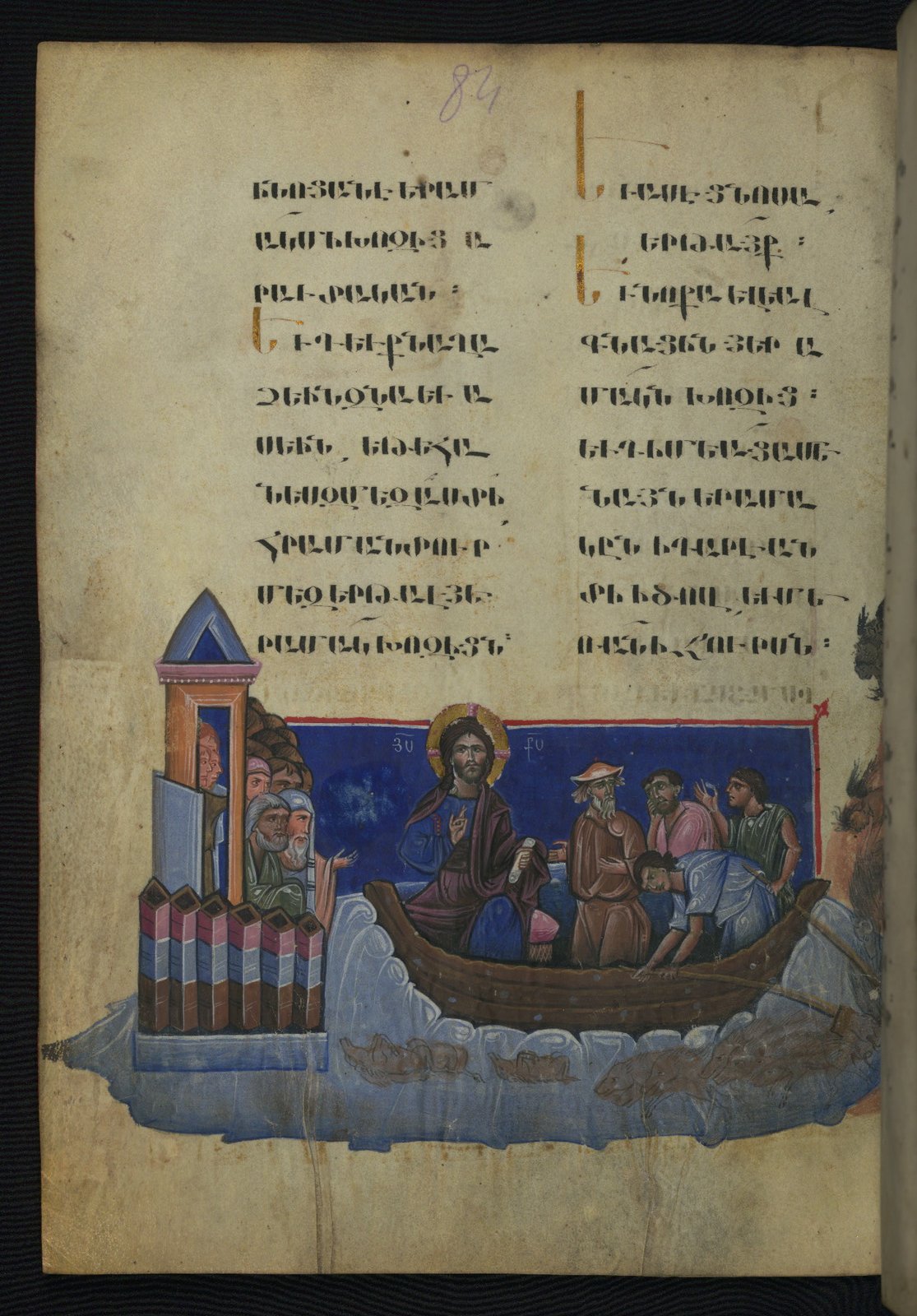
In the earliest Gospel the first mighty deed of Jesus is an exorcism. In the synagogue at Capernaum a man with an unclean spirit cries out that he knows who Jesus is, the Holy One of God; Jesus silences it and commands it to come out, and the onlookers marvel that even the unclean spirits obey him (Mark 1:23–27). In the country of the Gerasenes, across the Sea of Galilee, he meets a man living among the tombs whom no chain can hold; asked its name, the spirit answers that it is Legion, for they are many, and at its own request the spirits are sent into a herd of about two thousand pigs, which rush into the sea (Mark 5:1–20). Further accounts follow: a Syrophoenician girl healed at a distance, a boy with a mute spirit whom the disciples could not help, Mary Magdalene, from whom seven demons had gone out (Luke 8:2). Historians who doubt much else in the Gospels often regard the core of this tradition as old; Graham Twelftree's Jesus the Exorcist (1993) is a standard study. What distinguishes these accounts from other ancient exorcisms is the method: no rings, roots or long incantations, only a word of command.
Beelzebul and the Strong Man
The exorcisms provoked the oldest charge against him. Scribes from Jerusalem said that he had Beelzebul and cast out demons by the prince of demons (Mark 3:22–27). The name recalls Baal-zebub, the god of Ekron consulted by King Ahaziah in 2 Kings 1, and was understood as a title of the ruler of the demons. Jesus answers with an argument: how can Satan cast out Satan? A kingdom divided against itself cannot stand, and no one can plunder a strong man's house unless he first binds the strong man. In Matthew and Luke he adds that if he casts out demons by the Spirit or the finger of God, the kingdom of God has come upon his hearers (Matthew 12:28; Luke 11:20). The passage is one of the founding texts of Christian demonology. It presents the demons as a realm with a ruler, the exorcisms as raids on that realm, and the dispute as a question of authority: by whose power does he act? Later demonologies, from the Testament of Solomon to the grimoires, inherited the name Beelzebub from it.
Satan in the Wilderness
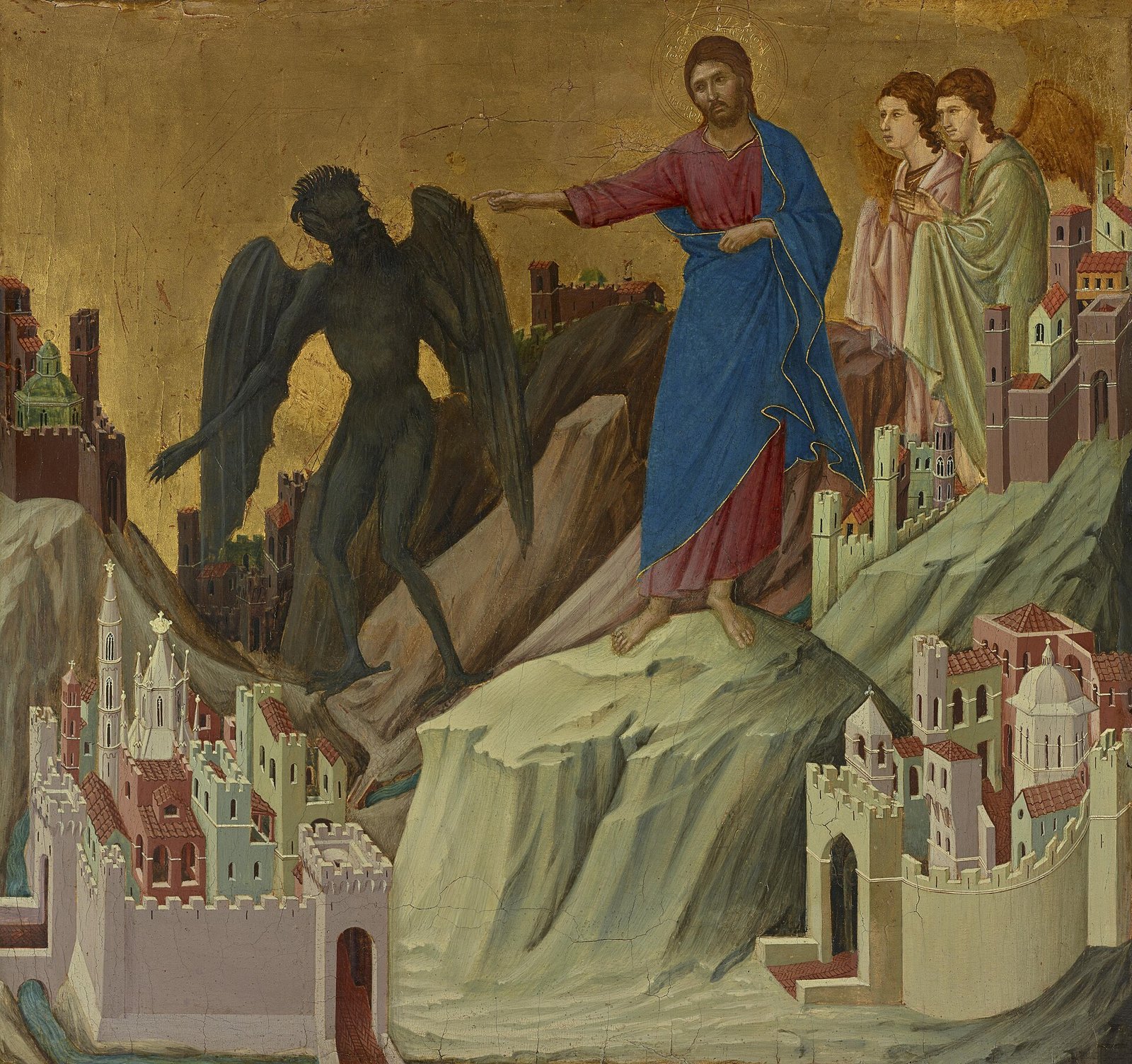
After his baptism, according to all three Synoptic Gospels, Jesus was driven into the desert and tempted by Satan for forty days. Mark gives only a sentence (Mark 1:12–13); Matthew and Luke describe three temptations (Matthew 4:1–11; Luke 4:1–13). The devil invites him to turn stones into bread, to throw himself from the pinnacle of the Temple so that angels would catch him, and to receive all the kingdoms of the world in return for worship; in Luke he adds that their authority has been given to him and that he gives it to whom he will. Jesus answers each time with a verse from Deuteronomy. Christian interpreters have read the scene as the reversal of Adam's fall and of Israel's forty years in the desert; others see in it a refusal of three kinds of power, over need, over miracle and over politics. Dostoevsky made exactly this reading the core of the Grand Inquisitor in The Brothers Karamazov (1880).
The Descent into Hell
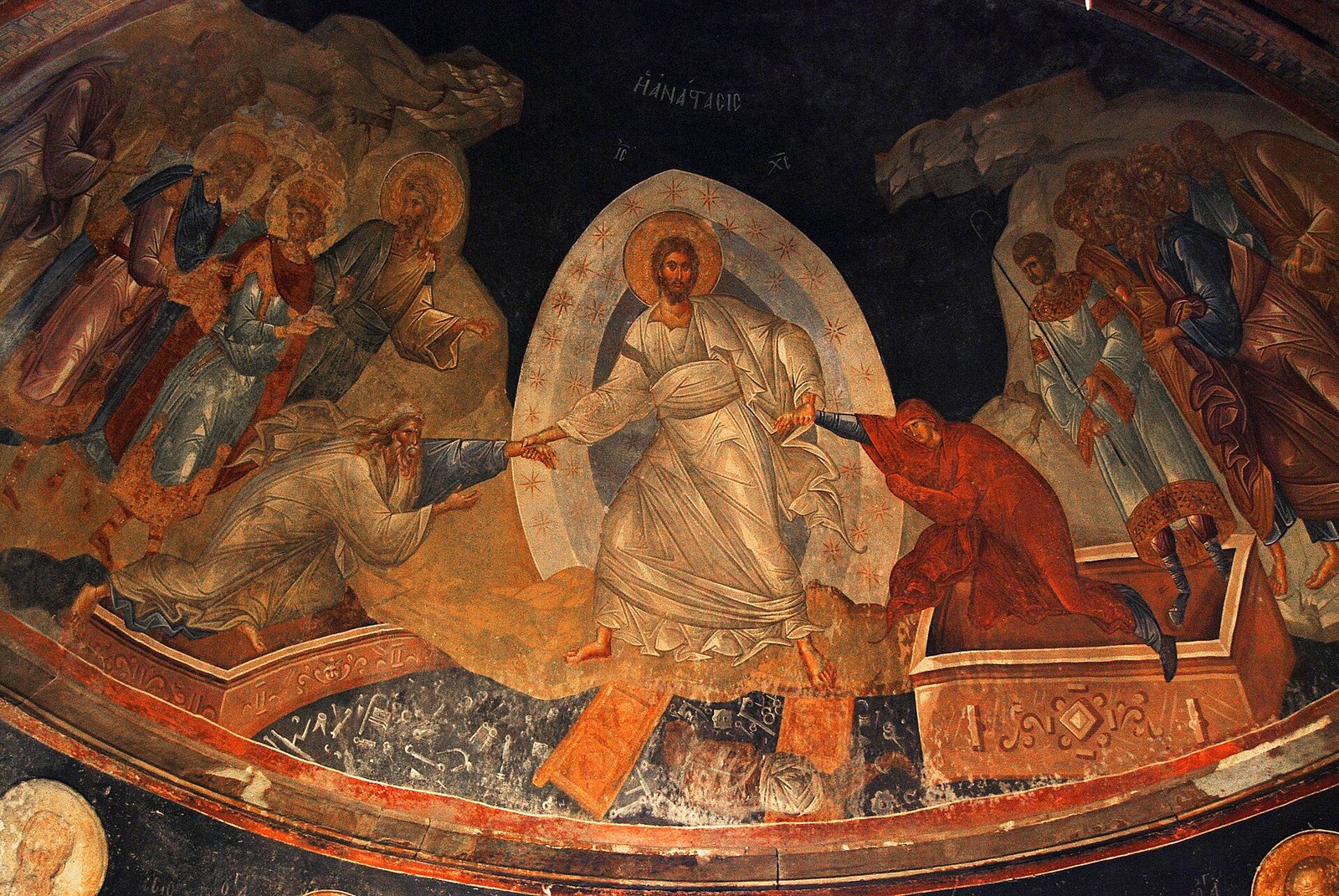
A short and difficult verse says that Christ went and preached to the spirits in prison (1 Peter 3:19). From this, and from passages such as Ephesians 4:9, grew the belief that between his death and resurrection he descended to the realm of the dead. It entered the Apostles' Creed as descendit ad inferos, he descended to the dead or into hell. The late antique Gospel of Nicodemus gives it dramatic form: Satan and Hades argue as the gates burst open, Christ binds Satan and leads Adam and the righteous out. Medieval art and the English mystery plays called the scene the Harrowing of Hell. For demonology it is the moment in which the underworld is entered not by a conjurer but by a conqueror, and its rulers lose their captives.
The Gnostic Christ
Second-century Gnostic teachers kept the name of Christ but changed almost everything around it. In the Valentinian system reported by Irenaeus, Christ and the Holy Spirit are emitted to restore order in the Pleroma after the passion of Sophia, and Jesus the Saviour, the common fruit of all the aeons, descends to redeem her and to awaken the spiritual seed in the world. Some teachers were docetists, from the Greek dokein, to seem: the Saviour only appeared to have a body and to suffer. Irenaeus reports that Basilides taught that Simon of Cyrene was crucified in his place, and the Apocalypse of Peter from Nag Hammadi shows a laughing Saviour above the cross. The Gospel of Thomas, found at Nag Hammadi in 1945, collects 114 sayings without birth, miracles or passion; salvation lies in understanding his words. The Gospel of Judas, preserved in the Coptic Codex Tchacos and published by the National Geographic Society in 2006, makes Judas the only disciple who understands; its first translators read him as a hero, while April DeConick argued in The Thirteenth Apostle (2007) that Jesus calls him the thirteenth daimon, a demon.
Jesus in Judaism and Islam
Judaism does not regard Jesus as the Messiah, since the messianic age of peace and restoration did not arrive. A few passages in the Babylonian Talmud speak of a Yeshu executed on the eve of Passover for sorcery and leading Israel astray (Sanhedrin 43a); whether all of them refer to Jesus of Nazareth is debated, and Peter Schäfer's Jesus in the Talmud (2007) reads them as a deliberate counter-narrative to the Gospels. The Toledot Yeshu, a polemical folk tale whose surviving manuscripts are medieval, tells a mocking version in which Jesus works his wonders by stealing the divine Name from the Temple; it arose under Christian pressure and was never doctrine. Modern Jewish scholars, from Joseph Klausner (1922) to Geza Vermes in Jesus the Jew (1973), have reclaimed him as a figure of Jewish history. In Islam, ʿĪsā ibn Maryam is one of the greatest prophets, born of a virgin, called al-Masīḥ, the Messiah, and given the Gospel. The Qur'an denies that he was God's son and says in Sura 4:157 that they did not kill him nor crucify him, but it was made to appear so to them; God raised him to Himself.
Jesus the Magician
From the second century onward opponents explained his miracles as magic. Around 175 to 180 the Platonist Celsus wrote The True Word, known only from Origen's reply Against Celsus (around 248): Jesus, he claimed, had learned magical powers in Egypt and returned to proclaim himself a god. The charge was not absurd in its world. Miracle-workers, exorcists and sellers of spells were everywhere, the Acts of the Apostles reports Jewish exorcists who tried to use his name (Acts 19:13–16), and the Greek Magical Papyri contain an exorcism that invokes Jesus, the god of the Hebrews (PGM IV 3007–3086). In 1978 the historian Morton Smith argued in Jesus the Magician that his contemporaries were right: the historical Jesus belonged to the world of ancient magicians, and the Gospels had covered this up. The book remains controversial, and Smith's own discovery of a Secret Gospel of Mark has been suspected of forgery, but it forced scholars to take seriously how much of what the Gospels report resembles the magic of the time.
Jesus on the Left-Hand Path
The currents of the left-hand path relate to Jesus in very different ways, and none of them simply as his enemy. Atheistic Satanism, from the Church of Satan to The Satanic Temple, rejects the Christian doctrine of sin, obedience and divine authority, but the person in the Gospels is rarely its target; many Satanists respect the man who confronted the powerful, broke rules on purpose and was executed by an alliance of temple and state. Some theistic and especially extremist currents are expressly hostile to everything they call Nazarene. Luciferians often note that the New Testament calls Christ the bright morning star (Revelation 22:16), and the Easter hymn Exsultet even names him the morning star, lucifer, that knows no setting. Aleister Crowley's Book of the Law (1904) attacks the crucified Christ in deliberately shocking terms, while the Gnostic churches of the occult revival honoured a revealing Christ. In demonolatry Jesus plays almost no role: its practice is directed to the demons themselves, not against a rival.
The Teacher of the Inner Way
The Vault reads Jesus differently from the churches, and it says so openly. For the Vault he was not a redeemer who had to die so that a debt could be paid, and not a lord to whom anyone owes submission, but a spiritual teacher who stood in his own centre and taught others to find theirs: the way inward. Christ, in this reading, is not his surname and not a rank above humanity but a name for something that can awaken in every person. The word itself points there: christos means the anointed one, from chriein, to anoint, and chrisma is the anointing oil. What follows gathers the passages and traditions on which this reading rests and marks clearly where history ends and the Vault's own reading begins.
Several sayings in the canonical Gospels support it, though none of them settles it. In Luke 17:21 Jesus tells the Pharisees that the kingdom of God does not come with signs to be observed, for the kingdom of God is entos hymōn. The King James Version and Luther rendered this as within you, most modern translations as among you or in your midst; the Greek allows both, and scholars still disagree, Ilaria Ramelli having argued in 2009 for within. In John 10:34 Jesus answers those who accuse him of making himself God by quoting Psalm 82:6: is it not written in your law, I said, you are gods? In its context the verse defends his own claim, but it states that scripture can call human beings gods. And in John 14:12 he promises that whoever believes in him will do the works he does, and greater works than these. Read together, these sayings describe a teacher who does not keep the divine for himself.
The Gospel of Thomas, discussed above among the Gnostic portraits, says it more plainly. In Logion 3 Jesus mocks those who would seek the kingdom in the sky or in the sea: the kingdom is inside you and outside you, and when you come to know yourselves you will know that you are the children of the living Father. Logion 70 says that what you bring forth from within yourselves will save you, and what you do not have within you will kill you. In Logion 77 he calls himself the light above all things and says that if you split a piece of wood he is there, and if you lift a stone you will find him there. In Logion 108 whoever drinks from his mouth becomes like him, and he himself becomes that person. This is the Christ the Gnostics knew, a revealer who awakens knowledge rather than a sacrifice that pays a debt. The historical critics reached a related conclusion by another road. Adolf von Harnack wrote in Das Wesen des Christentums (1900) that not the Son but the Father alone belongs in the Gospel as Jesus proclaimed it, William Wrede called Paul the second founder of Christianity (1904), and the doctrine that the death of Christ satisfied the honour of God received its classic form from Anselm of Canterbury in Cur Deus Homo, around 1098. How far the teaching of Jesus differed from the theology about him remains disputed; that the theology of redemption grew over centuries is not.
Western esotericism has spoken of Christ as a state within the human being for more than a century. Annie Besant taught in Esoteric Christianity (1901) that the aim was not to be saved by an external Christ but to unfold the Christ within; Rudolf Steiner described in Christianity as Mystical Fact (1902) how the mysteries of antiquity were brought into the open in the life of Jesus; and the language of Christ consciousness in the New Age carries the idea further. The Vault stands close to these readings: Christ is for it a state that awakens in us, and God is not a ruler outside us but the divine within us.
Two further images belong to the Vault's reading that are not historical at all, and they are named here as what they are, modern esoteric interpretations. The first is the chakras. The Gospels know nothing of them; the idea reached the West through Theosophy, where James Morgan Pryse read the Book of Revelation as an allegory of the seven centres of the body in The Apocalypse Unsealed (1910), Rudolf Steiner described the lotus flowers of the soul in How to Know Higher Worlds (1904–1905), and C. W. Leadbeater's The Chakras (1927) gave the system its popular Western form; modern kundalini-Christian teachers read the Gospels in the same light. The second is the Christ oil: the teaching of a sacred secretion, an oil or seed that rises along the spine to the head, which its modern proponents trace to George W. Carey and Inez Eudora Perry's God-Man: The Word Made Flesh (1920) and which plays on the link between christos and chrisma. The Vault takes up both openly as images of the way inward, not as a report of what Jesus said; that he taught the chakras is the Vault's reading, not something any ancient source records.
Where the Vault Leaves It
What history can say with confidence is modest. A Jewish teacher and healer named Jesus lived in Galilee, was baptised by John, gathered followers, was known as an exorcist and was crucified under Pontius Pilate; within a few years his followers proclaimed him risen and Messiah. His divinity, his resurrection and the meaning of his death belong to faith and doctrine, and the Vault respects those who hold them. That the kingdom lies within, that Christ is a state awakening in us and that Jesus taught a way inward, perhaps even the centres the East calls chakras, is the Vault's own reading, supported by sayings in Luke, John and Thomas and by the esoteric tradition, but not proven by them.
The Vault does not hide behind that distinction. For the Vault, Jesus was not a redeemer and not a lord to whom anyone must submit, but a teacher who pointed to the divine in every human being; religion as submission was never his teaching, and Christ is not a man to be worshipped but a state that awakens within us. This is also why Satanism is not the opposite of anything here: its quarrel, where there is one, is with coercion exercised in his name, not with the man in the Gospels, and the duel between Satan and Jesus is a Christian story the Vault does not need to take up.
Appearance
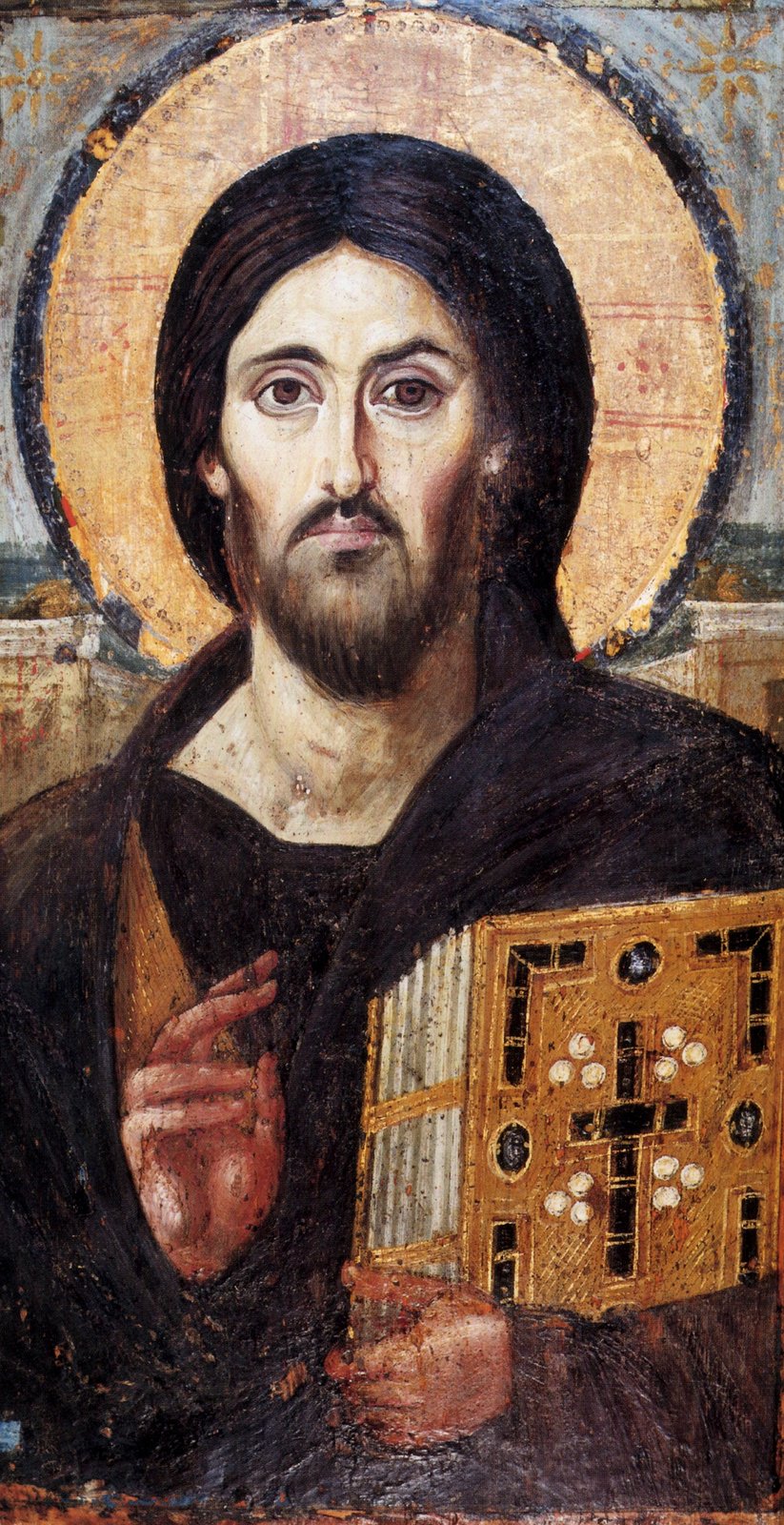
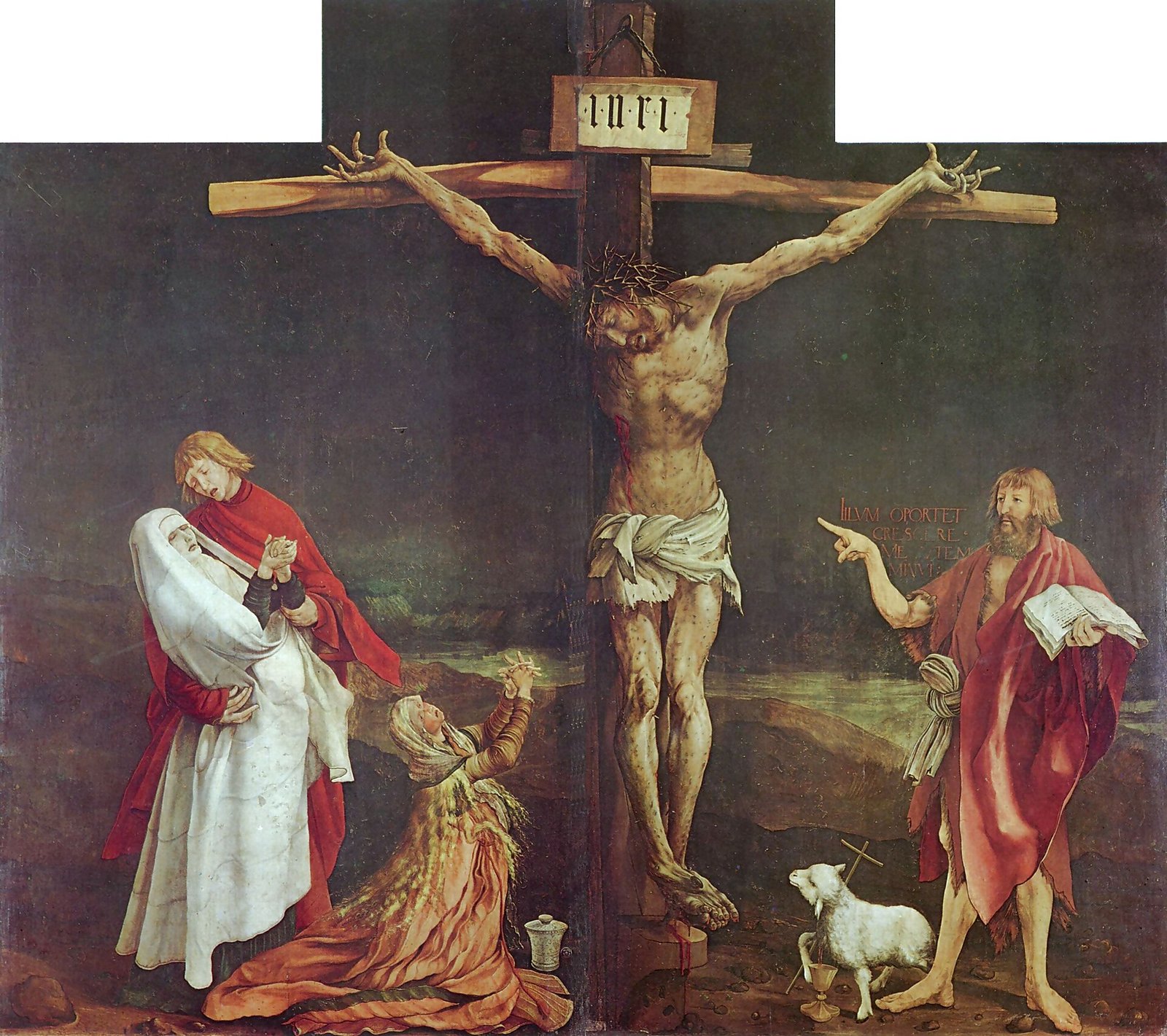
The Gospels never describe his appearance. The earliest images show a young, beardless shepherd or teacher; from the fourth century the bearded figure with long hair prevails, as in the Christ Pantokrator of icons; Western art shows him above all crucified, with the wounds of nails and spear and the crown of thorns
Powers
- Casting out unclean spirits by a word of command
- Healing
- Authority over Satan and the strong man's house
- Forgiveness of sins (in Christian teaching)
- Descent to the realm of the dead
- Revelation of hidden knowledge (in Gnostic teaching)
Also Known As
Jesus of Nazareth, Yeshua, Iēsous Christos, The Messiah, Son of God, The Word (Logos), Emmanuel, ʿĪsā ibn Maryam, Yeshu
Attributes
- Teacher and healer
- Exorcist
- Messiah (Christ)
- Crucified and proclaimed risen
- Word and revealer
Symbolic Correspondences
- Elements: Water (the baptism in the Jordan), bread and wine (the Last Supper), light (the light of the world, John 8:12), the wood of the cross
- Colours: In Byzantine icons a red or purple tunic and a blue mantle, often read as divinity and assumed humanity; liturgically white and gold at Easter, purple in Lent, red for the passion
- Numbers: Three (the third day), twelve (the disciples), forty (the days in the wilderness), 888 (the numerical value of Iēsous in Greek letters, noted in antiquity)
- Associations: The cross, the Chi-Rho, the fish (Ichthys), the lamb, the good shepherd, the morning star, Alpha and Omega, the Jordan, Golgotha, the empty tomb, Beelzebul and Legion, the Pleroma and Sophia
The Figure, Symbol by Symbol
- The Cross: A Roman instrument of execution for slaves and rebels became the sign of a whole religion. It does not appear as a common Christian image before the fourth century; earlier believers preferred the fish, the anchor and the shepherd. The cross holds the paradox at the centre of the tradition: power shown in a public defeat.
- The Fish (Ichthys): The Greek word ichthys forms an acrostic for Iēsous Christos Theou Hyios Sōtēr, Jesus Christ, Son of God, Saviour. Fishermen among the disciples, the calling to be fishers of people and the multiplication of loaves and fishes gave the sign its weight; in times of persecution it served as an inconspicuous mark.
- The Chi-Rho: The first two Greek letters of Christos, X and P, set over one another. Lactantius reports that Constantine had the sign placed on his soldiers' shields before the battle at the Milvian Bridge in 312; from then on the name of a crucified man became an imperial emblem.
- The Lamb: John the Baptist calls him the Lamb of God who takes away the sin of the world (John 1:29), and Revelation shows a lamb as though slain upon the throne. The image joins the Passover lamb and the sacrifice of the Temple: the one who is killed is the one who rules.
- The Morning Star: Revelation 22:16 has him call himself the bright morning star, and the Easter Exsultet names him lucifer, the morning star that knows no setting. The same title that later tradition gave to the fallen angel belongs in the oldest Christian usage to Christ; Luciferian readings take this overlap seriously.
- The Name: In the Gospels his name drives out demons even in the mouth of strangers (Mark 9:38), and it appears in the Greek Magical Papyri among the names of power. Long before it was a confession, the name of Jesus was used as an instrument of command over spirits.
- The Empty Tomb: The Gospels end not with a portrait of the risen one but with an absence: a stone rolled away and women who flee in fear (Mark 16:8). Believers read it as the overcoming of death, historians as the beginning of a conviction whose origin they cannot fully explain; the sign itself remains an open space.
Reading the Whole
Read as a whole, the symbols of Jesus are not a portrait but a record of how a community made sense of a defeat. A crucified teacher left no image, no writing and no successor; his followers answered with signs that turned the instrument of his death into an emblem, his name into a confession, his title into an acrostic and his absence from the tomb into a beginning. Almost every sign carries this reversal within it: the lamb that rules, the cross that saves, the star that does not set, the strong man's house plundered from within.
That is why the same symbols could be read in such different directions. The church read them as victory over sin and death, the Gnostics as the escape of light from matter, the magicians as names of power, and the left-hand path in part as signs of a light-bringer it recognises in its own tradition. The readings recorded here show how far a single figure can be carried; the Vault's own, the teacher of the inner way, is set out in the entry itself.
Theological Significance
In Christian theology Jesus Christ is the centre of everything: the incarnate Son of God, whose death and resurrection reconcile humanity with God and whose return will complete history. The councils of Nicaea and Chalcedon defined him as true God and true man, and the main churches still confess this definition. For demonology, however, a further line of the tradition is decisive, one that is older than the developed doctrine and runs through the Gospels themselves: Jesus as the one who overcomes the powers of evil.
The Defeat of the Powers
The New Testament describes his work again and again as a victory over hostile powers. The Son of God appeared to destroy the works of the devil (1 John 3:8); on the cross he disarmed the principalities and powers and made a public spectacle of them (Colossians 2:15). The early church fathers developed this into a theology of ransom and deception, in which Satan seized a prey he had no right to and thereby lost his claim. In 1930 the Swedish theologian Gustaf Aulén, in a book known in English since 1931 as Christus Victor, argued that this view was the classic understanding of the atonement, before Anselm of Canterbury and the later theories of satisfaction and substitution displaced it in the West.
The Root of Christian Exorcism
Because Jesus cast out demons and gave his disciples authority to do the same (Mark 6:7), exorcism became a permanent office of the church. The early church exorcised candidates for baptism, a minor order of exorcists existed for centuries, and the Rituale Romanum of 1614 set out the rite for the Catholic Church, revised in 1999. Every Christian exorcism appeals to his name and his authority; the demonology of the church is to a large extent an elaboration of what the Gospels report about him.
The Revealer of the Gnostics
In the Gnostic systems the emphasis shifts from the cross to knowledge. Christ does not save by dying but by awakening: he comes down from the Pleroma, reveals to the spiritual the truth about their origin and about the Demiurge who keeps them captive, and leads Sophia and the scattered light back to the fullness. Where the church saw in him the victor over the devil, many Gnostics saw the one who unmasks the creator of this world.
Practical Application
Jesus Christ has no place in the working practice of demonolatry or of the left-hand path as a being to be called. No tradition the Vault keeps invokes him, and the use of his name to command spirits belongs to Christian exorcism and to the ancient magical papyri, not to the relational practice described elsewhere in the Vault. Christian practitioners will approach him through prayer, sacrament and scripture, and that is their own tradition, which the Vault respects and does not imitate.
Within the Vault he is approached as a teacher of the inner way, not as a figure of worship. Read Luke 17:21 in both translations, within you and among you, and then Logia 3 and 70 of the Gospel of Thomas, and notice which of them speaks to your own experience; sit in silence with Logion 77, not as a command but as a pointer that the divine is not somewhere else. Reading the exorcisms in Mark and the Beelzebul dispute beside them shows how the same figure became the centre of Christian demonology. A useful question for a journal is the one the Satanism map already asks: where does your own quarrel with religion lie, with a person or with a structure of coercion? And a second one: what would awaken in you if Christ were not a person above you but a state within you?
Modern Interpretations
Since the Enlightenment Jesus has been read in more ways than any other figure of antiquity: as a historical problem, as an esoteric principle, as a literary character and as a test case for every critique of religion. The readings below are recorded as their proponents hold them.
The Quest for the Historical Jesus
From the fragments of Hermann Samuel Reimarus, published by Lessing between 1774 and 1778, scholars tried to separate the man from the faith. In 1906 Albert Schweitzer showed in Von Reimarus zu Wrede, known in English as The Quest of the Historical Jesus, that each generation had painted a Jesus in its own image, and himself described an apocalyptic prophet who expected the imminent end of the world. Later phases of the research placed Jesus firmly within the Judaism of his time. A small minority, the so-called mythicists, deny that he existed at all; academic historians almost unanimously reject this position.
The Esoteric Christ
Western esotericism distinguished early between the man Jesus and a cosmic Christ principle. Annie Besant's Esoteric Christianity (1901) taught an inner Christ to be unfolded in every soul; Theosophy and its successors read Christ as a great initiate or world teacher; Rudolf Steiner made the Mystery of Golgotha the turning point of human evolution; and the New Age speaks of Christ consciousness as a state of awareness open to anyone. These readings stand in the tradition of the Gnostic distinction between Jesus and the Christ who descended upon him, though they rarely share the Gnostic rejection of the world. The Vault's own reading of Jesus as a teacher of the inner way belongs to this line.
Jesus and Satan in Literature
Modern literature has repeatedly placed Jesus and the devil side by side. Dostoevsky's Grand Inquisitor (1880) accuses the returned Christ of having burdened humanity with freedom, and the inquisitor takes the side of the wilderness tempter. Mikhail Bulgakov's The Master and Margarita, written from 1928 to 1940 and published in 1966 and 1967, interweaves the trial of Yeshua Ha-Notsri before Pilate with the visit of the devil Woland to Moscow. Nikos Kazantzakis's The Last Temptation of Christ (1955), filmed by Martin Scorsese in 1988, lets the devil tempt him on the cross with an ordinary human life.
The Satanist Respect
Within modern Satanism a reading has spread that separates the Jesus of the Gospels from the church built on him. It sees in him a rule-breaker who called the pious hypocrites, sat at table with outcasts and was executed by religious and political authority together, and it locates the conflict not with him but with the institutions that later spoke in his name.
Across these readings one thread holds: the figure is always larger than any single portrait of him, and each age, church and counter-tradition has found in Jesus the question it most needed to ask.
Sources & Historical Texts
- New Testament — the letters of Paul, esp. 1 Corinthians 15:3–8; Galatians 1:19 (c. 50–60 CE)
- New Testament — Gospel of Mark, esp. 1:12–13; 1:23–27; 3:22–27; 5:1–20 (c. 70 CE)
- New Testament — Gospel of Matthew 4:1–11; 12:22–32 and Gospel of Luke 4:1–13; 11:14–23 (c. 80–90 CE)
- New Testament — Gospel of John (c. 90–100 CE)
- New Testament — 1 Peter 3:19; Colossians 2:15; 1 John 3:8; Revelation 22:16
- Psalm 82:6; Luke 17:21; John 10:34; John 14:12
- Flavius Josephus — Antiquities of the Jews XVIII 63–64; XX 200 (c. 93/94 CE)
- Tacitus — Annals XV 44 (c. 116 CE)
- Suetonius — Life of Claudius 25.4 (c. 121 CE)
- Pliny the Younger — Letters X 96 (c. 112 CE)
- Ignatius of Antioch — Letters to the Trallians and Smyrnaeans (early 2nd c.)
- Irenaeus of Lyon — Against Heresies I (c. 180 CE)
- Origen — Against Celsus (c. 248 CE), preserving Celsus, The True Word (c. 175–180 CE)
- Gospel of Thomas — Nag Hammadi Codex II (found 1945), esp. Logia 3, 70, 77, 108
- Apocalypse of Peter — Nag Hammadi Codex VII
- Gospel of Judas — Codex Tchacos (published 2006)
- Greek Magical Papyri — PGM IV 3007–3086
- Gospel of Nicodemus (Descent into Hell), late antiquity
- Council of Nicaea (325) and Council of Chalcedon (451) — definitions
- Babylonian Talmud — Sanhedrin 43a; Toledot Yeshu (medieval manuscripts)
- Qur'an — Sura 3:45–49; 4:157–158; 19:16–34
- Anselm of Canterbury — Cur Deus Homo (c. 1098)
- Fyodor Dostoevsky — The Brothers Karamazov (1880)
- Adolf von Harnack — Das Wesen des Christentums (1900)
- Annie Besant — Esoteric Christianity, or The Lesser Mysteries (1901)
- Rudolf Steiner — Christianity as Mystical Fact (1902); How to Know Higher Worlds (1904–1905)
- William Wrede — Paulus (1904)
- Albert Schweitzer — Von Reimarus zu Wrede (1906)
- James Morgan Pryse — The Apocalypse Unsealed (1910)
- George W. Carey and Inez Eudora Perry — God-Man: The Word Made Flesh (1920)
- C. W. Leadbeater — The Chakras (1927)
- Morton Smith — Jesus the Magician (1978)
- Graham H. Twelftree — Jesus the Exorcist (1993)
- April D. DeConick — The Thirteenth Apostle (2007)
- Peter Schäfer — Jesus in the Talmud (2007)
- Ilaria Ramelli — Luke 17:21: The Kingdom of God is Inside You, Hugoye 12 (2009)